
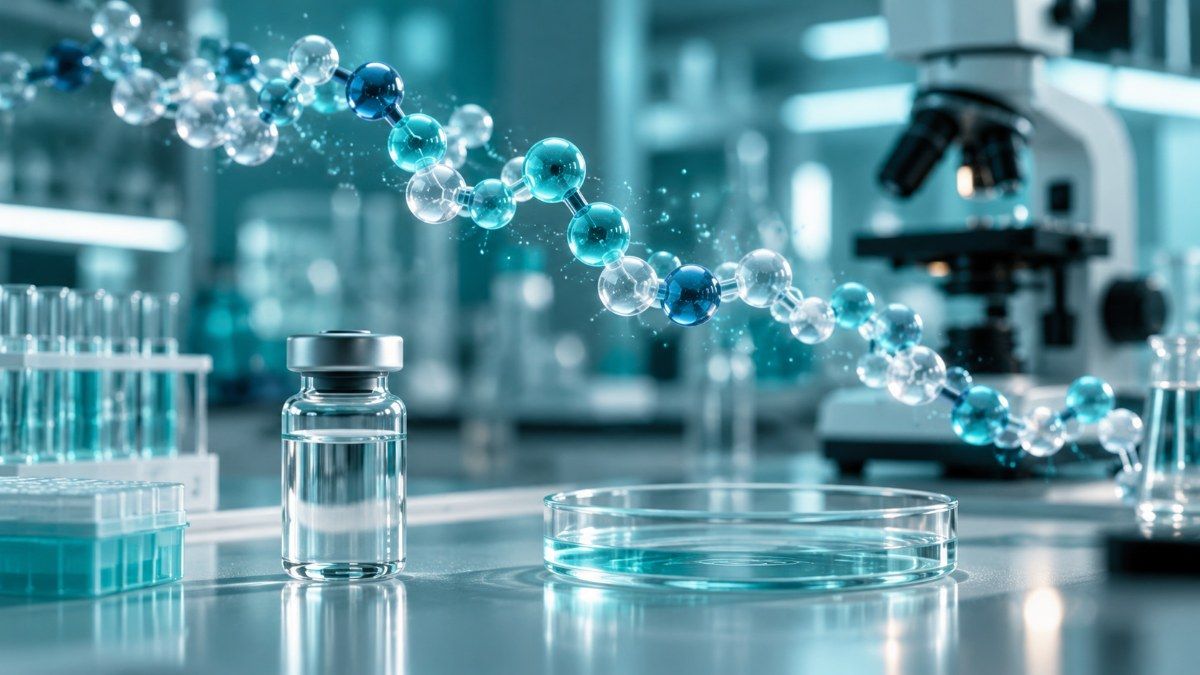
What Is BPC-157? A Plain-English Guide to the Peptide, the Evidence and Its Legal Status
BPC-157 is a 15-amino-acid lab peptide based on a stomach-juice protein. Strong rat data, 3 small human studies (30 people), not approved, banned in sport.
Written by Dr. Andrii Kaleniuk. Updated October 29, 2026.
BPC-157 is a lab-made peptide, a short chain of 15 amino acids, copied from a fragment of a protein found in human stomach juice. The name stands for 'body protection compound'. In hundreds of rat and mouse studies, most of them from one research group in Zagreb, it has sped the healing of tendons, ligaments, muscle, bone and the gut, which is why it has become one of the most talked-about recovery peptides in gyms and online clinics. What it has not done is pass a single published, controlled trial in people. A 2026 systematic review found just three human studies, with 30 participants in total and no control groups, and rated the certainty of the evidence as very low. BPC-157 is not an approved medicine anywhere, it cannot currently be compounded legally by US pharmacies, and it is banned in sport. This plain-English guide explains what BPC-157 is, what people claim it does, what the research actually shows, how it is sold, and what its legal status means for anyone thinking about it.
What Is BPC-157? The Short Answer
- 1What it is: a synthetic peptide of 15 amino acids, based on a fragment of a protein in human gastric juice. Also called 'body protection compound 157' or pentadecapeptide BPC 157.
- 2What it is claimed to do: speed healing of tendons, ligaments, muscles and the gut, and reduce inflammation and pain.
- 3What the evidence shows: consistent healing effects in rats and mice; in humans, three small uncontrolled studies (30 people in total) and no published randomised trial.
- 4How it is sold: as 'research use only' vials, capsules and nasal sprays online, and through some clinics. None of these products is regulated.
- 5Legal status (US, October 2026): not an approved drug; not lawfully compoundable at present; prohibited by WADA in sport.
- 6Safety: no serious problems reported in the tiny human studies, but long-term safety is unknown, and products of unknown content carry their own risks.
Where BPC-157 Comes From
In the early 1990s Predrag Sikirić and colleagues at the University of Zagreb described a protein in human gastric juice that seemed to protect the stomach lining, and identified a 15-amino-acid fragment of it that kept the protective activity in rats. They called it body protection compound 157. The peptide used in research and sold online is a synthetic copy of that fragment, made in a laboratory; it is not extracted from anyone's stomach. One unusual property drove much of the interest: unlike most peptides, which are broken down by stomach acid within minutes, BPC-157 is reported to be stable in gastric juice for hours, which is why it has been studied both by injection and by mouth. A Croatian pharmaceutical company developed it as a drug for inflammatory bowel disease in the early 2000s, ran early-stage human studies, and then stopped. Since then nearly all the research has come from the same Zagreb group, which matters for how much weight it can carry.
What BPC-157 Is Claimed to Do
BPC-157 claims and the evidence behind each
Faster tendon and ligament healing
Many rat studies of cut or crushed tendons and ligaments heal faster
None controlled; one retrospective series of knee injections
Muscle injury repair
Rat muscle crush and tear models improve
None
Gut healing (ulcers, colitis, fistulas)
The deepest animal literature: ulcers, colitis, fistulas, anastomoses
One 2005 Phase II ulcerative colitis trial, reported only as an abstract
Bone healing
Rat fracture and defect models
None
Pain relief
Indirect, through healing
One retrospective knee-pain series; one interstitial cystitis series
Anti-inflammatory, 'systemic repair'
Many models across organs
None
Brain, mood, addiction
Rodent behaviour studies
None
Safety
No toxicity found at tested doses in animals
Two-person intravenous safety pilot; no serious events in the small series
The animal results are striking in their range and consistency, and that is precisely what makes experienced researchers cautious. When one compound appears to heal tendon, bone, gut, liver, brain and blood vessels, mostly in studies from one laboratory, the usual explanation is a combination of a genuine but modest biological effect and study designs that make positive results easy to obtain, such as small groups, outcomes scored by people who know which animal was treated, and untreated rather than active comparators. Independent replication, the basic test of any finding, is thin. The tendon claims are examined in detail in BPC-157 for tendon recovery, and the gut claims, where the case is strongest, in BPC-157 for gut health.
How BPC-157 Is Thought to Work
In animal and cell studies BPC-157 has been linked to several healing pathways: increased growth of new blood vessels (angiogenesis), partly through signalling of vascular endothelial growth factor; effects on nitric oxide, which regulates blood flow; activation of growth-hormone receptors on tendon cells; and faster migration of the fibroblasts that lay down new collagen. Each of these is plausible for a healing agent, and none has been shown to operate in people at the doses being used. The angiogenesis effect is also the basis of the main theoretical safety concern: anything that promotes new blood vessel growth could, in principle, help existing tumours grow. No study has shown that BPC-157 does this, but no study has been designed to rule it out either. The side-effect evidence and this concern are reviewed in BPC-157 side effects.
What Human Studies Exist
A systematic review published in October 2026 in Acta Orthopaedica Belgica searched Embase, PubMed, the Cochrane Library and ClinicalTrials.gov up to June 2026 for any human study of BPC-157 for musculoskeletal or regenerative use. It found three, with 30 participants in total: a retrospective review of 16 people who had BPC-157 injected into the knee for pain, a retrospective pilot of 12 people given BPC-157 into the bladder for interstitial cystitis, and a two-person prospective pilot of intravenous BPC-157 designed only to look at safety. All three reported improvement in most participants and no treatment-related adverse events, and all three were judged to be of poor methodological quality, without control groups. The reviewers rated the overall certainty of evidence as very low and concluded that BPC-157 should not be used clinically outside ethically approved, regulated, high-quality trials. Add the unpublished 2005 colitis trial and some early Phase I safety work, and that is the entire human record after more than 30 years.
How BPC-157 Is Sold and Used
Because no regulator has approved it, every BPC-157 product on the market sits in a grey or illegal zone. The most common forms are freeze-dried powder in vials labelled 'for research use only, not for human consumption', which buyers mix with sterile water and inject under the skin, capsules and tablets sold as supplements, often as an 'arginate salt' claimed to be better absorbed, nasal sprays, and creams. Some clinics and telehealth services have offered BPC-157 injections, typically compounded. None of these products is tested by a regulator for identity, purity, dose or sterility, and FDA testing of similar peptide products has found wrong amounts, impurities and contamination. Whether swallowing it can work at all, beyond the gut, is examined in oral BPC-157. Popular combinations with TB-500, a fragment of thymosin beta-4, are covered in BPC-157 vs TB-500 and the Wolverine stack.
Is BPC-157 Legal?
In the United States in October 2026, BPC-157 is not an FDA-approved drug and cannot lawfully be sold for human use. It is also not currently available through compounding pharmacies: in April 2026 the FDA removed it from Category 2 of its bulk-substance evaluation list after the nominations were withdrawn, a procedural step that the agency said was not a safety determination, and it has not been placed in Category 1 or on the final list that would permit compounding. In July 2026 an FDA advisory committee voted narrowly, 8 to 6 with one abstention, to recommend adding it to the list of substances pharmacies may compound; that recommendation is not binding and no rule has yet changed. The World Anti-Doping Agency lists BPC-157 as a prohibited substance at all times, and athletes have been sanctioned after taking products that contained it. The full position, including what each step means in practice, is set out in is BPC-157 legal.
BPC-157 status in October 2026
Approved as a drug in the US, EU, UK or elsewhere?
No
Can a US pharmacy compound it on prescription?
Not at present; an advisory vote in July 2026 recommended allowing it, but no final decision
Can it be sold as a dietary supplement?
No; FDA regards it as an unapproved drug
Legal to possess?
Generally yes for personal possession in the US; selling for human use is not
Allowed in tested sport?
No; prohibited by WADA at all times (S0, non-approved substances)
Any large human trial under way?
None publicly known
Is BPC-157 Safe?
The honest answer is that nobody knows. The small human series reported no serious problems, and animal studies have not found toxicity at the doses tested, which is genuinely reassuring as far as it goes. But safety in medicine is established in hundreds or thousands of people followed for months or years, with systematic recording of every adverse event, and that has never been done for BPC-157. The practical risks for someone using it today are more mundane and more certain than the theoretical ones: products that contain the wrong amount or the wrong substance, bacterial contamination of injectables made outside sterile conditions, injection-site infections, and delaying proper diagnosis and treatment of an injury that needed it.
Who Asks About BPC-157, and What to Consider Instead
- 1Lifters and athletes with tendon or joint pain: progressive loading rehabilitation has the strongest evidence for tendinopathy; a sports physician or physiotherapist is the place to start, and the shoulder case is discussed in BPC-157 for shoulder pain
- 2People recovering from muscle strains: graded return to training and adequate protein; TB-500's evidence, also animal-only, is in TB-500 for muscle recovery
- 3People with gut conditions: approved treatments with human trial data exist for ulcers, reflux, inflammatory bowel disease and IBS
- 4Competitive athletes: any product containing BPC-157 risks a ban, whatever the label says
When to Talk to Your Doctor
- 1Before using any peptide product, especially if you have a history of cancer, are pregnant or breastfeeding, or have a chronic illness
- 2If you have injected a peptide and develop redness, swelling, warmth, fever or pus at the site: possible infection
- 3If an injury is not improving after a few weeks: get a diagnosis rather than adding an unproven treatment
- 4If you have taken BPC-157: tell your clinician, so unexplained symptoms are not misread, and report adverse effects to FDA MedWatch
The Bottom Line
BPC-157 is a synthetic 15-amino-acid peptide based on a fragment of a stomach protein, with three decades of encouraging animal research behind it and almost no human evidence: three small uncontrolled studies with 30 people in total and very low certainty. It is not an approved drug, cannot currently be compounded legally in the US, and is banned in sport, and the products sold online are unregulated. The idea is interesting and might one day be tested properly; until then, BPC-157 is an experimental compound, not a treatment.
FAQ
A lab-made chain of 15 amino acids copied from part of a protein in human stomach juice. In animal studies it speeds healing of tendons, muscle, bone and the gut. It has not been proven to work in people and is not an approved medicine.
In animals it appears to promote new blood vessel growth, affect nitric oxide signalling and help the cells that repair tendons and other tissues. Whether it does any of this in humans at the doses people use is unknown.
No. It is a short peptide, not a steroid, and it is not a hormone. It is also not a growth-hormone secretagogue like ipamorelin or CJC-1295.
Barely. A 2026 systematic review found three human studies, 30 participants in total, none with a control group: knee injections for pain (16 people), bladder instillation for interstitial cystitis (12) and an intravenous safety pilot (2). The certainty of evidence was rated very low.
It is not an approved drug and cannot be sold for human use. It cannot currently be compounded by pharmacies; an FDA advisory committee recommended allowing compounding in July 2026, but no rule has changed. It is prohibited in sport by WADA.
Unknown. Small human series and animal studies reported no serious problems, but no large or long-term safety study exists, and products sold online are unregulated and may contain the wrong substance or dose.
Sources
- 1Poolton JT et al. Human evidence for BPC-157 in orthopaedic and regenerative medicine: a systematic review of efficacy and safety, Acta Orthopaedica Belgica, 2026
- 2Safety of intravenous infusion of BPC157 in humans: a pilot study, Alternative Therapies in Health and Medicine, 2025
- 3Sikiric P et al. Stable gastric pentadecapeptide BPC 157: novel therapy in gastrointestinal tract, Current Pharmaceutical Design, 2011
- 4Seiwerth S et al. BPC 157 and standard angiogenic growth factors: gastrointestinal tract healing, lessons from tendon, ligament, muscle and bone healing, Current Pharmaceutical Design, 2018
- 5Bulk drug substances nominated for use in compounding under Section 503A, U.S. Food and Drug Administration
- 6BPC-157: experimental peptide creates risk for athletes, U.S. Anti-Doping Agency
This article explains published research and regulatory status for general information. BPC-157 is not an approved treatment for any condition.

Dr. Andrii Kaleniuk
Author
Comments (0)
Be the first to comment on this article.
More articles
BPC-157 for Gut Health: What Rats Have Shown, What Humans Have Not, and What Actually Treats Each Gut Problem
October 27, 2026
Oral BPC-157: Does Taking It by Mouth Work? Acid Stability, Rat Studies, the Arginate Claim and the Missing Human Data
October 26, 2026
Is BPC-157 Legal in 2026? FDA Status, the July Committee Vote, Sport Bans and the Rules by Country
October 25, 2026
