
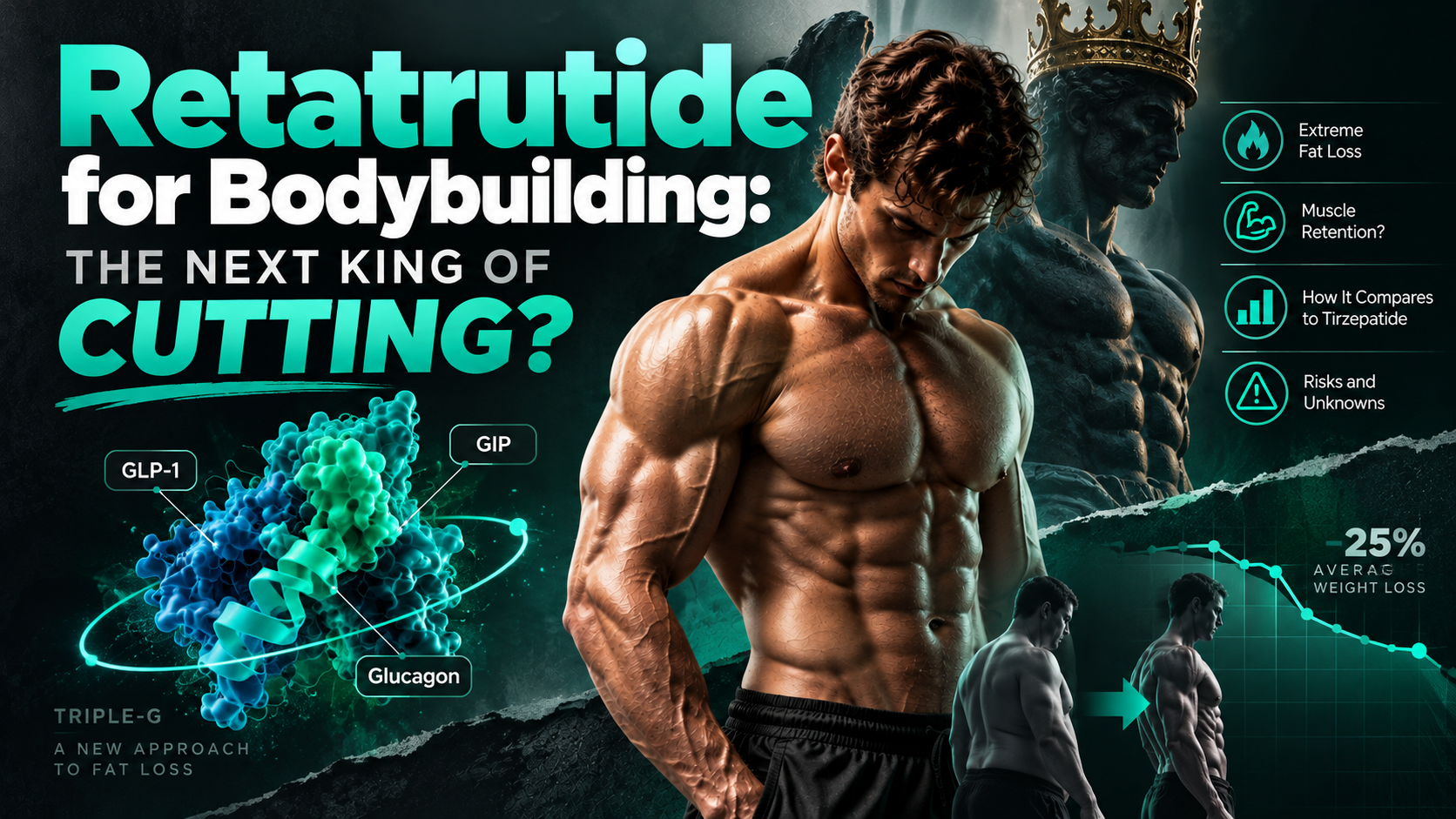
x: The Next King of Cutting?
Retatrutide is making waves in the bodybuilding world, and the numbers explain why. Clinical trials have reported average weight loss reaching 25% of starting body weight, putting this experimental Triple-G drug at the center of the cutting conversation. But there's a catch: losing massive amounts of weight doesn't guarantee a shredded physique. What happens to your hard-earned muscle when fat loss becomes this aggressive? And is retatrutide really more powerful than tirzepatide? The latest research reveals impressive results, unexpected trade-offs, and some serious unanswered questions.
Retatrutide for Bodybuilding: The Next King of Cutting?
Retatrutide has delivered weight-loss results that would have sounded almost unbelievable a few years ago. But the drug generating enormous excitement in fat-loss research has one unanswered question for bodybuilders: what happens to your muscle when the weight starts disappearing this fast? Imagine spending five years building a physique, only to discover that the next major breakthrough in weight loss could make getting lean dramatically easier. Less hunger. Substantial weight reduction. A new metabolic target that goes beyond what drugs like tirzepatide already do.
That's the promise driving interest in retatrutide, the experimental triple-hormone receptor agonist sometimes nicknamed "Triple-G." And the excitement isn't built entirely on internet speculation. A major Phase 3 trial published in September 2026 reported an average 25% body-weight reduction over 80 weeks in the highest-dose group under its primary intention-to-treat analysis. A separate efficacy analysis highlighted by the manufacturer reported 28.3%. Those numbers are extraordinary. But here's where bodybuilding changes the equation.
Losing 25% of your body weight and achieving competition-ready conditioning are two very different achievements. A bodybuilder doesn't simply want to become smaller. The goal is to remove fat while protecting muscle, strength, fullness, and performance. So is retatrutide really the next king of cutting? Or is the bodybuilding hype getting ahead of the evidence?
What Is Retatrutide, and Why Is Everyone Talking About Triple-G?
Retatrutide, also known as LY3437943, is an investigational drug developed by Eli Lilly. Its defining feature is that it activates three different hormone receptors:
- 1GLP-1: Involved in appetite regulation, glucose control, and the slowing of gastric emptying.
- 2GIP: Influences insulin secretion and metabolic regulation.
- 3Glucagon: Involved in energy metabolism and the regulation of glucose production.
That third receptor is what makes retatrutide particularly interesting. Tirzepatide activates GIP and GLP-1 receptors. Retatrutide adds glucagon receptor activation to the combination. Glucagon signaling can affect energy expenditure and fuel metabolism, potentially adding another mechanism to support weight reduction. But there's an important distinction. Activating an additional receptor doesn't automatically mean three times the fat loss. These pathways interact in complex ways, and the clinical results—not the number of targets—determine how effective a drug actually is. Still, the concept is compelling.
Instead of focusing primarily on appetite and glucose regulation, retatrutide combines those effects with another metabolic pathway. And researchers have now demonstrated that this combination can produce substantial weight reduction.
The Clinical Results Are Where the Hype Gets Serious
The original excitement around retatrutide came from a Phase 2 obesity trial published in the New England Journal of Medicine in 2023. The study involved 338 adults with obesity or qualifying overweight. After 48 weeks, the highest studied dose produced an average weight reduction of 24.2%, compared with 2.1% in the placebo group. Read that again. Nearly one-quarter of starting body weight, on average, over 48 weeks. These were not bodybuilding transformations posted on social media. They were results from a randomized clinical trial. And the weight-loss trajectory had not clearly plateaued by the end of the study.
That raised an obvious question: what would happen in larger and longer trials?
The 2026 Phase 3 Results Changed the Conversation
The answer became much clearer in 2026. In the TRIUMPH-1 Phase 3 trial, published September 29, researchers studied 2,339 randomized participants with obesity and without diabetes over 80 weeks. The peer-reviewed study reported the following average changes in body weight using its intention-to-treat analysis:
- 1Treatment group | Average weight change
- 2Retatrutide 4 mg | −17.6%
- 3Retatrutide 9 mg | −23.7%
- 4Retatrutide 12 mg | −25.0%
- 5Placebo | −3.9%
These figures represent outcomes from specific clinical trial groups, not suggested bodybuilding doses. You may also have seen headlines claiming 28.3% average weight loss. That figure is real, too. Eli Lilly reported 28.3% in the highest-dose group using an efficacy estimand, which models treatment effects under different assumptions from the trial's primary intention-to-treat approach. The important result isn't that one calculation produces a bigger headline. It's that substantial weight loss appeared across different analyses of the same major trial. The numbers also come from adults with obesity, not already-lean athletes.
That difference becomes extremely important when discussing bodybuilding.
Why Retatrutide Has Caught Bodybuilders' Attention
Anyone who has completed a demanding cut knows the hardest part often isn't understanding the diet. It's living with it. Calories fall. Hunger grows. Meals become smaller. Recovery can suffer, and food starts occupying an unreasonable amount of mental space. Retatrutide appears attractive because it could change the experience of energy restriction.
1. Appetite Control Could Make Dieting Feel Different
For some people, pharmacological appetite suppression makes consuming fewer calories much easier. Instead of spending the day thinking about the next meal, hunger may become less intrusive. For bodybuilders accustomed to fighting appetite through the final stages of a cut, that sounds extremely appealing. But reduced hunger is not the same as improved muscle retention.
2. The Weight-Loss Results Are Difficult to Ignore
A treatment associated with average weight reductions approaching one-quarter of starting weight naturally attracts attention from physique-focused communities. The problem is that most competitive bodybuilders aren't starting at the body-fat levels represented in obesity trials. A 250-pound person with obesity losing 25% of body weight is not physiologically equivalent to a 200-pound trained athlete trying to expose the final lines of abdominal definition. The starting conditions are fundamentally different.
3. Glucagon Receptor Activation Adds a New Dimension
This is one of the most scientifically interesting aspects of retatrutide. Its glucagon receptor activity could contribute to changes in energy expenditure and fuel use. However, it would be premature to describe the drug as a proven muscle-sparing fat burner or claim that it directly melts stubborn fat. The human trial results demonstrate substantial weight reduction. They do not establish selective fat loss from particular body regions or a special advantage for stage-lean athletes. And that leads to the biggest question of all.
The Muscle-Loss Problem Nobody Should Ignore
Here's the uncomfortable reality behind every spectacular weight-loss result. The scale cannot tell you whether the weight disappearing is fat, muscle, or other lean tissue. A bodybuilder could lose substantial weight and still be disappointed with the final appearance. If muscle fullness, training performance, or actual muscle tissue declines significantly, a lower body weight may not deliver the desired physique. So what do we know about retatrutide and body composition? More than we knew in 2023—but not enough to promise muscle preservation.
A 2025 Study Looked Beyond Body Weight
A body-composition substudy published in The Lancet Diabetes & Endocrinology examined retatrutide in adults with type 2 diabetes. Researchers used DXA scans to assess changes in fat and lean mass during 36 weeks of treatment. Among the studied groups, average fat-mass reduction reached 26.1% in the pooled 8-mg group. That is a percentage change in fat mass, not total body weight. The researchers also observed reductions in lean mass. Overall, the proportion of lean mass lost relative to total weight loss was similar to that seen with other obesity treatments. This is an important finding.
Retatrutide did not appear to cause a uniquely disproportionate loss of lean mass in that study. But it did not eliminate lean-mass loss, either. The analysis was relatively small: 189 people entered the substudy, and 103 completed treatment with both baseline and follow-up DXA scans. Most importantly, these participants were not competitive bodybuilders.
Lean Mass Is Not Exactly the Same as Muscle
A DXA scan does not measure only skeletal muscle when reporting lean mass. Lean mass includes water, organs, and other non-fat tissues. Changes in hydration and glycogen-associated water can affect measurements. So a decline in DXA lean mass should not automatically be interpreted as an identical quantity of pure muscle tissue lost. Nevertheless, maintaining muscle remains an important concern during substantial weight reduction. And there is currently no strong evidence showing that retatrutide protects skeletal muscle in lean bodybuilders preparing for competition.
Retatrutide may be powerful at reducing weight. That does not make it a proven muscle-preservation drug.
Retatrutide vs. Tirzepatide: Is Triple-G Actually Stronger?
This is probably the comparison most people want to see. Tirzepatide has already demonstrated impressive weight-loss results and has established regulatory approvals for specific medical indications. Retatrutide introduces an additional glucagon receptor target and has produced striking results in its own clinical development program. But comparing them requires care.
What the Major Trials Show
- 1Feature | Retatrutide | Tirzepatide
- 2Receptor targets | GIP, GLP-1, glucagon | GIP, GLP-1
- 3Key obesity trial | TRIUMPH-1 | SURMOUNT-1
- 4Trial duration | 80 weeks | 72 weeks
- 5Highest-dose average weight loss in main analysis | 25.0% | 20.9%
- 6US regulatory status, October 2026 | Investigational | Approved for certain indications
- 7Proven muscle-preserving benefit for bodybuilders | No | No
On the surface, retatrutide looks like the obvious winner. Twenty-five percent versus 20.9%. But that's not a head-to-head comparison. The trials involved different populations, study protocols, treatment durations, and statistical considerations. You cannot simply subtract those percentages and declare retatrutide 4.1 percentage points more effective. There is a direct comparison study, TRIUMPH-5, evaluating retatrutide against tirzepatide in adults with obesity. As of October 2026, results had not yet been publicly posted. Until those findings become available, superiority remains unconfirmed by direct randomized evidence.
What About Cutting Specifically?
Even if a future trial demonstrates greater average weight loss with retatrutide, that wouldn't automatically establish it as a superior bodybuilding cutting drug. A physique athlete cares about more than weight. The relevant questions include:
- 1How much of the lost weight is actual fat?
- 2How much skeletal muscle is preserved?
- 3Can the athlete maintain training intensity?
- 4Does the treatment interfere with eating enough protein?
- 5What happens to recovery and performance?
- 6Are the effects different in people who are already lean?
The major obesity trials were not designed to answer all of those questions. The strongest weight-loss drug isn't automatically the best physique-preservation tool.
The Dark Side of Extreme Appetite Suppression
There's a reason extreme cutting isn't always a good thing. Your body still needs energy and nutrients even when your appetite stops reminding you. Strong appetite suppression can create a new problem: eating enough to support training becomes difficult. For a bodybuilder, that matters. Heavy resistance training requires adequate recovery. Muscle retention requires an appropriate training stimulus and sufficient nutrition. And protein requirements do not disappear because someone feels full after a small meal. This isn't unique to retatrutide. It is a broader concern with substantial medication-assisted weight loss.
The Training Problem
Imagine that your body weight is falling rapidly while your gym performance deteriorates. At first, the scale might make that seem like success. But declining strength, persistent fatigue, and poor recovery may indicate that the overall approach is no longer supporting the physique goal. Weight loss and successful bodybuilding preparation are not interchangeable. Resistance training and appropriate nutrition remain central to muscle preservation during an energy deficit. And if appetite suppression makes adequate nutrition difficult, that is a medical and nutritional problem—not an achievement to celebrate.
The Risks: Retatrutide Isn't Just Another Fat-Loss Supplement
The word "peptide" can make an investigational drug sound surprisingly ordinary. Retatrutide is anything but ordinary. It is a potent, experimental hormone-receptor agonist still undergoing regulatory evaluation as of October 2026. And powerful effects can come with meaningful adverse effects.
Gastrointestinal Side Effects
In clinical studies, gastrointestinal symptoms have been among the most frequently reported adverse events. These include:
- 1Nausea
- 2Diarrhea
- 3Vomiting
- 4Constipation
- 5Other gastrointestinal discomfort
For someone performing intense workouts, persistent nausea or inadequate food and fluid intake can become especially disruptive.
Heart Rate Changes
The Phase 2 obesity trial reported dose-dependent increases in heart rate. Those increases peaked around week 24 before declining later in the study. This doesn't mean everyone receiving retatrutide will develop a heart problem. It does mean that cardiovascular safety deserves serious attention, particularly when people are considering uses outside the populations and conditions studied.
Altered Skin Sensations
Some participants have also reported abnormal skin sensations, including dysesthesia or increased skin sensitivity. These effects appeared in the clinical research and were also monitored in the Phase 3 program. They are another reminder that retatrutide has a complex physiological profile.
The Unregulated Product Problem
There is one more issue that bodybuilding communities should take seriously. Retatrutide has not received US approval for routine human treatment as of October 2026. Products advertised online as retatrutide may come from unregulated sources with uncertain identity, purity, or quality. A label claiming to contain retatrutide is not proof of what is inside. And positive results from legitimate clinical trials do not establish the safety of products marketed outside those trials. For tested athletes, an investigational substance may also raise anti-doping concerns under rules governing non-approved pharmacological substances.
What We Still Don't Know About Retatrutide
Despite the impressive results, several major questions remain unanswered.
Does It Preserve Muscle in Trained Athletes?
There is no convincing trial evidence showing that retatrutide allows lean, resistance-trained bodybuilders to lose substantial fat without sacrificing muscle. The available body-composition research is informative but doesn't resolve that question.
Is It Better Than Tirzepatide?
The separate trial programs suggest retatrutide has substantial weight-loss potential. But the direct randomized comparison is still needed before confidently declaring a winner.
What Happens During Very Aggressive Cutting?
The clinical programs focus on people with obesity, overweight, diabetes, and related health conditions. They do not establish the safety or effectiveness of retatrutide for pushing an already-lean athlete toward extreme competition conditioning.
What Happens After Treatment Stops?
Maintaining weight loss after medication withdrawal is a major issue across obesity pharmacotherapy. Retatrutide-specific longer-term discontinuation and maintenance data remain important for understanding whether its benefits persist and how body composition changes afterward.
What Are the Long-Term Safety Implications?
Phase 3 studies have expanded the evidence considerably. But rare adverse effects, longer exposure, and broader use require continued investigation. Eli Lilly has indicated plans to seek US regulatory approval in 2027. Approval cannot be assumed in advance.
The Verdict: Is Retatrutide the Next King of Cutting?
Retatrutide has earned attention for a very good reason. Its weight-loss results are genuinely impressive. The Phase 2 trial showed an average reduction of up to 24.2% over 48 weeks. The larger Phase 3 TRIUMPH-1 trial subsequently reported 25.0% average weight loss in its highest-dose group under the main intention-to-treat analysis after 80 weeks. And a body-composition substudy demonstrated substantial reductions in fat mass, although lean mass declined too. That is enough evidence to take retatrutide seriously as an emerging treatment in obesity medicine. But bodybuilding requires a different standard of success.
Getting lighter isn't the same as getting shredded. And getting shredded isn't much of a victory if you sacrifice the muscle that made the physique worth cutting for. Retatrutide has not been established as a safe or effective cosmetic cutting tool for otherwise healthy, already-lean bodybuilders. It has not been shown to preserve muscle better than tirzepatide in that population. And the long-term implications of using it for extreme physique conditioning remain uncertain. So is it the next king of cutting? It may become one of the most powerful tools in medical weight management. But the crown for bodybuilding hasn't been earned.
The real question isn't how much weight retatrutide can make someone lose. It's what remains when the weight is gone. And for a bodybuilder, that's everything.
Frequently Asked Questions
Retatrutide has produced larger headline weight-loss percentages in separate major obesity trials. However, the studies differ, and direct head-to-head results are needed to determine whether retatrutide is more effective than tirzepatide under comparable conditions.
The Phase 3 TRIUMPH-1 study reported an average 25.0% body-weight reduction in the highest-dose group over 80 weeks under its main intention-to-treat analysis. Individual outcomes vary, and these findings come from adults with obesity.
Body-composition research shows substantial fat-mass reduction alongside some loss of lean mass. Lean mass includes more than skeletal muscle. The evidence does not establish that retatrutide selectively removes fat while preserving all muscle.
No. As of October 2026, retatrutide remains investigational and is not FDA-approved for bodybuilding or other routine treatment indications.
Its glucagon receptor activity may contribute to effects on energy expenditure and fuel metabolism. However, the precise contribution of those mechanisms to weight loss in humans is still being investigated, and it has not been proven to selectively burn stubborn fat in athletes.
Its safety and efficacy for competitive bodybuilding preparation have not been established. Existing trials primarily involve people with obesity, overweight, or metabolic disease rather than already-lean athletes.
That remains uncertain. Retatrutide has promising clinical results, but its regulatory approval, comparative benefits, safety profile, and potential medical role need to be established through ongoing research and regulatory review.
Research and Sources
- 1Jastreboff AM, et al. — Triple–Hormone-Receptor Agonist Retatrutide for Obesity: A Phase 2 Trial. NEJM, 2023. https://www.nejm.org/doi/full/10.1056/NEJMoa2301972
- 2Jastreboff AM, et al. — Retatrutide, a Triple Hormone Receptor Agonist, for Treatment of Obesity. NEJM, September 2026. https://www.nejm.org/doi/abs/10.1056/NEJMoa2604169
- 3Coskun T, et al. — Effects of Retatrutide on Body Composition in People With Type 2 Diabetes. The Lancet Diabetes & Endocrinology, 2025. https://pubmed.ncbi.nlm.nih.gov/40609566/
- 4Jastreboff AM, et al. — Tirzepatide Once Weekly for the Treatment of Obesity. NEJM, 2022. https://www.nejm.org/doi/full/10.1056/NEJMoa2206038
- 5TRIUMPH-5 — Retatrutide Compared With Tirzepatide. ClinicalTrials.gov. https://clinicaltrials.gov/study/NCT06662383
- 6Eli Lilly — TRIUMPH-1 Phase 3 Results, May 2026. https://lilly.gcs-web.com/news-releases/news-release-details/lillys-triple-agonist-retatrutide-delivered-powerful-weight-loss
- 7Eli Lilly — TRIUMPH-2 Phase 3 Results, September 2026. https://investor.lilly.com/node/54981
Research status: October 8, 2026. This article is for educational purposes. It does not recommend using investigational medication for bodybuilding, self-experimentation, or cosmetic cutting. Clinical-trial outcomes are not individual predictions, and medical treatment decisions require qualified professional assessment.
Dr. Andrii Kaleniuk
Comments (0)
Be the first to comment on this article.