
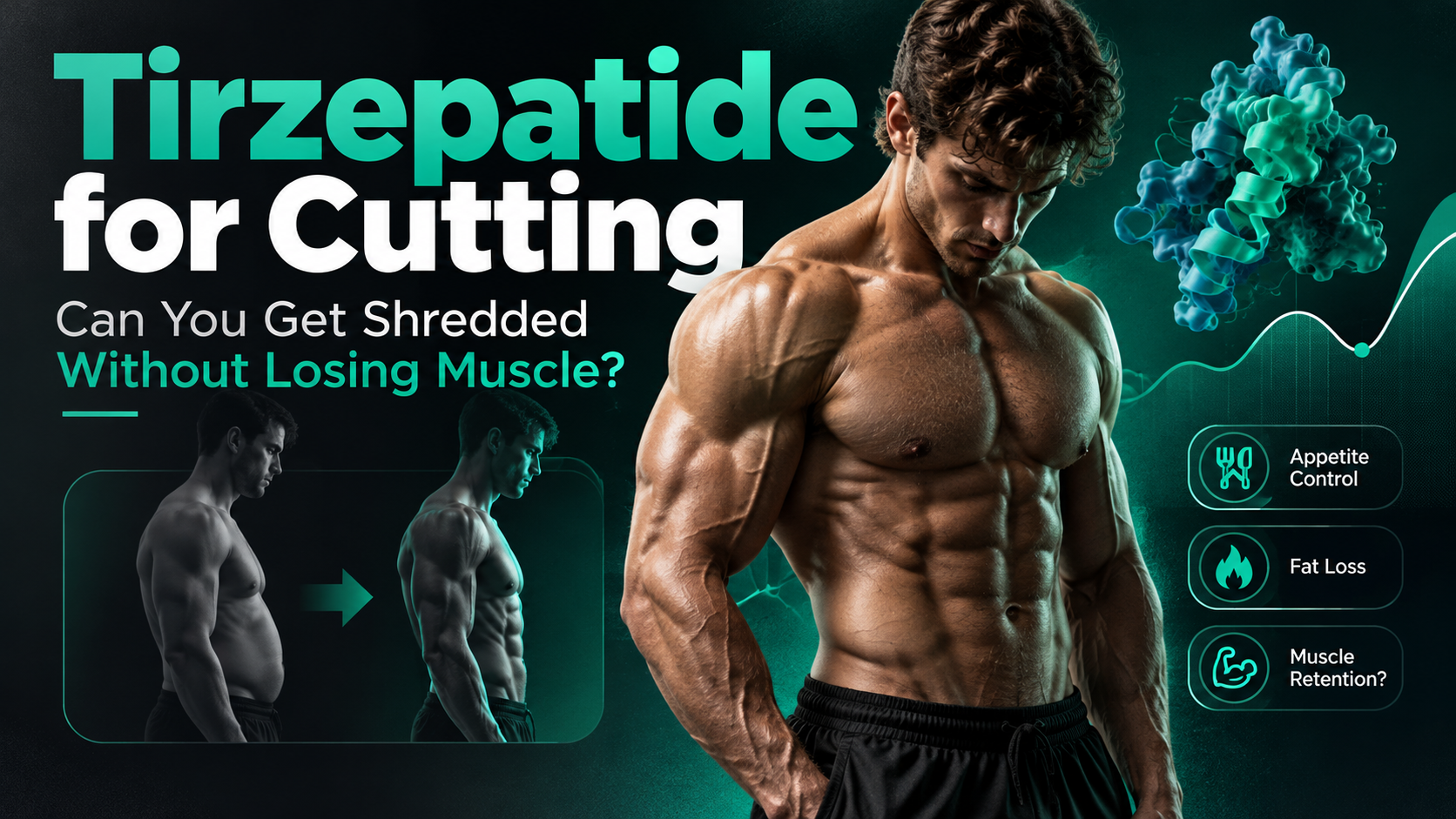
Tirzepatide for Cutting: Can You Get Shredded Without Losing Muscle?
Tirzepatide can dramatically reduce appetite and drive serious fat loss. For bodybuilders chasing a shredded physique, that sounds like the ultimate cutting shortcut. But there's a catch nobody should ignore: losing weight doesn't mean losing only fat. What happens to the muscle you've spent years building when the scale starts dropping fast? Clinical research reveals a surprising split between fat loss and lean mass loss — and the numbers raise an important question. Can tirzepatide really help you get shredded without sacrificing your hard-earned muscle?
Tirzepatide for Cutting: Can You Get Shredded Without Losing Muscle?
Tirzepatide can dramatically reduce appetite and drive significant weight loss. But there's one thing it can't promise bodybuilders: keeping every pound of hard-earned muscle while the fat disappears.
Getting lean is one thing. Getting shredded without sacrificing muscle is a completely different challenge.
For bodybuilders, the ideal cutting phase is simple in theory: strip away body fat, maintain strength, and keep the muscle that took months or years to build.
The reality? Hunger increases. Energy drops. Training becomes harder. And the more aggressive the calorie deficit, the greater the concern about muscle retention.
That's why tirzepatide has attracted attention far beyond traditional weight-loss circles. A drug that makes eating less feel easier sounds almost tailor-made for cutting.
But the science reveals a catch: losing weight is not the same as losing only fat. And the numbers behind tirzepatide make that distinction impossible to ignore.
How Does Tirzepatide Actually Work?
Tirzepatide is a dual GIP and GLP-1 receptor agonist. In the United States, it is marketed as Mounjaro for type 2 diabetes and Zepbound for certain weight-management and obesity-related indications.
Its effects include influencing appetite regulation, food intake, and blood glucose control. It also delays gastric emptying.
For someone struggling with a calorie deficit, the appeal is obvious. Instead of constantly fighting hunger, a person may experience reduced appetite and find it easier to consume fewer calories.
But here's the distinction that matters: tirzepatide isn't an anabolic drug. It doesn't directly build muscle, and it hasn't been shown to selectively burn fat while protecting skeletal muscle.
Its weight-loss effects can be powerful. Its ability to preserve a bodybuilding physique is another question entirely.
Why Bodybuilders Are Interested in Tirzepatide
Traditional cutting often creates a frustrating contradiction. You want to eat less to lose fat, but you also need sufficient nutrition to train hard, recover, and preserve muscle.
Tirzepatide appears to address one side of that problem: appetite. For athletes who struggle with hunger during a deficit, appetite suppression can sound like a major advantage.
- 1Appetite control: Making a reduced-calorie diet easier to maintain.
- 2Fat loss: Clinical trials have demonstrated substantial reductions in body weight and fat mass.
- 3Diet adherence: Less hunger may make it easier for some people to sustain dietary changes.
But reducing hunger doesn't automatically solve the muscle-retention problem.
In fact, if appetite falls enough that protein, total calories, and training fuel become inadequate, the resulting diet may work against the very physique someone is trying to preserve.
That is the paradox: the appetite suppression that makes tirzepatide attractive for cutting can also make proper muscle-preserving nutrition harder to maintain.
The Muscle-Loss Question: What Does the Research Show?
Here's where things get interesting.
In the landmark SURMOUNT-1 trial, adults with obesity or overweight and a weight-related complication experienced average weight reductions of up to 20.9% over 72 weeks with tirzepatide, compared with 3.1% in the placebo group.
Those results established tirzepatide as a highly effective weight-loss treatment in the population studied. But a subsequent body-composition analysis revealed what happened beyond the number on the scale.
Researchers examined DXA scans from 160 participants in the SURMOUNT-1 study. The results were striking:
- 1Total body weight: average change of −21.3%.
- 2Fat mass: average change of −33.9%.
- 3Lean mass: average change of −10.9%.
Approximately 75% of the weight lost came from fat mass, while 25% came from lean mass.
That means tirzepatide produced substantial fat loss, but lean mass declined as well. And there is another detail: the fat-to-lean proportion of weight lost was similar in the placebo group, which also lost weight.
So the evidence does not show tirzepatide uniquely stripping muscle away. But it certainly doesn't establish that the drug prevents lean-mass loss.
For bodybuilders, that is the distinction worth paying attention to.
Research: Body Composition Changes During Weight Reduction With Tirzepatide in SURMOUNT-1 (2025). https://pubmed.ncbi.nlm.nih.gov/39996356/
Does Losing Lean Mass Mean Losing Muscle?
Not necessarily. This is one of the most misunderstood details in the discussion.
Lean mass and skeletal muscle are not interchangeable terms.
DXA-measured lean mass includes muscle, water, organs, and other non-fat tissues. Changes in hydration and glycogen-associated water can therefore influence lean-mass measurements.
So when a study reports that around a quarter of the weight lost was lean mass, it does not mean a quarter of the weight lost was pure muscle. That would be an inaccurate interpretation.
However, it would be equally misleading to dismiss lean-mass loss as irrelevant. Some muscle loss can accompany substantial weight reduction, particularly when nutrition and resistance training are inadequate.
And here is the crucial limitation: the SURMOUNT-1 body-composition participants were not a cohort of stage-lean competitive bodybuilders. Their average baseline BMI was 38, and most were women.
We cannot assume the same results would occur in a trained athlete attempting to move from relatively lean to competition-level conditioning.
The research demonstrates that tirzepatide can produce substantial fat loss. It does not prove that already-lean bodybuilders can use it to get shredded without losing muscle.
How Can Muscle Be Better Protected During a Cut?
Whether weight loss involves medication or conventional dieting, muscle retention depends heavily on how the calorie deficit is managed. For someone receiving medically appropriate tirzepatide treatment, the following principles remain important.
1. Keep Resistance Training a Priority
Muscle needs a reason to stay. Resistance training provides a stimulus that helps preserve muscle during weight loss.
That doesn't mean chasing personal records while severely under-fueled. It means maintaining productive, appropriately adjusted training and paying attention to strength, fatigue, and recovery.
If performance consistently deteriorates, that deserves attention rather than being celebrated as proof that the cut is working.
2. Don't Let Appetite Suppression Replace Protein
Reduced hunger can make eating less easier. Unfortunately, the body still requires adequate protein.
The International Society of Sports Nutrition generally recommends 1.4–2.0 grams of protein per kilogram of body weight daily for most exercising individuals. Higher intakes may be appropriate for some lean, resistance-trained athletes during calorie restriction, with recommendations often expressed relative to fat-free mass.
Those are general sports-nutrition recommendations, not tirzepatide-specific muscle-preservation targets. Not feeling hungry does not mean your muscles no longer need nutrition.
If medication-related nausea or appetite suppression makes adequate eating difficult, that is a reason to revisit the treatment and nutrition plan with a qualified clinician.
3. Faster Weight Loss Isn't Always Better
The scale can become addictive during a successful cut. Watching the number drop faster every week might feel like progress.
But in physique sports, the quality of weight loss matters more than its speed. Sports-nutrition research suggests that slower rates of weight loss can better preserve lean mass in already-lean individuals.
An unnecessarily aggressive deficit may also make it harder to recover, train consistently, and meet nutritional needs. A lower number on the scale means very little if the physique you wanted disappears with it.
4. Track More Than Body Weight
A successful cut shouldn't be judged by one measurement. Strength trends, training performance, waist measurements, recovery, and body-composition changes can provide more context.
No single marker is perfect. Even DXA has limitations. The goal isn't simply becoming lighter; it's improving body composition while maintaining as much useful muscle and physical performance as possible.
The Risks Bodybuilders Shouldn't Ignore
Tirzepatide isn't a harmless cutting supplement. It's a prescription medication with meaningful risks and contraindications.
Common adverse effects include nausea, vomiting, diarrhea, constipation, and abdominal discomfort.
More serious concerns include dehydration-related kidney injury, gallbladder problems, and pancreatitis.
Its US prescribing information also includes a boxed warning about thyroid C-cell tumors observed in rats. Whether this risk applies to humans is unknown. The medication is contraindicated for people with a personal or family history of medullary thyroid carcinoma or multiple endocrine neoplasia syndrome type 2.
These issues matter especially when someone is combining reduced food intake with demanding physical training.
Zepbound's approved weight-management use concerns people with obesity or qualifying overweight conditions, not otherwise healthy, already-lean bodybuilders who simply want sharper abdominal definition.
Using a potent weight-loss drug purely for cosmetic conditioning is not the same clinical situation as treating obesity.
The Verdict: Can Tirzepatide Get You Shredded Without Losing Muscle?
Tirzepatide can help produce significant fat loss. But getting shredded without losing muscle remains an unproven promise.
- 1First: Tirzepatide can substantially reduce body weight and fat mass in the populations studied.
- 2Second: Those reductions are commonly accompanied by some loss of lean mass, although lean mass is not the same thing as skeletal muscle.
- 3Third: Resistance training and adequate nutrition remain essential considerations for preserving muscle during weight reduction.
What we don't have is convincing evidence that tirzepatide delivers superior muscle-preserving results in lean, resistance-trained bodybuilders preparing for extreme conditioning.
Because bodybuilding has never been about who can make the scale drop fastest. It's about what remains when the fat is gone.
Tirzepatide might make eating less easier. It cannot guarantee that the weight you lose is only the weight you wanted to lose.
That's the difference between simply getting smaller and building a better physique.
Frequently Asked Questions
In a SURMOUNT-1 body-composition analysis, about 75% of lost weight came from fat mass and 25% from lean mass. Lean mass is not identical to skeletal muscle, so these percentages cannot be interpreted as exact amounts of muscle lost.
Tirzepatide produces substantial weight and fat loss in studied populations with obesity or qualifying overweight. Evidence does not establish that it is effective or appropriate for otherwise healthy, already-lean bodybuilders pursuing competition-level conditioning.
There is no convincing evidence that tirzepatide specifically preserves muscle in lean bodybuilders. Weight-loss studies show fat loss alongside reductions in lean mass. Resistance training and adequate nutrition remain important.
No. DXA lean mass includes muscle and other non-fat tissues, including water. The figure should not be described as pure skeletal-muscle loss.
When medically appropriate, resistance training is an important part of preserving muscle during weight loss. Training should be adjusted to account for recovery, energy intake, individual health, and professional medical advice.
The ISSN generally recommends 1.4–2.0 g/kg/day for most exercising people, while some lean resistance-trained athletes may benefit from higher intake during energy restriction. There is no validated tirzepatide-specific protein target for bodybuilding.
Common adverse effects are gastrointestinal. More serious concerns include pancreatitis, gallbladder problems, and dehydration-related kidney injury. Contraindications and boxed warnings appear in the official prescribing information.
Sources
This article draws on clinical-trial data, body-composition research, sports-nutrition guidance, and official prescribing information:
- 1Jastreboff AM, et al. Tirzepatide Once Weekly for the Treatment of Obesity. New England Journal of Medicine. https://www.nejm.org/doi/full/10.1056/NEJMoa2206038
- 2Body Composition Changes During Weight Reduction With Tirzepatide in SURMOUNT-1. Diabetes, Obesity and Metabolism (2025). https://pubmed.ncbi.nlm.nih.gov/39996356/
- 3International Society of Sports Nutrition: Diets and Body Composition. https://pubmed.ncbi.nlm.nih.gov/28630601/
- 4Strategies for Minimizing Muscle Loss During Incretin-Based Obesity Treatment. https://pubmed.ncbi.nlm.nih.gov/39295512/
- 5Zepbound — Official US Prescribing Information. DailyMed. https://dailymed.nlm.nih.gov/dailymed/drugInfo.cfm?setid=487cd7e7-434c-4925-99fa-aa80b1cc776b
Study populations, doses, treatment duration, starting body composition, diet, and physical activity all affect outcomes. Results from people with obesity or overweight cannot automatically be applied to lean competitive bodybuilders. This article is for general education and does not recommend tirzepatide for bodybuilding or cosmetic cutting; treatment decisions require individualized medical assessment.
Dr. Andrii Kaleniuk
Comments (0)
Be the first to comment on this article.