
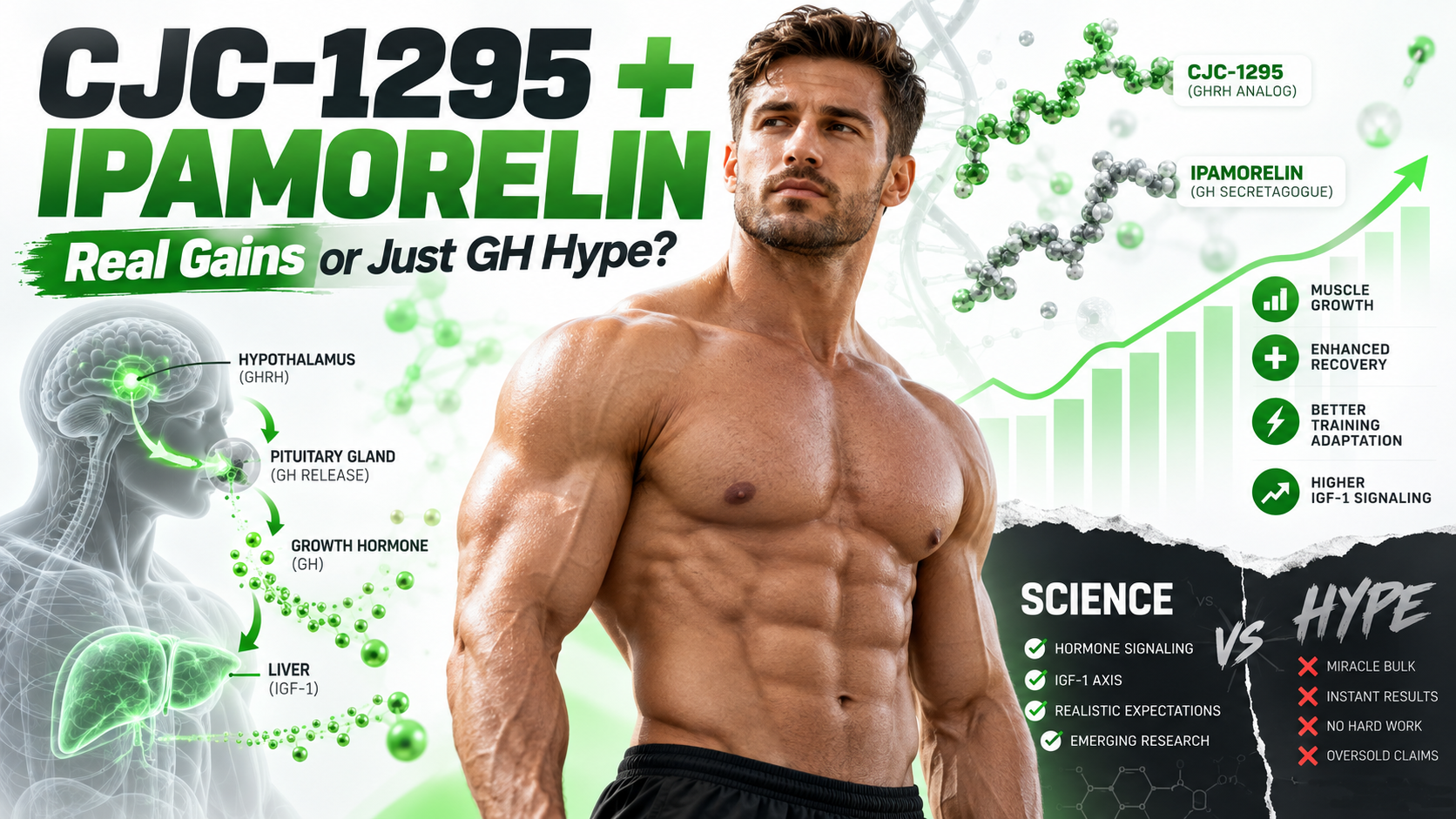
CJC-1295 + Ipamorelin for Muscle Growth: Real Gains or Just GH Hype?
More growth hormone. Faster recovery. Bigger muscles. That's the promise behind the CJC-1295 + Ipamorelin stack, one of bodybuilding's most talked-about peptide combinations. By stimulating two different pathways of growth hormone release, these compounds have gained attention for their potential to enhance muscle growth, improve sleep, accelerate recovery, and support fat loss. But here's the twist: human studies show that increasing growth hormone doesn't necessarily translate into greater strength or actual muscle gains. So does combining CJC-1295 and Ipamorelin deliver real bodybuilding results, or just impressive hormone numbers? Let's break down the mechanisms, clinical research, benefits, safety risks, and the science behind the GH hype.
CJC-1295 + Ipamorelin for Muscle Growth: Real Gains or Just GH Hype?
What if you could increase your body's growth hormone production, recover faster between workouts, sleep better, and build more muscle—all without taking growth hormone directly? That's the promise behind the CJC-1295 and Ipamorelin stack. And the science contains a surprising twist: researchers have demonstrated impressive growth hormone increases, but that is not the same as demonstrating impressive muscle gains.
Picture two bodybuilders following the same training program. Both eat enough protein, progressively overload their muscles, and take recovery seriously.
One follows the basics. The other adds an experimental peptide combination advertised as a way to stimulate natural growth hormone release.
Six months later, which athlete has built more actual muscle?
According to peptide marketing, the answer seems obvious. More growth hormone should mean faster recovery, greater protein synthesis, improved fat loss, and more impressive gains.
But biology rarely follows a marketing script.
One human study found that CJC-1295 increased average growth hormone concentrations by approximately 2- to 10-fold after a single administration. Another demonstrated that Ipamorelin triggered a measurable growth hormone pulse.
That sounds like a bodybuilding breakthrough. Until you examine studies of growth hormone itself, where increases in lean body mass have often failed to produce corresponding improvements in muscular strength.
So does the CJC-1295 + Ipamorelin stack build real muscle, or does it mainly make hormone numbers look impressive? Let's separate the endocrine science from the bodybuilding hype.
What Is the CJC-1295 + Ipamorelin Stack?
CJC-1295 + Ipamorelin is an experimental peptide combination promoted for stimulating the growth hormone axis. The two compounds act through different receptor systems associated with growth hormone secretion.
- 1CJC-1295: A synthetic growth hormone-releasing hormone analogue designed to stimulate the pituitary's GHRH receptor.
- 2Ipamorelin: A synthetic growth hormone secretagogue that acts through the ghrelin receptor, also called GHSR1a.
- 3The proposed stack: Two signaling routes intended to increase endogenous growth hormone secretion.
- 4The popular claims: Increased muscle growth, improved recovery, better sleep, reduced body fat, and enhanced training readiness.
- 5The clinical reality: The combination has not been established as an effective or safe bodybuilding treatment in controlled human trials.
The central idea is that stimulating two different growth hormone signaling pathways might produce a stronger response than stimulating either one alone.
It's a biologically plausible concept. But biological plausibility does not establish that the combination produces more muscle, better recovery, or fewer side effects.
How the Growth Hormone Axis Actually Works
Before evaluating the stack, it helps to understand what growth hormone actually does.
Growth hormone, or GH, is produced by the anterior pituitary gland. Its secretion is controlled by several interacting signals, including growth hormone-releasing hormone, somatostatin, ghrelin-related signaling, sleep, nutrition, and feedback from downstream hormones.
GH is normally released in pulses rather than at one constant concentration throughout the day.
One important downstream mediator is insulin-like growth factor 1, or IGF-1. Growth hormone stimulates IGF-1 production in the liver and other tissues. Together, these signals influence metabolism, growth-related processes, and tissue physiology.
But the GH/IGF-1 axis is not a simple muscle-growth switch.
Growth hormone affects fat metabolism, fluid balance, connective-tissue processes, and several other systems. A higher circulating GH concentration does not automatically translate into more contractile muscle tissue.
The Simple GH Pathway
- 1Hypothalamus: Releases signals that stimulate or suppress pituitary GH secretion.
- 2Pituitary gland: Releases growth hormone into the bloodstream.
- 3GH-sensitive tissues: Respond to growth hormone through specific receptors.
- 4Liver and other tissues: Produce IGF-1 in response to growth-related signaling.
- 5Muscle and connective tissue: Experience complex downstream effects that depend on physiology, nutrition, training, and many other factors.
CJC-1295 and Ipamorelin intervene near the beginning of this pathway. Their popularity depends on the assumption that amplifying its early signals will improve the outcomes bodybuilders care about.
That assumption is the central question of this article.
CJC-1295: The Peptide That Can Keep GH Elevated for Days
CJC-1295 was developed as a long-acting analogue of growth hormone-releasing hormone, or GHRH.
Its purpose was to stimulate the body's own GH production while overcoming the relatively short duration of natural GHRH signaling.
The best-known human CJC-1295 experiments were published in 2006. Unlike many claims surrounding research peptides, these studies provide real controlled human hormone measurements.
The 2006 Human Study: Growth Hormone Increased Dramatically
Researchers conducted two randomized, placebo-controlled, double-blind studies investigating CJC-1295 in healthy adults aged 21 to 61.
They measured GH, IGF-1, pharmacokinetics, and short-term safety rather than training performance or muscular hypertrophy.
After a single administration, researchers observed the following:
- 1Mean GH concentrations increased approximately 2- to 10-fold for six days or longer.
- 2Mean IGF-1 concentrations increased approximately 1.5- to 3-fold for nine to eleven days.
- 3The estimated terminal half-life of CJC-1295 was approximately 5.8 to 8.1 days.
- 4After repeated administration, mean IGF-1 remained above baseline for up to 28 days in the studied conditions.
- 5No serious adverse reactions were reported in those small, short-duration trials.
Those results are impressive from an endocrine pharmacology perspective.
CJC-1295 clearly demonstrated the ability to alter GH and IGF-1 levels in the people studied. But the experiment did not establish that participants gained muscle, improved their bench press, recovered faster, or slept better.
It established a hormonal effect—not a bodybuilding outcome.
Did CJC-1295 Eliminate Natural GH Pulses?
A separate 2006 study examined GH secretion patterns after CJC-1295 in healthy men.
Researchers found that GH secretion remained pulsatile, while baseline GH concentrations and overall exposure increased. The study reported an approximately 7.5-fold increase in trough GH levels and an increase in average GH concentrations of about 46%.
That provides further evidence that CJC-1295 influences hormone dynamics. But preserved GH pulsatility is not proof of safety, and it does not establish additional muscle growth.
CJC-1295 With DAC vs. Without DAC: A Critical Difference
Here is one of the biggest sources of confusion in peptide discussions.
Online products are frequently labeled CJC-1295 with DAC or CJC-1295 without DAC. Some discussions treat them as interchangeable, but they are not chemically identical.
DAC stands for Drug Affinity Complex. It refers to a chemical modification designed to allow the peptide to associate with circulating albumin, prolonging its exposure in the body.
The original CJC-1295 human studies investigated the long-acting DAC-containing compound.
Products marketed as CJC-1295 without DAC generally refer to a shorter-acting modified GHRH fragment, often called Modified GRF (1-29). Commercial terminology can be inconsistent, and the exact molecular identity of a particular product cannot be established from its advertised name alone.
- 1| Characteristic | CJC-1295 with DAC | Commonly marketed CJC-1295 without DAC |
- 2| Molecular distinction | Contains an albumin-binding modification | Lacks the DAC modification |
- 3| Expected exposure | Long-acting | Shorter-acting |
- 4| Published 2006 human hormone studies | Yes | Those specific studies did not investigate this form |
- 5| Established human hypertrophy benefit | No | No |
- 6| Established long-term athletic safety | No | No |
- 7| Can the forms be assumed interchangeable? | No | No |
This distinction changes how research should be quoted. The multi-day hormonal effects reported for long-acting CJC-1295 cannot automatically be applied to a no-DAC product.
When someone claims that their peptide stack has been proven to raise GH for almost a week, the first question should be: Which specific molecule was actually studied?
Ipamorelin: The GH Pulse Generator
Ipamorelin works differently from CJC-1295.
It is a synthetic pentapeptide that acts as a growth hormone secretagogue through the ghrelin-receptor signaling system.
Its development attracted interest because early pharmacological experiments showed substantial GH-releasing activity with a degree of hormonal selectivity in certain animal models.
But claims that Ipamorelin is completely free from effects on cortisol, prolactin, appetite, or other systems go beyond what limited human evidence can establish.
The Human Ipamorelin Study
A 1999 pharmacokinetic and pharmacodynamic investigation studied Ipamorelin in healthy male volunteers.
The experiment included five escalating exposure levels, with eight participants at each level. Researchers measured circulating Ipamorelin and GH concentrations.
Ipamorelin produced a distinct GH-release episode. The GH response reached its peak approximately 0.67 hours after administration and then declined. The reported terminal elimination half-life of Ipamorelin was approximately two hours.
This demonstrates that Ipamorelin can stimulate GH release in humans under experimental conditions.
It does not demonstrate that the peptide builds larger muscles, speeds recovery from training, or improves sleep quality.
That difference between hormone measurements and athletic outcomes is going to appear repeatedly in this investigation.
Why Do Bodybuilders Combine CJC-1295 and Ipamorelin?
The stack's appeal comes from the idea of complementary signaling.
CJC-1295 stimulates the GHRH receptor pathway. Ipamorelin stimulates the ghrelin receptor pathway. These systems can interact in regulating GH secretion.
That creates a plausible scientific hypothesis: activating both pathways could produce a greater GH response than activating one alone.
But there are two separate claims hiding inside that theory.
- 1Claim one: Combining these two specific compounds produces greater GH secretion than either compound alone in humans.
- 2Claim two: Any greater GH secretion produced by the combination translates into additional muscle growth, strength, sleep quality, or recovery.
The pharmacology of the two signaling systems provides a reason to investigate the first claim.
It does not establish the second.
As of October 2026, there is no convincing controlled human hypertrophy trial demonstrating that the CJC-1295 + Ipamorelin combination produces more skeletal muscle than placebo, training alone, or either peptide individually.
The Big Question: Does More Growth Hormone Mean More Muscle?
This is the most important part of the entire discussion.
The logic behind the stack sounds simple: GH is a growth-related hormone. The peptides increase GH. Therefore, the stack should increase muscle growth.
But scientific evidence does not support treating that chain of reasoning as a guaranteed outcome.
Human growth hormone studies have repeatedly demonstrated an important distinction between changes in lean body mass and improvements in muscular strength.
The 2008 Systematic Review: More Lean Mass, Not More Strength
A systematic review published in 2008 examined growth hormone administration and athletic performance in healthy people.
The review included 44 articles describing 27 study samples, with 303 participants receiving growth hormone.
The average increase in lean body mass among growth hormone recipients compared with controls was approximately 2.1 kilograms, with a reported 95% confidence interval of 1.3 to 2.9 kilograms.
Two kilograms of lean body mass sounds like an excellent bodybuilding result.
But the review did not find convincing improvements in muscle strength or exercise capacity. Participants receiving GH also experienced soft-tissue edema and fatigue more frequently.
In other words, the scale and body-composition measurements changed more convincingly than actual physical performance.
That is a major warning against using lean-mass changes as automatic proof of new muscle fibers.
The 2010 Athlete Trial: The Water-Weight Problem
A randomized, blinded, placebo-controlled trial published in 2010 investigated growth hormone in 96 recreationally trained athletes.
Participants underwent eight weeks of treatment followed by a six-week observation period. The investigators assessed body composition, muscular strength, jumping ability, endurance, and sprint capacity.
Growth hormone reduced fat mass and increased measured lean body mass. But the lean-mass increase was largely attributable to increased extracellular water.
The study did not demonstrate significant improvements in the other measured performance outcomes, including strength, although it found a modest improvement in sprint capacity.
Sprint capacity increased by approximately 3.9% in the combined male and female analysis. That effect was not maintained six weeks after stopping treatment.
This nuance matters. The study did detect a specific performance effect; it would be inaccurate to claim that growth hormone never affects any performance measure.
But a temporary improvement in one sprint test is not the same as demonstrating more hypertrophy, a stronger bench press, or lasting muscular gains.
And importantly, this experiment administered growth hormone itself—not CJC-1295, Ipamorelin, or their combination.
The 2017 Meta-Analysis Reached a Similar Conclusion
A later systematic review and meta-analysis evaluated 11 placebo-controlled trials involving 254 participants.
Growth hormone administration increased lean body mass and reduced fat mass. However, it did not significantly improve muscle strength or maximal oxygen uptake over the studied periods.
The muscle-strength comparison had a reported p-value of approximately 0.36, while the maximal oxygen uptake comparison had a p-value of approximately 0.89.
The broader scientific message is remarkably consistent: changing GH exposure can alter body composition without reliably producing the strength improvements expected from genuine resistance-training adaptations.
Lean Body Mass Is Not the Same as New Muscle
One reason GH-related compounds can seem more anabolic than the evidence supports is that the term lean body mass is frequently misunderstood.
Lean body mass includes much more than skeletal muscle. It also includes water, organs, blood, and other nonfat tissues.
If a compound causes fluid retention, some body-composition measurements may register an increase in lean mass without an equivalent increase in contractile muscle tissue.
For bodybuilders, this is a crucial distinction. The real goal is increased muscle size and performance—not simply a heavier number under the lean-mass column.
- 1| Measurement | What it tells you | Important limitation |
- 2| GH blood concentration | Hormonal response | Does not establish muscle growth |
- 3| IGF-1 concentration | Downstream endocrine response | Not a direct measure of hypertrophy |
- 4| Lean body mass | Total nonfat mass | Includes water and other nonmuscle tissue |
- 5| Muscle thickness or cross-sectional area | Structural muscle-size outcome | Requires reliable measurement and interpretation |
- 6| Strength improvement | Functional training outcome | Depends on neural and technical adaptations as well as muscle size |
- 7| Long-term training performance | Practical athletic outcome | Requires sufficiently long controlled follow-up |
This doesn't mean growth hormone has no physiological importance for muscle. It means endocrine changes, body-composition changes, and functional hypertrophy must be measured separately.
What About People Who Are Actually Growth Hormone Deficient?
There is an important exception to the simple interpretation that growth hormone does not improve strength.
Adults with clinically diagnosed growth hormone deficiency can experience abnormal body composition, reduced exercise capacity, and other health problems.
Appropriately prescribed GH replacement can improve several outcomes in those patients. Some longer-term investigations have also observed improvements in muscular strength.
But treating a documented endocrine deficiency is fundamentally different from increasing GH secretion beyond normal physiology in an otherwise healthy bodybuilder.
Evidence that replacement therapy benefits deficient patients does not establish that experimental GH secretagogues improve muscle growth in healthy lifters.
If someone has symptoms suggesting a genuine hormone disorder, an endocrinology assessment is more appropriate than self-diagnosing low GH from fatigue, soreness, or a disappointing training block.
Does the CJC-1295 + Ipamorelin Stack Have Direct Muscle-Growth Evidence?
Now let's return to the combination itself.
CJC-1295 has demonstrated hormonal activity in controlled human studies. Ipamorelin has also demonstrated the ability to stimulate GH release in humans.
But combining two compounds with documented individual hormonal effects does not automatically establish an additional clinical benefit.
The key unanswered questions are whether the exact combination provides meaningful additional GH activity in people, whether that exposure improves resistance-training adaptations, and whether any benefit outweighs the risks.
As of October 2026, there is no convincing published randomized human trial demonstrating superior muscle hypertrophy, strength, or body-composition outcomes from CJC-1295 plus Ipamorelin in trained bodybuilders.
What Would a Proper Stack Study Need to Show?
A useful clinical trial would compare matched groups following a standardized resistance-training program.
- 1Placebo plus training.
- 2CJC-1295 plus training.
- 3Ipamorelin plus training.
- 4CJC-1295 and Ipamorelin together plus training.
Researchers would need to measure actual muscle size, strength, body composition including fluid changes, recovery outcomes, hormone exposure, and adverse events.
The trial would also need to specify the exact CJC-1295 formulation, since DAC-containing and DAC-free compounds should not be treated as identical.
Until a study like that demonstrates a benefit, calling the combination a proven muscle-building stack is premature.
Can CJC-1295 + Ipamorelin Improve Recovery After Heavy Training?
Muscle growth isn't the only reason bodybuilders are interested in these peptides.
The stack is also promoted for faster recovery between demanding workouts, improved tissue repair, reduced soreness, and better readiness for the next session.
Those claims sound plausible because GH and IGF-1 participate in biological processes related to tissue metabolism and repair.
But direct human evidence is the missing piece.
No convincing controlled human trial has shown that the CJC-1295 + Ipamorelin combination reduces delayed-onset muscle soreness after resistance exercise, restores strength faster, shortens recovery from diagnosed muscle injuries, or enables greater sustainable training volume.
Why Recovery Claims Are So Difficult to Prove
Imagine a lifter who begins using an experimental GH-secretagogue combination while also reducing training volume, increasing food intake, and prioritizing sleep.
Three weeks later, the athlete reports improved recovery.
Did the peptides cause it? Did the training changes help? Was the previous recovery problem temporary? Did expectations affect perceived soreness?
Without proper controls, those possibilities cannot be separated reliably.
Feeling recovered is valuable, but it isn't the same as demonstrating faster restoration of muscular function.
Does the Stack Improve Sleep Quality?
Sleep is another major part of the CJC-1295 and Ipamorelin marketing narrative.
Because GH secretion is closely associated with sleep physiology, especially slow-wave sleep, the logic sounds attractive: increase growth hormone and you might sleep more deeply.
But the relationship does not necessarily work in reverse.
The Sleep Study That Challenges the Hype
A controlled investigation published in 1993 examined whether administering GH or stimulating GH release with GHRH changed sleep in healthy male volunteers.
Although the interventions changed GH-related hormone levels, the researchers did not observe meaningful improvements in total sleep time or sleep-stage distribution under the tested conditions.
This was not a CJC-1295 + Ipamorelin trial. But it demonstrates why the connection between GH secretion and sleep should not be oversimplified.
Just because GH secretion is associated with deep sleep does not mean artificially increasing GH will necessarily produce better sleep.
As of October 2026, controlled human studies have not established that the CJC-1295 + Ipamorelin stack improves sleep efficiency, deep-sleep duration, or next-day training recovery.
What About Fat Loss and Body Recomposition?
Some lifters aren't only interested in muscle growth. They hope the stack will help them get leaner while maintaining or increasing muscle mass.
GH influences lipid metabolism, and trials involving GH administration have observed reductions in fat mass under certain conditions.
However, those findings do not establish that CJC-1295 plus Ipamorelin is an effective fat-loss treatment.
There is no convincing controlled human evidence demonstrating that this specific combination produces superior fat loss, improved muscle retention during cutting, or a more favorable physique transformation in trained athletes.
And an apparent improvement in lean body mass may partly reflect fluid changes rather than new muscle tissue.
That makes reliable body-composition assessment especially important when evaluating GH-related claims.
CJC-1295 + Ipamorelin: Claims vs. Actual Evidence
Here's how the popular bodybuilding claims compare with the available scientific evidence.
- 1| Popular claim | Evidence status |
- 2| CJC-1295 increases GH and IGF-1 | Demonstrated for the long-acting DAC-containing compound in small human studies |
- 3| Ipamorelin stimulates GH secretion | Demonstrated in human pharmacology research |
- 4| The combination produces superior GH responses | Biologically plausible, but not adequately established for a defined stack in controlled human outcome trials |
- 5| The stack builds more muscle | Not demonstrated in controlled human hypertrophy studies |
- 6| The stack increases strength | Not demonstrated |
- 7| The stack improves recovery after training | Not demonstrated |
- 8| The stack improves sleep quality | Not demonstrated |
- 9| The stack accelerates injury healing | Not demonstrated |
- 10| The stack reduces body fat | Not established in controlled human stack trials |
- 11| The stack has proven long-term safety | No |
The strongest evidence concerns endocrine activity. The weakest evidence concerns the actual bodybuilding outcomes used to market the combination.
That gap is the entire story.
Potential Side Effects and Safety Risks
CJC-1295 and Ipamorelin are often marketed as gentler alternatives to administering growth hormone directly.
But stimulating endogenous hormone secretion does not automatically make a compound safe.
Both peptides have insufficient human safety evidence for long-term bodybuilding use, and their combination introduces additional uncertainties.
1. Fluid Retention, Swelling, and Joint Symptoms
Growth hormone administration can increase fluid retention. Related effects in GH treatment settings include swelling, joint discomfort, and symptoms associated with nerve compression.
That does not prove the experimental stack produces every one of these effects at the same frequency. It does show why sustained GH-axis stimulation deserves careful evaluation rather than being assumed harmless.
2. Glucose Regulation and Insulin Sensitivity
Growth hormone has metabolic effects that can oppose some actions of insulin. Excessive GH exposure can impair insulin sensitivity and affect glucose regulation.
For athletes interested in long-term health, this is not a trivial concern. More hormone signaling is not automatically better, particularly when the exposure pattern and long-term consequences of a combination have not been adequately studied.
3. FDA-Identified Concerns About CJC-1295
The U.S. Food and Drug Administration has raised safety concerns about CJC-1295 in the context of drug compounding.
The FDA has identified potential issues involving immunogenicity, peptide-related impurities, and active pharmaceutical ingredient characterization.
It has also identified reports of serious adverse events associated with CJC-1295, including increased heart rate and systemic vasodilatory reactions.
These observations do not establish the frequency of those events across all formulations. They do contradict the claim that CJC-1295 has an established, negligible risk profile.
4. Ipamorelin Is Not Automatically Risk-Free
Ipamorelin has also been studied in humans for a purpose unrelated to bodybuilding: postoperative gastrointestinal recovery.
A randomized Phase 2 trial published in 2014 enrolled 117 patients undergoing bowel surgery. The treatment did not significantly improve the study's main clinical outcome compared with placebo.
The median time to tolerance of a solid meal was 25.3 hours for the Ipamorelin group versus 32.6 hours for placebo, with a reported p-value of 0.15.
The FDA has also discussed serious adverse events, including deaths, reported in the clinical literature involving intravenously administered Ipamorelin for gastrointestinal indications.
Those reports should not be interpreted as proof that Ipamorelin caused every serious event. The patients were undergoing major surgery, and treatment-related causality requires careful assessment.
But the evidence also does not justify presenting Ipamorelin as proven safe for healthy athletes or for routes and exposure patterns that have not been adequately evaluated.
5. Product Identity, Purity, and Combination Risks
Products marketed as research peptides may differ in identity, concentration, purity, or quality.
The distinction between DAC-containing CJC-1295 and products labeled without DAC illustrates why the exact substance matters.
Combining two experimental compounds also creates questions about interactions, cumulative hormone exposure, and long-term effects that cannot be answered by studying each compound separately.
Are CJC-1295 and Ipamorelin FDA-Approved?
Neither CJC-1295 nor Ipamorelin is FDA-approved as a muscle-building, athletic-recovery, or sleep-improvement treatment.
Regulatory consideration of a substance for compounding is not equivalent to approval as a drug. It does not establish effectiveness, safety, or an approved treatment indication.
The FDA's ongoing discussions about unapproved peptides and compounding do not turn this combination into a clinically validated bodybuilding therapy.
Are CJC-1295 and Ipamorelin Banned in Tested Bodybuilding?
Yes. Both compounds are prohibited under the applicable World Anti-Doping Agency rules.
CJC-1295 is listed among growth hormone-releasing hormone analogues. Ipamorelin is listed among growth hormone secretagogues and their mimetics.
For athletes subject to WADA-based anti-doping programs, these substances are prohibited at all times, including outside competition.
The anti-doping issue is separate from whether the stack has actually demonstrated meaningful muscle-growth benefits.
What Actually Has Better Evidence for Muscle Growth?
Here's the less glamorous side of bodybuilding science.
The strongest evidence for building muscle still centers on resistance training, sufficient nutrition, and sustained recovery—not experimentally manipulating GH secretion.
1. Progressive Resistance Training
Muscle hypertrophy requires an appropriate training stimulus. Progressive overload, sufficient hard training volume, and consistent technique provide that stimulus over time.
There is no convincing evidence that a GH-secretagogue stack can substitute for those training adaptations.
2. Adequate Protein
Protein provides amino acids required for muscle protein synthesis. The International Society of Sports Nutrition recommends approximately 1.4 to 2.0 grams of protein per kilogram of body weight per day for most exercising individuals, with needs varying according to context.
Consistently meeting appropriate protein needs has a much stronger evidence base for training adaptation than this experimental peptide combination.
3. Appropriate Energy Intake
Building muscle is more difficult when an athlete's energy intake is insufficient to support training and recovery. Appropriate calorie intake depends on the person's body composition, training, and goals.
No GH-secretagogue combination has been shown to eliminate the importance of adequate nutrition.
4. Sleep and Recoverable Training Volume
Sleep, fatigue management, and sensible programming influence an athlete's ability to train consistently and productively.
A stack that changes GH levels has not been shown to replace sufficient sleep or compensate reliably for excessive training stress.
Who Might Find GH-Related Research Clinically Relevant?
The GH axis is an important area of legitimate medical research, especially for disorders involving hormone deficiency or abnormal growth-related physiology.
That is different from promoting unapproved peptides for muscle enhancement in people with normal endocrine function.
Individuals experiencing unexplained fatigue, altered body composition, or unusually poor exercise tolerance may benefit from an appropriate medical evaluation if clinical symptoms warrant it.
But those symptoms are nonspecific. They can arise from inadequate sleep, insufficient nutrition, training stress, and many medical conditions unrelated to GH deficiency.
GH deficiency requires proper clinical assessment and is not reliably diagnosed through one random GH measurement because normal secretion is pulsatile.
Final Verdict: Real Gains or Just GH Hype?
The CJC-1295 + Ipamorelin combination is built around an interesting and scientifically plausible idea: stimulate growth hormone secretion through two different biological pathways.
There is real research behind the individual compounds.
The long-acting form of CJC-1295 produced substantial increases in GH and IGF-1 in small controlled human studies. Ipamorelin triggered GH release in healthy volunteers.
Those findings support the idea that these peptides can influence endocrine physiology.
But the next step in the marketing story is where the evidence starts to break down.
Increasing GH does not automatically create new muscle tissue. Human studies of administered growth hormone have found changes in body composition, including increases in extracellular water, without consistent improvements in muscular strength.
And there is no convincing controlled clinical evidence demonstrating that CJC-1295 plus Ipamorelin improves hypertrophy, strength, sleep, or post-workout recovery in trained bodybuilders.
The combination's long-term safety is not established, both compounds carry regulatory concerns, and both are prohibited in applicable anti-doping programs.
The Final Scorecard
- 1| Question | Verdict |
- 2| Can CJC-1295 stimulate GH and IGF-1? | Yes, demonstrated for the long-acting DAC-containing compound |
- 3| Can Ipamorelin stimulate GH secretion? | Yes, demonstrated in human pharmacology research |
- 4| Is the combination proven synergistic in human bodybuilding? | No |
- 5| Does the stack build more contractile muscle? | Not demonstrated |
- 6| Does it reliably increase strength? | Not demonstrated |
- 7| Does it improve training recovery? | Not demonstrated |
- 8| Does it improve sleep quality? | Not demonstrated |
- 9| Is long-term safety established? | No |
- 10| Is it FDA-approved for bodybuilding? | No |
- 11| Is it allowed under WADA rules? | No |
The scientific verdict: Real hormonal effects. Unproven bodybuilding benefits.
The marketing pitch makes GH sound like a direct shortcut to bigger muscles. The research tells a more complicated story.
Because a higher growth hormone reading on a laboratory report isn't the same thing as another five kilograms on your bench press—or another five kilograms of actual muscle.
The ultimate bodybuilding question isn't how high you can push a hormone marker. It's whether the intervention helps you build more muscle, perform better, and stay healthy.
For CJC-1295 + Ipamorelin, those outcomes still need to be proven.
Frequently Asked Questions
There is no convincing controlled human clinical evidence establishing that the CJC-1295 + Ipamorelin combination increases muscle hypertrophy in bodybuilders. Each compound can influence GH secretion under studied conditions, but higher hormone levels do not automatically demonstrate more contractile muscle growth.
In small controlled human studies published in 2006, the long-acting DAC-containing CJC-1295 compound increased mean GH concentrations approximately 2- to 10-fold for at least six days after a single administration. Those findings concern the specific studied formulation and do not establish equivalent effects for products marketed as CJC-1295 without DAC.
There is no reliable human head-to-head hypertrophy evidence establishing that either peptide produces superior muscle growth. CJC-1295 acts through GHRH-related signaling, whereas Ipamorelin stimulates the ghrelin receptor pathway. Their different mechanisms do not prove that one is more effective for bodybuilding.
DAC refers to an albumin-binding chemical modification that makes the original studied CJC-1295 compound long-acting. Products marketed as CJC-1295 without DAC generally refer to shorter-acting modified GHRH fragments. The original multi-day human pharmacology findings cannot automatically be applied to the no-DAC form.
Controlled human studies have not established that the combination improves deep sleep, sleep efficiency, or sleep quality. Although natural GH secretion is associated with sleep physiology, raising GH does not necessarily improve sleep. Controlled studies of administered GH and GHRH have found hormonal changes without corresponding improvements in sleep measurements.
There is insufficient controlled human evidence showing that this specific stack reduces delayed-onset muscle soreness, restores strength faster after resistance training, or shortens recovery from muscle injuries. Recovery claims are largely extrapolated from GH-axis biology rather than demonstrated athletic outcomes.
Their long-term safety for bodybuilding use has not been established. The FDA has highlighted concerns involving CJC-1295, including reported serious adverse events, and has identified safety information gaps and potential immunogenicity or impurity risks involving Ipamorelin. Sustained GH-axis stimulation may also raise concerns involving fluid retention and glucose regulation.
Neither compound is FDA-approved for muscle growth, recovery, or sleep improvement. Both are prohibited under applicable World Anti-Doping Agency rules: CJC-1295 as a growth hormone-releasing hormone analogue and Ipamorelin as a growth hormone secretagogue. Athletes subject to those rules may face anti-doping consequences.
Research and Sources
- 1Teichman SL, et al. (2006). Prolonged Stimulation of Growth Hormone (GH) and Insulin-Like Growth Factor I Secretion by CJC-1295, a Long-Acting Analog of GH-Releasing Hormone, in Healthy Adults. Journal of Clinical Endocrinology & Metabolism. https://pubmed.ncbi.nlm.nih.gov/16352683/
- 2Ionescu M, Frohman LA. (2006). Pulsatile Secretion of Growth Hormone Persists During Continuous Stimulation by CJC-1295, a Long-Acting GH-Releasing Hormone Analog. Journal of Clinical Endocrinology & Metabolism. https://pubmed.ncbi.nlm.nih.gov/17018654/
- 3Raun K, et al. (1998). Ipamorelin, the First Selective Growth Hormone Secretagogue. European Journal of Endocrinology. https://pubmed.ncbi.nlm.nih.gov/9849822/
- 4Gobburu JVS, et al. (1999). Pharmacokinetic-Pharmacodynamic Modeling of Ipamorelin, a Growth Hormone Releasing Peptide, in Human Volunteers. Journal of Pharmaceutical Sciences. https://pubmed.ncbi.nlm.nih.gov/10496658/
- 5Liu H, et al. (2008). Systematic Review: The Effects of Growth Hormone on Athletic Performance. Annals of Internal Medicine. https://pubmed.ncbi.nlm.nih.gov/18347346/
- 6Meinhardt U, et al. (2010). The Effects of Growth Hormone on Body Composition and Physical Performance in Recreational Athletes: A Randomized Trial. Annals of Internal Medicine. https://pubmed.ncbi.nlm.nih.gov/20439575/
- 7Impact of GH Administration on Athletic Performance in Healthy Young Adults: A Systematic Review and Meta-Analysis of Placebo-Controlled Trials. (2017). Growth Hormone & IGF Research. https://pubmed.ncbi.nlm.nih.gov/28514721/
- 8Systemic Growth Hormone Does Not Affect Human Sleep. (1993). Journal of Clinical Endocrinology & Metabolism. https://pubmed.ncbi.nlm.nih.gov/8501147/
- 9Beck DE, et al. (2014). Prospective, Randomized, Controlled, Proof-of-Concept Study of the Ghrelin Mimetic Ipamorelin for the Management of Postoperative Ileus in Bowel Resection Patients. International Journal of Colorectal Disease. https://pubmed.ncbi.nlm.nih.gov/25331030/
- 10Endocrine Society. (2011). Evaluation and Treatment of Adult Growth Hormone Deficiency: An Endocrine Society Clinical Practice Guideline. Journal of Clinical Endocrinology & Metabolism. https://academic.oup.com/jcem/article/96/6/1587/2833853
- 11Jäger R, et al. (2017). International Society of Sports Nutrition Position Stand: Protein and Exercise. Journal of the International Society of Sports Nutrition. https://pubmed.ncbi.nlm.nih.gov/28642676/
- 12U.S. Food and Drug Administration. Certain Bulk Drug Substances for Use in Compounding That May Present Significant Safety Risks. https://www.fda.gov/drugs/human-drug-compounding/certain-bulk-drug-substances-use-compounding-may-present-significant-safety-risks
- 13U.S. Anti-Doping Agency. World Anti-Doping Agency Prohibited List and 2026 Resources. https://www.usada.org/substances/prohibited-list/
Research status: October 8, 2026. This article is for educational purposes only. CJC-1295 and Ipamorelin remain experimental for bodybuilding-related muscle growth, recovery, and sleep enhancement. The combination has no established clinical efficacy or comprehensive long-term human safety profile, and this article does not recommend its use.
Dr. Andrii Kaleniuk
Comments (0)
Be the first to comment on this article.