
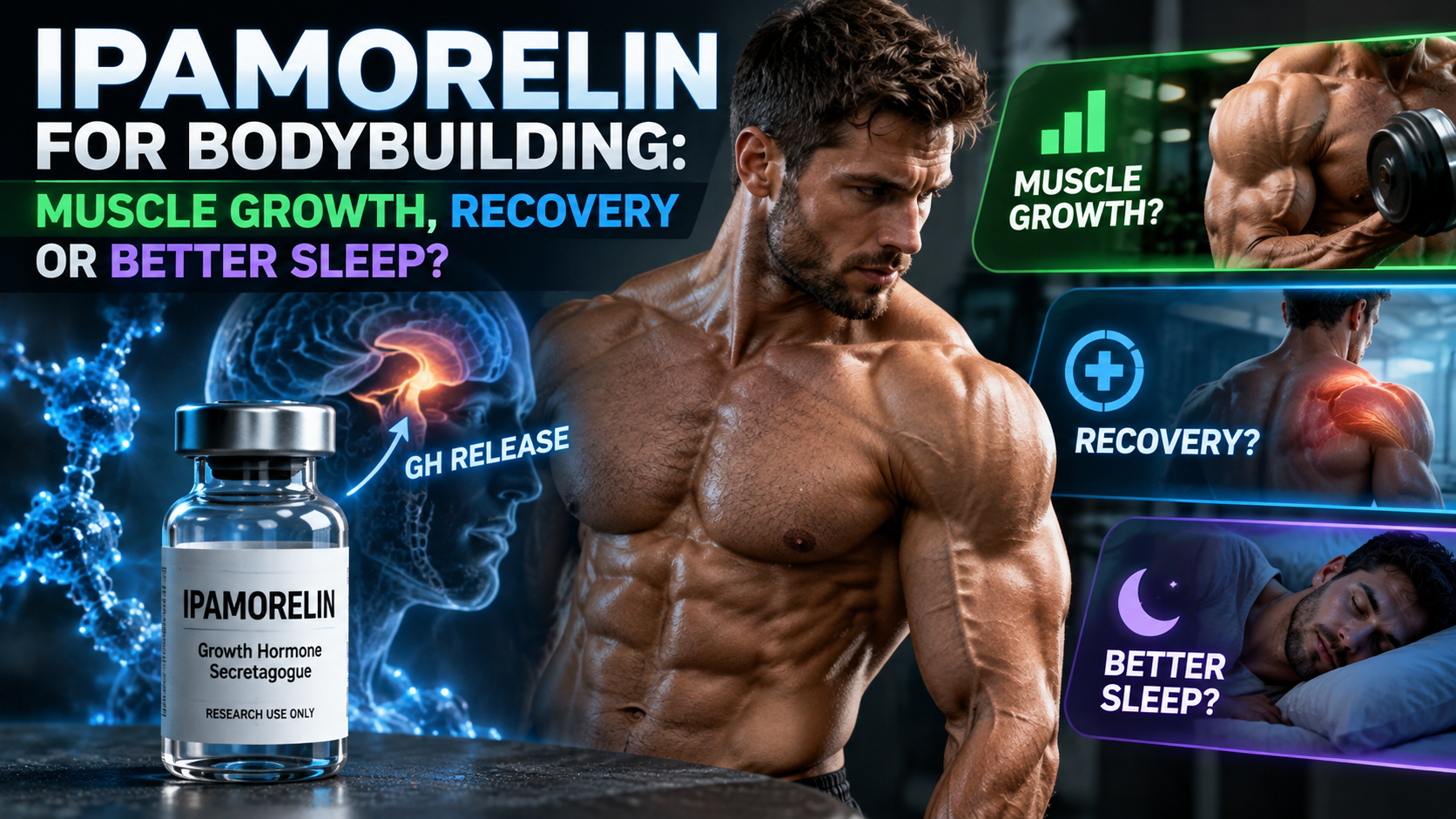
Ipamorelin for Bodybuilding: Muscle Growth, Recovery or Better Sleep?
One peptide. Three big promises: more muscle, faster recovery, and better sleep. Ipamorelin has become a popular topic in bodybuilding because it stimulates the body's natural growth hormone release. But can a GH boost really translate into bigger gains, shorter recovery times, or deeper sleep? Human research confirms that Ipamorelin triggers measurable growth hormone pulses, yet evidence supporting its bodybuilding benefits remains surprisingly limited. Meanwhile, studies of growth hormone itself reveal an unexpected twist: increased lean body mass doesn't necessarily mean greater muscle strength. So which of Ipamorelin's three major claims makes the most scientific sense? Let's break down the mechanisms, human studies, potential benefits, side effects, and the truth behind the hype.
Ipamorelin for Bodybuilding: Muscle Growth, Recovery or Better Sleep?
One peptide. Three massive promises: bigger muscles, faster recovery, and deeper sleep. Ipamorelin has become a favorite in bodybuilding discussions because it can stimulate the body's own growth hormone release. But here's the twist: the strongest human evidence proves that Ipamorelin changes hormone levels—not that it delivers any of the three benefits people are buying it for.
Imagine you've just finished a brutal training session. Your chest is pumped. Your shoulders are exhausted. Your hamstrings are still complaining about yesterday's deadlifts.
Tomorrow, you have another workout. And tonight? You're hoping for eight hours of uninterrupted sleep.
Now imagine someone offers you one experimental peptide that's supposedly capable of solving all three problems: More muscle. Faster recovery. Better sleep.
That peptide is Ipamorelin.
It's often described as a selective growth hormone secretagogue—a compound that encourages the body to release more growth hormone rather than supplying growth hormone directly.
In bodybuilding circles, that mechanism has become the foundation for an entire list of promises. But when you examine the research, an important distinction appears.
A 1999 human study demonstrated that Ipamorelin produces a measurable growth hormone pulse. A subsequent randomized trial involving 117 surgical patients investigated the compound for an entirely different purpose—and did not demonstrate a statistically significant improvement in its primary outcome.
Meanwhile, human studies involving growth hormone itself have produced an awkward result for the muscle-building narrative: more lean body mass without corresponding improvements in muscular strength.
So what is Ipamorelin actually best suited for discussing? Muscle growth? Post-workout recovery? Or sleep? Let's put all three claims under the microscope and find out which has the strongest scientific foundation.
What Is Ipamorelin?
Ipamorelin is a synthetic peptide consisting of five amino acids. It was developed as a growth hormone secretagogue, meaning it can stimulate growth hormone secretion from the pituitary gland.
Unlike growth hormone itself, Ipamorelin does not replace GH with an externally supplied hormone. Instead, it interacts with a receptor system involved in controlling endogenous GH release.
That sounds like a subtle distinction. In reality, it explains almost the entire marketing strategy.
Ipamorelin is promoted as a way to stimulate the body's own hormonal machinery rather than directly administer growth hormone. But stimulating an endogenous hormone does not automatically make a compound safer, more natural, or more effective.
The Growth Hormone Receptor Connection
Ipamorelin acts through the growth hormone secretagogue receptor, commonly called GHSR1a. This receptor is associated with the signaling pathway used by ghrelin, a naturally occurring hormone involved in appetite regulation and several physiological functions.
The ghrelin receptor system also participates in regulating growth hormone secretion. When Ipamorelin activates this pathway, it can stimulate the pituitary gland to release GH.
The resulting hormonal response is measurable. But GH secretion is not the same thing as muscle hypertrophy. And that difference matters more than almost anything else in this article.
How Does Ipamorelin Work?
The mechanism begins with the body's growth hormone axis. Growth hormone is produced by the anterior pituitary gland.
Its secretion is regulated by several interacting signals, including:
- 1Growth hormone-releasing hormone (GHRH).
- 2Somatostatin, which suppresses GH secretion.
- 3Ghrelin-related signaling.
- 4Sleep and circadian physiology.
- 5Nutritional and metabolic feedback.
Ipamorelin interacts with the ghrelin-receptor pathway to stimulate GH release. Growth hormone can then influence various tissues directly and stimulate downstream processes involving insulin-like growth factor 1, or IGF-1.
The Ipamorelin Pathway
- 1| Step | Biological event |
- 2| 1 | Ipamorelin interacts with growth hormone secretagogue receptors |
- 3| 2 | Pituitary GH secretion increases |
- 4| 3 | GH enters circulation |
- 5| 4 | GH influences metabolic and growth-related signaling |
- 6| 5 | Downstream physiological effects may occur depending on tissue and context |
This creates an understandable hypothesis. If GH is involved in growth and repair, perhaps increasing GH could help bodybuilders recover and build muscle.
But each proposed benefit requires separate testing. A proven hormonal response is only the beginning of the evidence—not the conclusion.
Why Is Ipamorelin Popular in Bodybuilding?
The attraction is easy to understand. Bodybuilders are constantly trying to improve the relationship between training stimulus and recovery.
Training provides a reason for muscles to adapt. Recovery gives the body the opportunity to respond. And Ipamorelin is marketed as a compound that might enhance the biological environment surrounding that process.
Three claims dominate the conversation.
1. Muscle Growth
Ipamorelin is marketed as a way to increase GH signaling, potentially supporting lean mass and hypertrophy.
2. Faster Recovery
Its association with the GH axis leads to claims involving tissue repair, soreness reduction, and shorter recovery periods between workouts.
3. Better Sleep
Because natural GH secretion is closely related to slow-wave sleep, Ipamorelin is frequently promoted as a nighttime recovery and sleep-support peptide.
All three stories sound plausible. But they do not have the same level of scientific support. Let's start with the effect researchers have actually demonstrated.
The Human Study That Proved Ipamorelin Can Release Growth Hormone
In 1999, researchers published a pharmacokinetic and pharmacodynamic study of Ipamorelin in healthy male volunteers. This is one of the most relevant human studies for understanding how the compound actually works.
The investigators examined five different experimental exposure levels, with eight healthy male participants at each level. That means the study included 40 participants across five groups.
Researchers measured circulating Ipamorelin concentrations and growth hormone responses.
What Happened?
Ipamorelin triggered a distinct episode of GH release. The growth hormone response reached its peak approximately 0.67 hours after administration—about 40 minutes.
The reported terminal elimination half-life of Ipamorelin was approximately two hours. The investigators also developed a pharmacokinetic-pharmacodynamic model describing the relationship between Ipamorelin exposure and GH release.
The important result was clear: Ipamorelin stimulated growth hormone secretion in humans under controlled experimental conditions.
That's real evidence. But look at what the study didn't examine.
- 1Skeletal muscle hypertrophy.
- 2One-repetition maximum strength.
- 3Post-workout soreness.
- 4Recovery between bodybuilding sessions.
- 5Deep-sleep duration.
- 6Long-term improvements in body composition.
The study was designed to investigate a hormone response. Not bodybuilding performance. And that leads us to the first major claim.
Round 1: Does Ipamorelin Actually Build Muscle?
This is the headline promise. If Ipamorelin increases GH, and GH is a growth-related hormone, then Ipamorelin should increase muscle growth. Right?
Unfortunately, the evidence is much more complicated.
The Problem With the Phrase Growth Hormone
The name growth hormone creates an expectation. More growth hormone sounds like it should produce more growth. But GH influences many processes beyond the accumulation of contractile muscle tissue.
These include:
- 1Fat metabolism.
- 2Fluid balance.
- 3Connective-tissue physiology.
- 4Glucose regulation.
- 5IGF-1 signaling.
- 6Growth-related processes in various tissues.
The effects also depend on factors such as age, underlying hormone status, health, and nutrition. For a bodybuilder, the most important question isn't whether a substance raises GH.
It's whether the substance produces more actual muscle tissue and better performance.
The 2008 Growth Hormone Review: A Reality Check
A systematic review published in Annals of Internal Medicine examined growth hormone use and athletic performance in healthy individuals.
Researchers included 44 articles representing 27 study samples. Across the studies, 303 participants received growth hormone.
The analysis found that GH recipients gained approximately 2.1 kilograms more lean body mass than comparison participants, with a 95% confidence interval from 1.3 to 2.9 kilograms.
That sounds like an excellent result. But there was a catch.
The review did not find convincing improvements in muscular strength or exercise capacity. Growth hormone recipients also experienced soft-tissue swelling and fatigue more frequently.
So the body-composition measurements improved more convincingly than physical performance. And that's a huge warning for anyone assuming that higher GH automatically means more muscle.
The 2010 Trial: 96 Athletes and the Water-Weight Problem
Another randomized trial investigated growth hormone in 96 recreationally trained athletes. The experiment included eight weeks of treatment followed by a six-week observation period.
Researchers assessed body composition, muscular strength, jumping ability, endurance, and sprint capacity.
GH increased measured lean body mass and reduced fat mass. But a significant part of the lean-mass increase came from extracellular water.
In other words, some of the apparent increase in lean mass was fluid—not necessarily newly developed muscle tissue.
And the results became even more interesting. The researchers did not find statistically significant improvements in strength or several other performance measurements.
There was a modest improvement in sprint capacity, approximately 3.9% in the combined male and female analysis. However, that improvement did not persist six weeks after treatment stopped.
Why This Matters for Ipamorelin
These studies investigated growth hormone itself. They were not clinical trials of Ipamorelin. Therefore, their results cannot tell us exactly what Ipamorelin would do.
But they directly challenge the most important assumption behind Ipamorelin's muscle-building reputation. Even when growth hormone exposure increases, actual strength and muscle-related performance do not necessarily improve.
And there's a second problem. No convincing randomized human trial has demonstrated that Ipamorelin increases muscle hypertrophy in trained bodybuilders.
The Difference Between Lean Mass and Real Gains
Body-composition terminology can be misleading. Lean body mass is not identical to skeletal muscle. It includes water, organs, blood, and other nonfat tissues.
If a substance increases fluid retention, some body-composition measurements may show an increase in lean mass without a matching increase in contractile muscle.
For bodybuilders, that distinction matters. The real goal is not simply a higher lean-mass number. The goal is muscle capable of generating force and supporting long-term training progress.
Round 1 Verdict: Muscle Growth
- 1Biological rationale: Plausible.
- 2Human evidence that Ipamorelin releases GH: Yes.
- 3Human evidence that Ipamorelin builds more muscle: Not established.
- 4Human evidence that it increases bodybuilding strength: Not established.
- 5Winner: The hormone mechanism is real. The muscle-building promise remains unproven.
Round 2: Can Ipamorelin Improve Post-Workout Recovery?
This is arguably the most interesting theoretical application. Because recovery isn't always about adding new muscle. Sometimes the immediate goal is simply to perform well again.
Imagine finishing a high-volume leg session. Your quads are sore. Your hamstrings feel tight. Your strength is temporarily reduced. Two days later, another lower-body session is scheduled.
If a compound could safely restore muscular function faster, that might have practical value. That's the recovery story behind Ipamorelin.
But what does the evidence actually show?
Why GH Is Connected to Recovery
Growth hormone and related signaling pathways participate in tissue physiology. Researchers have investigated GH-related mechanisms in connection with protein metabolism, collagen turnover, and other growth-associated processes.
Those observations provide a reason to ask whether a growth hormone secretagogue might influence recovery. But they don't establish a clinical benefit.
There are several different recovery problems that researchers would need to investigate separately.
Recovery From Normal Muscle Soreness
Delayed-onset muscle soreness, or DOMS, often appears after unfamiliar or demanding exercise. It can involve muscle tenderness, stiffness, and temporary reductions in performance.
Recovery typically occurs as the body adapts to the exercise stimulus. There is no convincing controlled human evidence showing that Ipamorelin reduces DOMS after resistance training.
Nor has it been established that Ipamorelin restores strength faster after an unusually demanding workout.
Recovery From Muscle Injuries
A diagnosed muscle strain is different from normal soreness. A hamstring tear, for example, may involve structural injury, strength deficits, and a need for progressive rehabilitation.
Ipamorelin has not been shown in controlled human trials to accelerate recovery from bodybuilding-related muscle tears. There is also no convincing evidence that it reduces reinjury risk or helps athletes return to heavy training sooner.
Recovery From Tendon Problems
Persistent tendon pain can be particularly frustrating for bodybuilders. Some GH-related pathways are relevant to connective-tissue physiology.
But that isn't evidence that Ipamorelin treats Achilles tendinopathy, elbow pain, rotator cuff injuries, or patellar tendon problems. No reliable human clinical trials have established Ipamorelin as a tendon-repair treatment.
Could Ipamorelin Help You Train More Frequently?
Here's a common bodybuilding argument: If recovery improves, training frequency can increase. If training frequency increases, muscle growth should improve.
But that logic depends on two major assumptions. First, Ipamorelin would have to produce meaningful improvements in recovery. Second, those improvements would have to support more productive training rather than simply encouraging additional fatigue.
Neither step has been demonstrated in controlled human bodybuilding studies. And more training is not automatically better.
Successful hypertrophy requires enough training stimulus to produce adaptation while allowing fatigue to remain manageable.
Round 2 Verdict: Recovery
- 1Biological rationale: Worth investigating.
- 2Human evidence for faster DOMS recovery: Not established.
- 3Human evidence for faster muscle-strain healing: Not established.
- 4Human evidence for better training readiness: Not established.
- 5Winner: A plausible research direction—not a proven recovery advantage.
Round 3: Does Ipamorelin Help You Sleep Better?
This might be the most persuasive marketing story of all. Because the relationship between sleep and growth hormone is real. But that doesn't mean Ipamorelin has been proven to improve sleep.
Why Sleep and Growth Hormone Are Connected
Growth hormone is secreted in pulses. In healthy young men, a major GH pulse commonly occurs after sleep onset and is closely associated with slow-wave sleep.
Slow-wave sleep is often called deep sleep. Research has consistently demonstrated a relationship between deep sleep and GH secretion.
A review published in 2000 described strong evidence linking slow-wave sleep with increased GH output. Another investigation examined age-related changes in sleep and hormone secretion.
Researchers found that reductions in slow-wave sleep were associated with reductions in GH secretion. That's meaningful physiology.
But here's the question everyone skips. Does raising GH make you sleep better—or does sleep help regulate GH? Those are not the same proposition.
The Reverse-Causation Trap
Imagine observing that people who get more deep sleep also exhibit particular GH secretion patterns. That does not prove that artificially increasing GH will increase deep sleep.
The direction of the relationship matters. Sleep affects hormonal secretion. Hormones can also influence aspects of sleep physiology.
But one association cannot establish that a specific experimental peptide improves sleep.
The 1993 Human Sleep Experiment
A study published in The Journal of Clinical Endocrinology & Metabolism examined the effects of growth hormone and growth hormone-releasing hormone on sleep in healthy male volunteers.
The researchers used controlled experimental conditions to investigate whether changing GH-related signaling altered sleep.
Growth hormone administration increased circulating GH and related hormone levels. But the interventions did not produce meaningful improvements in total sleep time or the distribution of sleep stages.
The investigators also found that stimulating GH secretion with GHRH did not significantly change sleep under the tested conditions.
This was not an Ipamorelin trial. But it demonstrates an important principle: Increasing growth hormone signaling does not necessarily improve sleep quality.
Does Ipamorelin Increase Deep Sleep?
There is no convincing randomized human trial demonstrating that Ipamorelin improves deep-sleep duration, sleep efficiency, or objectively measured sleep quality in bodybuilders.
The claim is frequently repeated online. But the evidence behind it is largely indirect.
It comes from the relationship between natural GH secretion and sleep physiology—not from trials demonstrating that Ipamorelin treats poor sleep.
Does Taking Ipamorelin at Night Make It Work Better?
Claims about specific bedtime timing often rely on the natural association between GH pulses and early sleep. However, that association does not establish an optimal bodybuilding administration schedule.
The human GH-response study demonstrated acute hormonal activity. It did not compare nighttime and daytime regimens for hypertrophy, recovery, or sleep outcomes.
Without appropriate clinical trials, claims about an optimal nighttime protocol remain unsupported.
Round 3 Verdict: Sleep
- 1Connection between natural GH secretion and deep sleep: Strong physiological evidence.
- 2Proof that Ipamorelin increases deep sleep: Not established.
- 3Proof that it treats insomnia: Not established.
- 4Proof that it improves next-day recovery through better sleep: Not established.
- 5Winner: A compelling theory with a missing clinical result.
So Which Goal Has the Strongest Evidence?
Now we can compare all three.
- 1| Goal | Why people use Ipamorelin | Direct human evidence | Practical verdict |
- 2| Muscle growth | Increased GH may support growth-related pathways | No convincing hypertrophy trial | Unproven |
- 3| Workout recovery | GH participates in tissue-related processes | No convincing training-recovery trial | Unproven |
- 4| Better sleep | Natural GH secretion is linked with slow-wave sleep | No convincing Ipamorelin sleep-quality trial | Unproven |
- 5| Stimulating GH release | Ipamorelin activates a GH-secretagogue pathway | Demonstrated in human volunteers | Supported pharmacological effect |
The surprising winner is not muscle growth, recovery, or sleep. It's growth hormone release itself.
That is the outcome the human evidence directly demonstrates. Of the three bodybuilding claims, recovery may be a reasonable area for future mechanistic investigation because of growth hormone's wider roles in tissue physiology.
But that is a research hypothesis, not a clinically supported recommendation.
The sleep argument has a particularly intuitive physiological connection, yet changing GH levels has not consistently changed sleep outcomes in human experiments.
And the muscle-growth argument faces an additional obstacle: research involving GH administration itself has failed to establish reliable improvements in strength among healthy athletes.
The most scientifically defensible description of Ipamorelin is a growth hormone secretagogue—not a proven muscle builder, recovery drug, or sleep aid.
The Other Human Ipamorelin Trial Most Bodybuilders Never Hear About
Ipamorelin was not investigated exclusively for hormone physiology. Researchers also explored whether its ghrelin-related activity could have medical applications involving gastrointestinal function.
This matters because it provides a rare example of a relatively large randomized human trial involving Ipamorelin.
The 2014 Postoperative Trial
A multicenter, double-blind, placebo-controlled trial evaluated Ipamorelin in patients undergoing bowel surgery. The study enrolled 117 patients, with 114 included in the safety and modified intention-to-treat populations.
The goal was to investigate postoperative gastrointestinal recovery. Not bodybuilding. Not muscle growth. Not sleep.
The primary outcome was the time from the first treatment to tolerating a standardized solid meal.
What Happened?
- 1| Outcome | Ipamorelin | Placebo |
- 2| Median time to first tolerated solid meal | 25.3 hours | 32.6 hours |
- 3| Participants reporting treatment-emergent adverse events | 87.5% | 94.8% |
The difference in the primary outcome was not statistically significant. The reported p-value was 0.15.
This does not prove that Ipamorelin lacks all potential physiological effects. It means that the trial failed to demonstrate a statistically significant benefit for the outcome being investigated.
And there's another important lesson. An experimental drug can have a convincing biological mechanism, produce measurable physiological activity, and still fail to deliver a meaningful clinical result.
That's exactly why hormone-response data alone cannot establish bodybuilding benefits.
Is Ipamorelin Safer Than Other GH Secretagogues?
Ipamorelin has developed a reputation for being relatively selective. That reputation has roots in preclinical pharmacology. But claims about selectivity are often exaggerated.
The 1998 Study: Why Ipamorelin Was Called Selective
A 1998 study published in the European Journal of Endocrinology investigated Ipamorelin's GH-releasing activity.
Researchers compared its pharmacological profile with other growth hormone-releasing peptides, including GHRP-2 and GHRP-6.
In the studied animal models, Ipamorelin produced GH release without the same statistically significant increases in ACTH and cortisol observed with some comparator compounds.
That finding helped establish its reputation as a selective GH secretagogue. But the study primarily concerned experimental pharmacology.
It does not establish that Ipamorelin has no effect on cortisol or prolactin in every human setting. And it certainly does not establish comprehensive long-term safety.
Selective Does Not Mean Side-Effect-Free
The word selective describes relative activity within a particular experimental framework. It does not mean a compound affects only one biological pathway under every possible condition.
Nor does it guarantee that long-term use is harmless. Ipamorelin's GH-related activity also introduces questions about systemic metabolic effects.
These include potential concerns involving fluid balance and glucose regulation. The extent to which those concerns apply to different Ipamorelin exposure patterns has not been adequately characterized in controlled long-term human trials.
What Are the Potential Side Effects of Ipamorelin?
One of the biggest problems with Ipamorelin isn't only that its bodybuilding benefits remain unproven. It's that long-term human safety information is limited.
1. Immune Responses and Peptide Impurities
The FDA has identified potential safety concerns involving compounded Ipamorelin acetate. These include possible immunogenicity associated with peptide aggregation and impurities.
The agency has also discussed difficulties related to the characterization of peptides containing unnatural amino acids.
These concerns do not prove that every exposure causes harm. They do mean that reliable safety evaluation requires more than reassuring marketing language.
2. Serious Events in Clinical Research
The FDA has noted serious adverse events, including deaths, reported in clinical literature involving intravenously administered Ipamorelin for postoperative gastrointestinal indications.
This needs to be interpreted carefully. The patients in those studies were recovering from major surgery and had significant medical risks.
The presence of serious events does not establish that Ipamorelin caused them. However, the findings do not support portraying the compound as having a comprehensively established safety profile.
3. Fluid Retention and Metabolic Concerns
Growth hormone itself can affect fluid retention and insulin sensitivity. That provides a mechanistic reason to investigate similar concerns when stimulating the GH axis.
It would be inaccurate to assign the known adverse-event rates of growth hormone treatment directly to Ipamorelin.
But it would also be inaccurate to assume that stimulating endogenous GH is inherently free from metabolic consequences.
4. Uncertain Long-Term Effects
The main human Ipamorelin pharmacology study examined acute GH responses. The postoperative clinical trial investigated a short treatment period in a specific patient population.
Neither establishes what happens with prolonged use by healthy bodybuilders. Long-term safety, repeated exposure, and interaction effects remain inadequately studied.
5. Product Quality
Products marketed as research peptides may vary in identity, purity, and quality. An online label is not the same as pharmaceutical-grade verification.
And even a correctly identified compound is not necessarily approved or established as safe for the intended use.
Is Ipamorelin FDA-Approved?
No. As of October 2026, Ipamorelin is not FDA-approved for muscle growth, bodybuilding recovery, or sleep improvement.
Its presence in regulatory discussions about pharmaceutical compounding should not be mistaken for approval.
It is also important not to confuse Ipamorelin with other drugs that affect the GH axis. Some growth hormone-related medications have legitimate approved medical uses.
That does not establish approval or effectiveness for Ipamorelin. Different compounds require their own clinical evidence.
Is Ipamorelin Banned in Tested Bodybuilding?
Yes. The 2026 World Anti-Doping Agency Prohibited List explicitly identifies Ipamorelin among growth hormone secretagogues and their mimetics.
The relevant category applies at all times under WADA rules, including outside competition.
For athletes competing in tested bodybuilding organizations that follow applicable anti-doping regulations, this can create eligibility consequences.
Those consequences exist independently of whether Ipamorelin's bodybuilding benefits have been demonstrated.
Ipamorelin vs. CJC-1295: Are They the Same Thing?
No. Although the two peptides are often discussed together, they affect different GH-related signaling systems.
- 1| Feature | Ipamorelin | CJC-1295 |
- 2| Primary signaling target | Ghrelin/GHS receptor pathway | GHRH receptor pathway |
- 3| Type | GH secretagogue | GHRH analogue |
- 4| Human GH-release evidence | Yes | Yes, for the studied long-acting compound |
- 5| Established human muscle-growth benefit | No | No |
- 6| Established sleep benefit | No | No |
- 7| FDA-approved for bodybuilding | No | No |
- 8| WADA status | Prohibited | Prohibited |
This distinction explains why people combine them. The theory is that two different signaling pathways might produce a complementary GH response.
But a plausible hormonal interaction does not establish improved hypertrophy, recovery, sleep, or safety. There is no convincing controlled human trial demonstrating superior bodybuilding outcomes from the combination.
What Actually Works Better for Muscle Growth, Recovery, and Sleep?
If the goal is better bodybuilding results, there are several interventions with much stronger human evidence than Ipamorelin.
For Muscle Growth: Progressive Resistance Training
Muscle hypertrophy depends on a sufficient training stimulus over time. Appropriate volume, exercise selection, progression, and consistency matter.
A hormone secretagogue cannot be assumed to replace the adaptations produced by effective training.
For Muscle Growth and Recovery: Adequate Protein
Protein intake supports muscle protein synthesis and training adaptations.
The International Society of Sports Nutrition has recommended approximately 1.4–2.0 grams of protein per kilogram of body weight daily for most exercising individuals, with individual requirements depending on circumstances.
That is a practical recommendation grounded in human sports-nutrition research.
For Recovery: Manage Training Stress
If every workout leaves you unable to perform effectively for several days, training design may be part of the problem.
Excessive volume, abrupt increases in workload, insufficient energy intake, and poor sleep can all affect recovery.
Before assuming a hormonal intervention is necessary, examine whether the program matches the athlete's recovery capacity.
For Sleep: Improve the Conditions That Support It
Consistent sleep and wake times, sufficient sleep opportunity, appropriate light exposure, and management of factors that disrupt sleep are more defensible starting points than experimental GH stimulation.
Persistent insomnia or other significant sleep symptoms deserve proper assessment rather than self-treatment with unapproved peptides.
The scientific irony is important: Sleep helps regulate the growth hormone axis, but manipulating the growth hormone axis has not been proven to fix sleep.
What Would It Take to Prove Ipamorelin Works for Bodybuilders?
A convincing clinical trial would need to measure more than GH concentrations.
For muscle growth, researchers would need to evaluate changes in actual skeletal muscle size, strength, and training performance.
For recovery, they would need to measure muscle soreness, restoration of strength, physical function, and the ability to resume productive exercise.
For sleep, they would need objective outcomes such as sleep efficiency, sleep-stage distribution, and total sleep time, ideally measured through validated sleep assessments.
Researchers would also need to investigate adverse events and longer-term exposure. A comparison involving trained participants and an appropriate placebo group would be especially valuable.
Until such studies exist, the major bodybuilding claims remain unresolved.
Final Verdict: What Is Ipamorelin Actually Best For?
Let's answer the question directly. If we're talking about proven effects, Ipamorelin is best supported as an experimental growth hormone secretagogue.
The human evidence shows that it can stimulate GH release. That is not a trivial finding. It confirms a real pharmacological mechanism.
But the jump from that mechanism to bodybuilding results has not been established.
The Final Scorecard
- 1| Goal | Scientific rationale | Human evidence of benefit | Verdict |
- 2| Increasing GH secretion | Strong | Directly demonstrated | Supported pharmacological effect |
- 3| Building more muscle | Indirect GH-related hypothesis | No convincing Ipamorelin hypertrophy trial | Unproven |
- 4| Increasing strength | Indirect GH-related hypothesis | No convincing Ipamorelin strength trial | Unproven |
- 5| Recovering faster between workouts | Tissue-related biological rationale | No convincing Ipamorelin recovery trial | Unproven |
- 6| Healing muscle or tendon injuries | Experimental rationale | No established clinical efficacy | Unproven |
- 7| Improving deep sleep | Natural sleep-GH association | No convincing Ipamorelin sleep trial | Unproven |
- 8| Long-term safety in bodybuilders | Requires additional study | Insufficient | Not established |
Of the three popular claims, recovery is a reasonable topic for future mechanistic research, but it is not a demonstrated clinical advantage.
The muscle-growth claim faces a particularly difficult evidence problem because increasing growth hormone in healthy athletes has not consistently improved strength.
And the sleep claim rests heavily on an association that does not establish a treatment effect.
So here's the verdict. Ipamorelin can move the GH needle. It has not been shown to move the bodybuilding needle.
Maybe future research will identify useful clinical applications. Maybe carefully designed studies will clarify whether its effects extend beyond temporary hormone changes.
But until then, the most impressive Ipamorelin result remains a measurable GH pulse—not proven muscle growth, faster recovery, or better sleep.
And that's the difference between a compound with an interesting mechanism and a treatment that actually delivers results.
The final lesson? Don't confuse a hormone spike with a new personal record.
Frequently Asked Questions
There is no convincing controlled human clinical evidence demonstrating that Ipamorelin increases skeletal muscle hypertrophy in bodybuilders. Human research has confirmed its ability to stimulate growth hormone release, but a hormone response does not automatically establish increased muscle growth or strength.
A 1999 human pharmacology study found that Ipamorelin triggered a distinct GH-release episode, peaking approximately 0.67 hours after administration. The response varied with experimental exposure conditions. That study measured acute hormone responses rather than long-term muscle-growth outcomes.
Neither benefit has been established in controlled human bodybuilding trials. Recovery is a biologically plausible area for future investigation because GH-related pathways participate in tissue physiology. However, no reliable clinical evidence proves that Ipamorelin shortens post-workout recovery or produces more muscle.
There is no convincing controlled human trial showing that Ipamorelin increases deep-sleep duration, sleep efficiency, or overall sleep quality. Natural growth hormone secretion is closely associated with slow-wave sleep, but stimulating GH release does not necessarily improve sleep.
Preclinical experiments found that Ipamorelin had relatively selective GH-releasing effects compared with some other growth hormone-releasing peptides, particularly regarding certain ACTH and cortisol responses. However, that does not establish superior long-term human safety, and adequately controlled clinical safety comparisons are lacking.
Growth hormone can stimulate IGF-1 production, so an IGF-1 response is biologically plausible. However, the main 1999 human Ipamorelin pharmacology study focused on circulating Ipamorelin and GH measurements. It did not establish long-term IGF-1 effects or muscle-growth benefits from Ipamorelin.
Long-term human safety data are insufficient. The FDA has identified potential concerns involving immunogenicity, peptide impurities, and limited safety information for certain routes of administration. Serious adverse events have also been reported in postoperative research, although those reports do not automatically establish that Ipamorelin caused them.
Ipamorelin is not FDA-approved for bodybuilding, muscle recovery, or sleep improvement. It is also explicitly prohibited under applicable WADA anti-doping rules as a growth hormone secretagogue. Tested athletes may face eligibility consequences.
Research and Sources
- 1Gobburu JVS, Agersø H, Jusko WJ, Ynddal L. (1999). Pharmacokinetic-Pharmacodynamic Modeling of Ipamorelin, a Growth Hormone Releasing Peptide, in Human Volunteers. Pharmaceutical Research, 16(9), 1412–1416. https://pubmed.ncbi.nlm.nih.gov/10496658/
- 2Raun K, et al. (1998). Ipamorelin, the First Selective Growth Hormone Secretagogue. European Journal of Endocrinology, 139(5), 552–561. https://pubmed.ncbi.nlm.nih.gov/9849822/
- 3Beck DE, et al. (2014). Prospective, Randomized, Controlled, Proof-of-Concept Study of the Ghrelin Mimetic Ipamorelin for the Management of Postoperative Ileus in Bowel Resection Patients. International Journal of Colorectal Disease. https://pubmed.ncbi.nlm.nih.gov/25331030/
- 4Liu H, et al. (2008). Systematic Review: The Effects of Growth Hormone on Athletic Performance. Annals of Internal Medicine, 148(10), 747–758. https://pubmed.ncbi.nlm.nih.gov/18347346/
- 5Meinhardt U, et al. (2010). The Effects of Growth Hormone on Body Composition and Physical Performance in Recreational Athletes: A Randomized Trial. Annals of Internal Medicine, 152(9), 568–577. https://pubmed.ncbi.nlm.nih.gov/20439575/
- 6Van Cauter E, Copinschi G. (2000). Interrelationships Between Growth Hormone and Sleep. Growth Hormone & IGF Research, 10(Suppl B), S57–S62. https://pubmed.ncbi.nlm.nih.gov/10984255/
- 7Van Cauter E, Leproult R, Plat L. (2000). Age-Related Changes in Slow Wave Sleep and REM Sleep and Relationship With Growth Hormone and Cortisol Levels in Healthy Men. JAMA, 284(7), 861–868. https://pubmed.ncbi.nlm.nih.gov/10938176/
- 8Kern W, et al. (1993). Systemic Growth Hormone Does Not Affect Human Sleep. Journal of Clinical Endocrinology & Metabolism, 76(6), 1428–1432. https://pubmed.ncbi.nlm.nih.gov/8501147/
- 9Jäger R, et al. (2017). International Society of Sports Nutrition Position Stand: Protein and Exercise. Journal of the International Society of Sports Nutrition, 14, 20. https://pubmed.ncbi.nlm.nih.gov/28642676/
- 10U.S. Food and Drug Administration. Certain Bulk Drug Substances for Use in Compounding That May Present Significant Safety Risks. https://www.fda.gov/drugs/human-drug-compounding/certain-bulk-drug-substances-use-compounding-may-present-significant-safety-risks
- 11World Anti-Doping Agency. 2026 Prohibited List, including Ipamorelin under growth hormone secretagogues. https://www.wada-ama.org/sites/default/files/2025-09/2026list_en_final_clean_september_2025.pdf
Research status: October 8, 2026. This article is educational and does not recommend Ipamorelin as a treatment or performance-enhancing intervention. Its clinical efficacy for muscle growth, athletic recovery, and sleep improvement, as well as its long-term human safety, have not been established.
Dr. Andrii Kaleniuk
Comments (0)
Be the first to comment on this article.
