
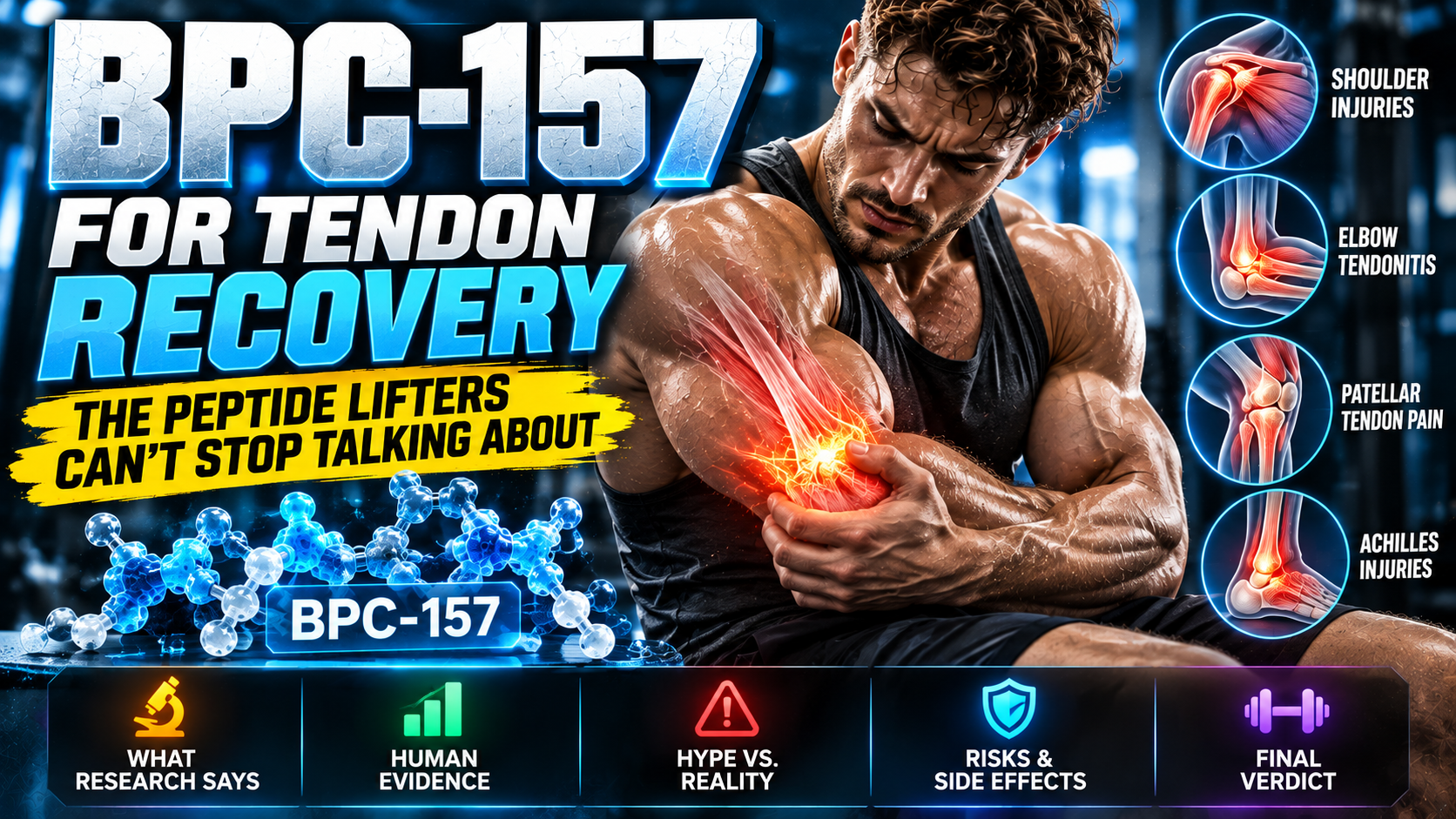
BPC-157 for Tendon Recovery: The Peptide Lifters Can’t Stop Talking About
A stubborn tendon injury can turn your best training cycle into weeks or even months of frustration. That's why BPC-157 has become one of the most talked-about recovery peptides in bodybuilding, with lifters sharing stories of faster healing, reduced pain, and dramatic comebacks. But can this experimental peptide actually repair damaged tendons and ligaments? Animal studies have shown promising results, while human evidence remains surprisingly limited. And a 2026 study adds an unexpected twist to the hype. Here's what the research really reveals about BPC-157, tendon recovery, and whether this controversial peptide deserves its reputation.
BPC-157 for Tendon Recovery: The Peptide Lifters Can’t Stop Talking About
A stubborn tendon injury can destroy months of training progress. BPC-157 promises a faster way back to lifting heavy—but the latest research reveals something that could change how you look at this controversial recovery peptide. You finally hit a new personal record. Your strength is climbing. Your training is consistent. Everything seems to be moving in the right direction. Then your elbow starts hurting. At first, it's nothing serious. A little discomfort during curls. Maybe some pain after bench pressing. You ignore it. Two weeks later, even your warm-up sets hurt.
Suddenly, the biggest obstacle to building muscle isn't motivation, protein, or your training program. It's a tendon that refuses to cooperate. That's exactly the kind of frustration that has helped turn BPC-157 into one of the most talked-about recovery compounds in bodybuilding. Stories of faster healing have spread through gyms, online communities, and fitness podcasts. But there's a problem. The science behind BPC-157 is genuinely interesting. The evidence that it actually repairs injured human tendons is still remarkably thin. And a 2026 animal study makes the conversation even more interesting.
So is BPC-157 a legitimate breakthrough waiting to happen, or another case of bodybuilding enthusiasm moving faster than the research?
Why Tendon Injuries Are a Nightmare for Lifters
Muscle soreness is familiar territory. You train hard, recover, and return to the gym. Tendon problems can be different. Unlike muscle tissue, tendons are specialized connective tissues that transmit muscular force to bone. Their mechanical properties and adaptation to loading are critical for strength training. When tendon pain becomes persistent, simply waiting a few days may not solve the underlying problem. And lifters have plenty of opportunities to develop tendon-related issues.
Elbow Pain That Ruins Arm Training
Persistent pain around the elbow can interfere with curls, pulling movements, and gripping. Depending on the location and cause, symptoms may involve the common flexor or extensor tendons, distal biceps tendon, or other structures. The problem isn't always a tear. Repeated loading can contribute to tendinopathy, a condition involving tendon pain and impaired load tolerance.
Shoulder Pain That Makes Pressing Miserable
Rotator cuff-related shoulder pain can affect bench pressing, overhead pressing, and other upper-body exercises. But not every painful shoulder is a tendon injury. Joint, muscular, and neurological problems can produce similar symptoms, making accurate assessment important.
Patellar Tendon Pain During Squats
Pain around the patellar tendon can make squats, lunges, jumps, and heavy leg training frustrating. Patellar tendinopathy is especially associated with repeated loading and jumping activities. Even when an athlete can still train, progressive pain may limit performance.
Achilles Tendon Problems
The Achilles tendon handles significant forces during walking, running, jumping, and other movements. Persistent Achilles pain can interfere with conditioning and lower-body activity. For many athletes, the frustrating part isn't just the discomfort. It's the uncertainty. Will it settle down next week? Will it take months? Can you train around it without making things worse? That uncertainty creates the perfect environment for something promising a shortcut. Enter BPC-157.
What Exactly Is BPC-157?
BPC-157 stands for Body Protection Compound-157. It is a synthetic peptide consisting of 15 amino acids, developed from a sequence associated with gastric proteins. Researchers have investigated its effects on tissue protection, inflammation, blood-vessel signaling, and repair processes. It isn't an anabolic steroid. It isn't a conventional painkiller. And it isn't an FDA-approved treatment for tendon injuries. Instead, BPC-157 is an experimental compound whose strongest supporting evidence comes from laboratory and animal research. That distinction matters.
Because the claims surrounding it extend far beyond what clinical researchers have established. Online discussions frequently describe BPC-157 as a potential solution for:
- 1Achilles tendon injuries
- 2Elbow tendinopathy
- 3Shoulder tendon problems
- 4Ligament injuries
- 5Muscle strains
- 6Persistent joint discomfort
But being discussed for those conditions is not the same as being proven to treat them. The real question is what the studies actually demonstrate.
Why BPC-157 Became So Popular in Bodybuilding
BPC-157 didn't become popular because of a massive human clinical trial. It became popular because its proposed effects address something nearly every serious lifter fears: losing training time. Think about the appeal. You have a painful tendon. You don't want to stop progressing. You hear about a peptide that researchers have associated with improved tendon repair in rats. Then someone online claims their shoulder felt better after using it. Another person says their elbow pain disappeared. Soon, the compound starts sounding less like experimental research and more like an essential recovery tool.
But personal experiences are difficult to interpret. Tendon symptoms can fluctuate naturally. People often reduce training loads, modify exercises, rest, or begin rehabilitation at the same time they try something new. Without a comparison group, it is difficult to know what actually caused an improvement. A recovery story can be completely genuine without proving that BPC-157 caused the recovery. That's not an accusation against anyone sharing their experience. It's the difference between an observation and a scientific conclusion.
What Does Research Say About BPC-157 and Tendon Healing?
Here's where the discussion becomes genuinely interesting. BPC-157 is not supported solely by internet testimonials. There are published experiments investigating its effects on tendons, ligaments, and connective-tissue repair. Some have produced encouraging findings. But almost all involve animals or cells rather than injured human athletes.
The Early Achilles Tendon Experiments
One frequently discussed study examined surgically injured Achilles tendons in rats. Researchers reported improvements in several measures of healing, including tendon structure, functional recovery, and biomechanical properties. Compared with controls, treated animals showed improved measures such as load to failure. That last measurement matters. Load to failure represents the force required to mechanically break the tissue during testing. It is more meaningful than simply observing reduced inflammation. But there is a limitation that cannot be ignored.
The experiments involved rats with controlled tendon injuries. They did not demonstrate that BPC-157 safely accelerates recovery from chronic tendinopathy in human weightlifters. Those are very different clinical situations.
Laboratory Studies Suggest a Possible Repair Mechanism
A 2011 study investigated BPC-157's effects on tendon fibroblasts. Fibroblasts are cells involved in the maintenance and repair of connective tissue. Researchers found that BPC-157 increased fibroblast migration and improved cell survival under experimentally induced stress. The study also identified changes in the FAK-paxillin signaling pathway, which participates in cell adhesion and movement. That provides a plausible biological explanation for some of the findings in animal models. But a plausible mechanism isn't proof of clinical effectiveness.
A compound can produce interesting effects on cells in a laboratory without delivering meaningful benefits in human patients.
A 2025 Review Revealed How Little Human Evidence Exists
In 2025, researchers published a systematic review titled Emerging Use of BPC-157 in Orthopaedic Sports Medicine. The review examined research available through June 2024. After screening the literature, the authors included 36 studies. Here's the revealing part:
- 1| Evidence category | Studies included |
- 2| Preclinical studies | 35 |
- 3| Human clinical studies | 1 |
- 4| Total | 36 |
Thirty-five preclinical studies. One human clinical study. That doesn't mean the experimental findings are worthless. It means the evidence is heavily concentrated at an early stage of development. The review described promising outcomes in animal models of tendon, ligament, muscle, and bone injury. But it also emphasized that high-quality human clinical evidence was lacking. The peptide had already become a major talking point in sports recovery before researchers had demonstrated that it heals injured human tendons. And the newer research hasn't closed that gap.
The 2026 Study That Makes the BPC-157 Debate Even More Interesting
Here's a detail that deserves more attention. In July 2026, researchers published an experimental study examining BPC-157 and TB-500 in Achilles tendon healing. Thirty-two male rats were divided into four groups after Achilles tendon injury and repair. The groups received different experimental treatments or served as controls. After four weeks, researchers examined tendon strength, microscopic structure, and collagen organization. Some findings were encouraging. But the results weren't the sweeping BPC-157 victory that online discussions might lead you to expect.
The BPC-157 group showed higher maximum load-to-failure values than the control group. However, that difference did not reach statistical significance. The TB-500 group did show a statistically significant advantage in that biomechanical outcome. And although some tissue-level findings favored the experimental treatments, BPC-157 alone did not achieve statistically significant improvement in the overall histological scoring measures reported. The combination of BPC-157 and TB-500 also failed to demonstrate an additional benefit over the individual treatments.
That makes the study valuable precisely because its results are more complicated than a marketing slogan. Even in animal research, the effects of BPC-157 are not uniformly dramatic or statistically convincing across every measurement. The study was small, and a nonsignificant result does not prove that BPC-157 has no effect. But it challenges the idea that every new experiment automatically confirms the hype. And there's still one enormous limitation. These were rats. Not powerlifters with elbow tendinopathy. Not bodybuilders recovering from shoulder injuries. Not athletes trying to return to heavy squats.
What About Human Studies of BPC-157?
This is where expectations need to meet reality. There have been a few small published human investigations involving BPC-157. But none has established that the compound accelerates structural tendon healing in humans.
The Knee Pain Study People Keep Quoting
A 2021 retrospective study examined patients who had received BPC-157 injections, sometimes combined with thymosin beta-4, for different types of knee pain. Of 17 patients identified, 16 were contacted for follow-up. Twelve had received BPC-157 alone. Of those 12 patients, 11 reported significant improvement in knee pain. Seven reported pain relief lasting longer than six months. That sounds impressive. And the people reporting improvement may genuinely have felt better. But look at what the researchers did not establish. There was no randomized placebo group.
The participants had different possible causes of knee pain. Pain improvement was assessed retrospectively rather than through a blinded, standardized comparison. And the study did not demonstrate that damaged human tendons had structurally regenerated. Pain relief and tendon healing are not the same outcome. That is a crucial distinction. Someone can experience reduced pain without the tendon having recovered its previous mechanical capacity. For a lifter planning to return to heavy training, that difference matters.
The Two-Person Human Safety Study
In 2025, researchers published a small pilot study involving two adults who received intravenous BPC-157. No adverse effects were reported during the brief observation period, and the measured laboratory markers did not show concerning changes. That is an observation worth reporting. But two participants cannot establish the general safety of a drug. The study also did not investigate tendon injury recovery. It tells us something limited about short-term exposure in two people. It does not establish that BPC-157 repairs human connective tissue or is safe for widespread use.
What the Broader 2026 Evidence Review Found
A 2026 review of BPC-157's pharmaceutical development identified three small published human studies involving different conditions or safety questions. None was a randomized controlled efficacy trial. None provided convincing clinical evidence of accelerated tendon repair in lifters. The central problem remains unchanged. Researchers have biological hypotheses and encouraging animal data. What they do not yet have is reliable clinical confirmation.
BPC-157 Hype vs. Reality
So how much of the bodybuilding discussion actually survives scrutiny?
- 1| Popular claim | What the evidence supports |
- 2| BPC-157 speeds up tendon recovery | Promising animal data; not demonstrated in controlled human tendon trials |
- 3| BPC-157 repairs ligaments | Improvements observed in animal models; human effectiveness unproven |
- 4| BPC-157 heals chronic gym injuries | No convincing direct clinical evidence |
- 5| BPC-157 eliminates joint pain | Small uncontrolled knee-pain observations, not proof of treatment efficacy |
- 6| BPC-157 is safe because it's a peptide | Human safety remains insufficiently characterized |
- 7| BPC-157 can replace rehabilitation | No evidence supports replacing established rehabilitation |
The reality is more interesting than either extreme. BPC-157 is not scientifically meaningless. Researchers have observed measurable effects in preclinical experiments. But it is also not an established regenerative treatment that athletes can confidently rely on. Both statements can be true at the same time.
The Risks Nobody Should Brush Aside
There's another side to the BPC-157 discussion that deserves attention. It isn't an FDA-approved medication. And the absence of extensive human research leaves important questions unanswered.
Long-Term Safety Is Unknown
Researchers have not established a comprehensive long-term safety profile in humans. Potential effects on immune responses, other biological processes, and interactions with medications remain incompletely characterized. The FDA has raised concerns about possible immunogenicity for certain administration routes and challenges involving peptide-related impurities and pharmaceutical characterization. That doesn't prove BPC-157 causes specific serious harm in every user. It means the information needed to assess those risks reliably is missing.
Product Quality Is a Serious Question
Another problem involves products marketed online as BPC-157. A product label cannot establish that the contents are authentic, uncontaminated, or accurately characterized. Research-grade labeling does not turn an unapproved compound into a validated human medicine. And the safety of a pharmaceutical substance depends on more than its chemical name. Manufacturing quality, impurities, formulation, and route of exposure can matter considerably.
What About the 2026 FDA Advisory Vote?
There's a regulatory development worth understanding. In July 2026, an FDA advisory committee voted narrowly in favor of recommending BPC-157-related substances for potential inclusion on a list used in certain pharmacy-compounding circumstances. That recommendation was not the same as FDA approval of BPC-157 as a drug. It also did not establish clinical efficacy for tendon injuries. Discussions about regulated compounding access and proof of medical benefit are two separate issues.
Competitive Athletes Have Another Problem
BPC-157 is prohibited under the World Anti-Doping Agency's S0 category for non-approved substances. It has been specifically identified as prohibited since 2022. Athletes competing under applicable anti-doping rules need to understand that an experimental recovery product can create eligibility consequences regardless of whether its performance benefits have been demonstrated.
What Actually Helps Tendons Recover?
Here is something that gets considerably less attention than experimental peptides. Progressively loading a painful tendon can have a meaningful role in rehabilitation. That might sound counterintuitive. If a tendon hurts, shouldn't you simply stop using it? Not necessarily. The appropriate approach depends on the diagnosis, severity, and stage of injury, but many tendinopathies respond to carefully managed progressive resistance exercise.
Progressive Loading Has Human Evidence
A randomized clinical trial involving 76 people with patellar tendinopathy compared progressive tendon-loading exercise with eccentric exercise therapy. After 24 weeks, the progressive-loading group experienced better average improvements in the study's primary clinical outcome. A separate systematic review examining resistance-exercise approaches for tendinopathy also supported appropriately structured loading programs. These are actual human clinical findings. That's an important distinction from the BPC-157 literature.
Recovery Isn't Just About Making Pain Disappear
For someone who lifts weights, successful recovery involves more than feeling comfortable at rest. The tendon must tolerate the forces demanded by training. Depending on the condition, recovery may involve:
- 1An accurate diagnosis and assessment of injury severity.
- 2Adjustments to aggravating training loads.
- 3Progressive strengthening and tendon-loading exercises.
- 4Sufficient recovery between challenging sessions.
- 5Gradual return to the movements and loads required by the sport.
A partial tendon tear, complete rupture, and chronic tendinopathy are not interchangeable diagnoses. A sudden pop, substantial bruising, obvious deformity, marked weakness, or inability to bear weight warrants prompt medical assessment rather than an experimental recovery shortcut. The goal isn't to ignore pain indefinitely. It's to restore function and loading capacity appropriately.
Could BPC-157 Eventually Become a Legitimate Recovery Treatment?
Possibly. There's a reason researchers continue investigating it. Preclinical findings suggest potentially interesting effects on cellular migration, inflammation-related signaling, vascular pathways, and connective-tissue repair. But turning that biological promise into an actual treatment would require considerably stronger evidence. Researchers would need well-designed human trials that examine specific injuries rather than mixing unrelated pain conditions. Those trials would need appropriate comparison groups and meaningful outcomes. Not just whether someone says they feel better.
But whether the injured tissue is recovering, whether function improves, whether athletes return to activity, and whether the benefits outweigh the risks. Long-term safety would also need proper evaluation. If those studies eventually demonstrate clear benefits, the scientific conversation could change. Until then, describing BPC-157 as a proven tendon-healing breakthrough would be getting ahead of the evidence.
The Verdict: Is BPC-157 Worth the Hype for Tendon Recovery?
Let's separate three things that often get mixed together. The scientific potential is real. BPC-157 has produced measurable effects in animal and laboratory studies, including experiments involving injured tendons and ligaments. The excitement among lifters is understandable. Persistent tendon pain can derail training for months, and athletes naturally want something that helps them recover sooner. But the human evidence isn't strong enough to justify the promises. There is still no convincing controlled clinical evidence demonstrating that BPC-157 accelerates structural tendon repair in human lifters.
Its long-term safety is insufficiently understood, and it remains an unapproved experimental compound. The 2026 animal research adds an especially useful reminder: even promising preclinical compounds do not produce dramatic results in every experiment or every outcome. So is BPC-157 the future of tendon recovery? It remains an interesting research candidate. But it hasn't earned the reputation of a proven recovery solution. And for athletes, that distinction is far more important than the latest viral testimonial.
The most dangerous assumption isn't that BPC-157 might work. It's believing that feeling better automatically means your tendon is ready to handle heavy training again. Because in bodybuilding, real recovery isn't simply getting rid of pain. It's getting back the ability to train—and keep training.
Frequently Asked Questions
Animal and laboratory studies have reported effects consistent with improved tendon repair. However, controlled clinical trials have not established that BPC-157 accelerates tendon healing in humans.
There is no convincing direct human clinical evidence showing that BPC-157 treats elbow tendinopathy. Existing experimental findings cannot reliably predict its effectiveness for this condition.
Studies involving rats with Achilles tendon injuries have produced some promising results, but no controlled human trial has demonstrated that BPC-157 improves Achilles tendon healing.
Animal research has reported improved outcomes in ligament injury models, including medial collateral ligament injuries. Whether these findings translate into meaningful human recovery benefits remains unknown.
There is no scientifically established healing timeline for BPC-157 in humans. Claims of recovery within a specific number of days or weeks are not supported by reliable human tendon-healing trials.
No. As of October 2026, BPC-157 is not an FDA-approved drug. A July 2026 advisory recommendation concerning potential pharmacy compounding does not constitute drug approval.
Yes. BPC-157 is prohibited under WADA's S0 category of non-approved substances. Athletes should also check the rules governing their particular sport or organization.
No clinical evidence supports replacing established tendon rehabilitation with BPC-157. Progressive loading and individualized rehabilitation have a substantially stronger human evidence base for many tendinopathies.
Research and Sources
- 1Vasireddi N, et al. (2025). Emerging Use of BPC-157 in Orthopaedic Sports Medicine: A Systematic Review. HSS Journal. https://pubmed.ncbi.nlm.nih.gov/40756949/
- 2Biçer O, et al. (2026). Effects of BPC-157 and TB-500 on Achilles Tendon Healing in Rats: A Histopathological and Biomechanical Study. Joint Diseases and Related Surgery. https://pubmed.ncbi.nlm.nih.gov/42542926/
- 3Chang CH, et al. (2011). The Promoting Effect of Pentadecapeptide BPC 157 on Tendon Healing Involves Tendon Outgrowth, Cell Survival, and Cell Migration. Journal of Applied Physiology. https://pubmed.ncbi.nlm.nih.gov/21030672/
- 4Lee E, Padgett B. (2021). Intra-Articular Injection of BPC 157 for Multiple Types of Knee Pain. Alternative Therapies in Health and Medicine. https://pubmed.ncbi.nlm.nih.gov/34324435/
- 5Lee E, Burgess K. (2025). Safety of Intravenous Infusion of BPC157 in Humans: A Pilot Study. Alternative Therapies in Health and Medicine. https://pubmed.ncbi.nlm.nih.gov/40131143/
- 6Mateescu DM, et al. (2026). BPC-157 as an Investigational Peptide Therapeutic: Biopharmaceutical Challenges, Formulation Strategies, and Translational Development Barriers. Pharmaceutics. https://pmc.ncbi.nlm.nih.gov/articles/PMC13210877/
- 7Breda SJ, et al. (2021). Effectiveness of Progressive Tendon-Loading Exercise Therapy in Patients With Patellar Tendinopathy: A Randomised Clinical Trial. British Journal of Sports Medicine. https://doi.org/10.1136/bjsports-2020-103403
- 8US FDA (2026). Pharmacy Compounding Advisory Committee Meeting, July 23–24, 2026. https://www.fda.gov/advisory-committees/advisory-committee-calendar/july-23-24-2026-meeting-pharmacy-compounding-advisory-committee-07232026
- 9US Anti-Doping Agency. Key Changes to the WADA Prohibited List: BPC-157. https://www.usada.org/athlete-advisory/key-changes-2022-prohibited-list/
Research status: October 8, 2026. This article is intended for educational purposes and does not recommend BPC-157 as a treatment for tendon, ligament, or other injuries. Medical assessment and individualized rehabilitation remain important when recovering from musculoskeletal injury.
Dr. Andrii Kaleniuk
Comments (0)
Be the first to comment on this article.