
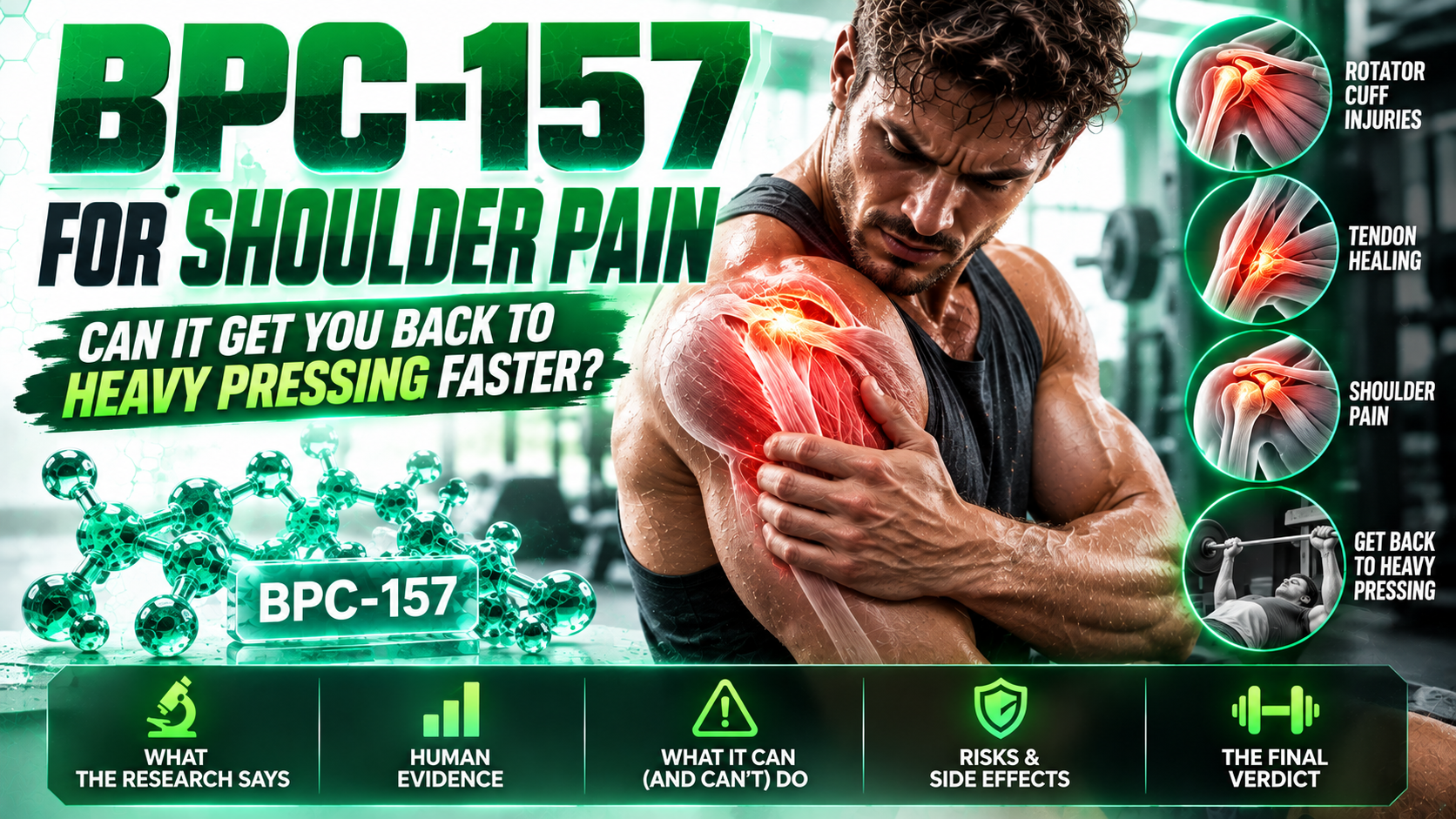
BPC-157 for Shoulder Pain: Can It Get You Back to Heavy Pressing Faster?
Your bench press was finally moving up. Your chest was getting stronger, and heavy pressing felt better than ever—until shoulder pain ruined everything. Now BPC-157 is making waves in bodybuilding circles, with lifters claiming this experimental peptide can speed up tendon healing and get them back under the bar faster. But can it actually repair an injured rotator cuff or reduce recovery time? Animal studies have shown promising results, yet convincing human evidence remains surprisingly scarce. Here's what the research reveals about BPC-157, shoulder recovery, and whether this controversial peptide can really
BPC-157 for Shoulder Pain: Can It Get You Back to Heavy Pressing Faster?
Your bench press was finally moving up. Then your shoulder started hurting. Now a peptide called BPC-157 is being promoted as a shortcut back to heavy lifting—but does the research actually support the hype?
There's a particular kind of frustration that only lifters understand. Your chest is ready to train. Your triceps feel strong. You've been adding weight to the bar for weeks. But your shoulder has other plans.
Maybe it started as a slight pinch at the bottom of a bench press. Maybe overhead pressing suddenly became uncomfortable. Or perhaps you wake up with a dull ache that seems to disappear during warm-ups, only to return after training. At first, you work around it. Then you start skipping exercises. Before long, the shoulder that once handled heavy pressing becomes the limiting factor in your entire upper-body routine.
That's when BPC-157 starts sounding interesting. Across bodybuilding communities, the experimental peptide has gained a reputation for helping injured tendons and other connective tissues recover. Some lifters describe dramatic improvements. Others call it a potential game-changer for stubborn shoulder problems.
But here's the uncomfortable question: if BPC-157 really helps injured shoulders recover faster, why don't we have convincing human clinical trials demonstrating it? The answer is more complicated than the online success stories suggest. And there's another issue every serious lifter should understand. Feeling less pain doesn't necessarily mean your shoulder is ready for a heavy barbell.
Why Shoulder Pain Is Such a Common Problem in Bodybuilding
The shoulder offers an extraordinary range of motion. That flexibility makes exercises like bench presses, overhead presses, lateral raises, dips, and pull-ups possible. But it also means multiple muscles, tendons, and other structures must work together to maintain stability under load.
The rotator cuff plays a central role. It consists of four muscles and their associated tendons:
- 1Supraspinatus
- 2Infraspinatus
- 3Teres minor
- 4Subscapularis
Together, they help stabilize the head of the upper arm bone within the shoulder joint. During resistance training, these structures must tolerate and control forces as the arm moves. When loading exceeds what an athlete can currently tolerate, shoulder symptoms may develop.
That doesn't mean heavy training automatically damages shoulders. Many athletes perform challenging resistance exercises without developing injuries. But training demands, recovery capacity, previous injuries, technique, and individual anatomy can all influence how the shoulder responds.
Bench Pressing Can Expose Existing Shoulder Problems
The bench press places substantial demands on the shoulder, particularly as the upper arm moves through the lowering and pressing phases. For someone with an irritated shoulder, certain positions may provoke pain. Some lifters notice discomfort near the bottom of the movement. Others experience pain when increasing their training loads or performing high-volume pressing sessions.
But the painful structure isn't always the same. Symptoms can involve rotator cuff tendons, the biceps tendon, the acromioclavicular joint, or other tissues. A painful bench press is a symptom, not a diagnosis.
Overhead Pressing Creates Different Demands
Overhead movements require coordinated movement of the upper arm, shoulder blade, and surrounding muscles. When the shoulder is sensitive, pressing overhead can become uncomfortable. Pain may appear during the lifting phase, near the top of the movement, or afterward. That doesn't automatically indicate a rotator cuff tear. Several conditions can cause similar symptoms.
The Real Problem: Lifters Don't Want to Stop Training
For someone who trains consistently, shoulder pain can interfere with far more than a single exercise. Bench press progress stalls. Overhead pressing becomes unpredictable. Chest and shoulder workouts require modification. Even pulling movements may become uncomfortable. And when the problem persists, the temptation to find a faster solution grows. That's exactly where BPC-157 enters the conversation.
What Is BPC-157 and Why Do Lifters Think It Helps Shoulder Injuries?
BPC-157, or Body Protection Compound-157, is a synthetic peptide consisting of 15 amino acids. It was developed from a sequence associated with proteins found in gastric tissue. Researchers have investigated the compound for its potential effects on tissue repair, inflammation-related processes, vascular signaling, and cellular activity.
It is not an anabolic steroid. It is not an approved shoulder-pain medication. And it has not been established as a treatment for rotator cuff injuries. The excitement comes primarily from preclinical studies suggesting that BPC-157 may influence biological processes involved in healing.
That sounds promising. Especially when someone is dealing with a painful tendon and wants to return to training. But there is a major difference between a substance influencing repair-related pathways and a substance actually making injured human shoulders recover faster. One is an experimental observation. The other requires clinical proof. And that second part is where the evidence becomes much weaker.
The Claims Behind BPC-157 for Shoulder Recovery
If you spend enough time reading discussions about recovery peptides, you'll encounter some impressive claims. BPC-157 is frequently described as something that may:
- 1Accelerate rotator cuff tendon healing.
- 2Reduce shoulder inflammation.
- 3Help repair minor tendon injuries.
- 4Improve recovery from persistent shoulder pain.
- 5Shorten the time needed before returning to heavy pressing.
- 6Support ligament and connective-tissue recovery.
These claims have helped make BPC-157 appealing to athletes frustrated with conventional recovery timelines. But not all claims are supported by the same level of evidence. Some are extrapolated from laboratory findings. Others come from animal research. And many come from personal experiences shared online. Those categories should never be treated as interchangeable.
Why Personal Recovery Stories Can Be Misleading
Imagine a lifter who develops shoulder pain. They reduce bench press intensity. They stop performing painful dips. They improve their sleep. They start rehabilitation exercises. They also begin using BPC-157. Four weeks later, the shoulder feels much better.
What caused the improvement? Was it the peptide? Was it reduced loading? Was it natural symptom fluctuation? Was it the rehabilitation program? Or was it some combination of those factors? Without a controlled comparison, there's no reliable way to isolate BPC-157's contribution.
The recovery can be real while the explanation remains uncertain. A genuine testimonial isn't the same thing as evidence that a treatment works. That's especially important when the treatment is experimental.
What Does the Research Actually Show About BPC-157?
Here's where the conversation gets interesting. BPC-157 isn't supported by nothing. There are laboratory and animal experiments reporting biological effects relevant to tissue repair. Some of these findings are genuinely worth investigating further. But the leap from those studies to human shoulder recovery is enormous.
Animal Studies Have Shown Promising Tendon Results
One frequently cited study examined BPC-157 in rats with surgically injured Achilles tendons. Researchers reported improvements in several measures of recovery, including:
- 1Tendon mechanical properties.
- 2Functional recovery.
- 3Microscopic tissue organization.
- 4Load-to-failure measurements.
Load to failure describes the amount of force required to rupture tissue under testing conditions. That's a meaningful mechanical outcome in an experimental tendon-healing study. The results helped establish why BPC-157 attracted interest in sports medicine. But there's a critical limitation.
A surgically injured rat Achilles tendon is not the same thing as a human rotator cuff problem caused by months of resistance training. Different tissues, different loading patterns, different injury mechanisms, and different biological conditions can affect how experimental findings translate. We cannot simply assume that success in one animal tendon model means faster shoulder recovery in humans.
Laboratory Studies Offer Possible Explanations
A 2011 study investigated BPC-157's effects on tendon fibroblasts. These cells participate in connective-tissue maintenance and repair. The researchers found that BPC-157 promoted tendon fibroblast migration and improved cell survival under experimentally induced stress. They also observed changes involving FAK-paxillin signaling, which is associated with cell adhesion and movement.
Additional research has investigated its effects on growth hormone receptor expression in tendon cells. These findings provide possible explanations for the effects observed in animal experiments. But they do not demonstrate that an injured human shoulder becomes stronger or heals faster after BPC-157 exposure. A biological mechanism is a starting point for clinical research. It isn't the finishing line.
The Number That Should Make Every Lifter Think Twice
In 2025, researchers published a systematic review examining BPC-157 in orthopedic sports medicine. The authors searched research published through June 2024 and included 36 studies. Here is what they found.
- 1Evidence type | Number of studies
- 2Preclinical studies | 35
- 3Human clinical studies | 1
- 4Total included | 36
Thirty-five preclinical studies. Just one clinical study. And that single human study wasn't about shoulder injuries. It involved people with knee pain. The review concluded that BPC-157 showed potential in preclinical models of musculoskeletal injuries, but high-quality human evidence was lacking.
Since then, additional small human reports and reviews have appeared, but they have not established the peptide's effectiveness for shoulder recovery. The biggest problem with the BPC-157 shoulder-recovery hype isn't that researchers found nothing interesting. It's that the strongest claims are being made before the necessary human trials exist. For someone hoping to return to heavy bench pressing, that distinction matters.
What Human Evidence Do We Actually Have?
There have been a few small published investigations involving BPC-157 and human participants. But none provides convincing evidence that BPC-157 accelerates recovery from rotator cuff tendinopathy or shoulder tendon injuries.
The Small Knee Pain Study
A 2021 retrospective study examined patients who received BPC-157, sometimes alongside another peptide, for knee pain. Of 17 patients identified, 16 were contacted during follow-up. Twelve had received BPC-157 alone. Eleven of those twelve reported significant improvement in knee pain. That number sounds impressive. But the study had substantial limitations.
There was no randomized control group. There was no placebo comparison. Participants had different possible causes of knee pain. Follow-up relied on patients reporting their experiences rather than standardized, blinded clinical assessment. Most importantly, investigators did not demonstrate that BPC-157 repaired a damaged tendon. And they weren't investigating shoulders.
Why You Can't Apply Those Results to Bench Pressing
A person reporting less knee pain doesn't establish that someone with an irritated supraspinatus tendon can safely return to heavy bench pressing faster. Those are different outcomes. One concerns perceived pain in a small uncontrolled group. The other would require evidence of improved function, loading capacity, and recovery in people with diagnosed shoulder conditions. We don't have that evidence.
What About Newer Human Safety Research?
A 2025 pilot report involving only two adults described intravenous BPC-157 exposure without reported adverse effects during brief observation. That observation adds a small amount of information about those participants. But a two-person report cannot establish population-level safety. It also did not investigate shoulder recovery. So the key question remains unanswered.
There is no established BPC-157 treatment that has been demonstrated in controlled human trials to accelerate a return to heavy pressing after a shoulder injury.
BPC-157 for Rotator Cuff Injuries: What Can It Really Do?
Let's separate the claims from the evidence.
- 1Claim | What is actually known
- 2BPC-157 heals rotator cuff tendons | Not demonstrated in controlled human trials
- 3BPC-157 reduces shoulder pain | No convincing shoulder-specific clinical evidence
- 4BPC-157 improves tendon repair | Some encouraging preclinical findings
- 5BPC-157 gets lifters back to heavy pressing faster | Not clinically established
- 6BPC-157 helps avoid shoulder surgery | No reliable clinical evidence
- 7BPC-157 is safe because it is a peptide | Human safety remains insufficiently characterized
The important takeaway isn't that BPC-157 can never become useful. It's that we don't currently know whether it provides meaningful benefits for these problems. And without reliable trials, we also cannot determine whether any possible benefit outweighs the risks.
The Most Dangerous Mistake: Confusing Less Pain With a Healed Shoulder
Imagine your shoulder has been hurting for six weeks. Then the discomfort suddenly decreases. You can move your arm more comfortably. The warm-up sets feel better. So you load the barbell. Heavy singles. Heavy doubles. Maybe even a personal-record attempt. But there's a problem.
Pain intensity doesn't directly measure how much mechanical load a tendon can safely tolerate. Pain is influenced by multiple factors, including tissue sensitivity, previous experiences, and nervous-system processing. A tendon may remain poorly conditioned for high loads even after symptoms improve. Conversely, some discomfort can occur during rehabilitation without necessarily indicating new structural damage.
This is why a return to heavy pressing shouldn't be based on pain alone. Strength, range of motion, movement control, functional capacity, and the response to progressively increasing loads all matter. BPC-157 has not been demonstrated to remove the need for those assessments. And treating reduced pain as permission to ignore loading capacity could create avoidable problems.
What Actually Helps Lifters Recover From Shoulder Pain?
Here's something that deserves more attention than experimental peptides. There is human clinical evidence supporting active rehabilitation for many rotator cuff-related shoulder conditions. That doesn't mean every shoulder problem responds to exactly the same program. But appropriate exercise and individualized load management are established parts of care.
A 2025 Clinical Guideline Supports Active Rehabilitation
A 2025 clinical practice guideline published in the Journal of Orthopaedic & Sports Physical Therapy reviewed the diagnosis and treatment of rotator cuff tendinopathy. It recommended active rehabilitation programs that may include motor-control and resistance exercises as an initial treatment approach. The guideline also emphasizes evaluating an athlete's shoulder strength, load tolerance, functional performance, and readiness when planning a return to sport.
That is a substantially stronger clinical foundation than anything currently available for BPC-157 in shoulder recovery.
A 708-Person Clinical Trial Offers Another Perspective
The GRASP trial, published in The Lancet in 2021, included 708 adults with rotator cuff disorders. Researchers compared a progressive exercise program with a single session of best-practice physiotherapy advice, with or without a corticosteroid injection. Over 12 months, the more extensive progressive exercise program was not significantly better than the best-practice advice session for shoulder pain and disability.
That finding is interesting. It doesn't mean exercise is useless. Both approaches involved professional guidance and advice intended to support recovery. It suggests that improvement doesn't always require the most elaborate treatment. And it reinforces a bigger point.
Human shoulder research can test actual recovery strategies and measure clinical outcomes. The equivalent evidence for BPC-157 is still missing.
How to Approach Returning to Heavy Pressing
A painful shoulder doesn't automatically require permanently abandoning bench presses or overhead training. But it does require understanding the problem. For many lifters with non-urgent rotator cuff-related pain, rehabilitation may involve several stages.
1. Identify the Actual Problem
Shoulder pain can result from rotator cuff tendinopathy, a tendon tear, joint irritation, instability, or other conditions. Not all shoulder injuries are interchangeable. If the diagnosis is unclear, a clinician or physical therapist can help determine which structures and functions need attention. Sudden traumatic pain, marked weakness, deformity, inability to move the arm, or significant neurological symptoms warrant prompt assessment.
2. Modify Training Loads
An irritated shoulder may tolerate some exercises better than others. Depending on the diagnosis, temporary modifications could include reducing loads, changing range of motion, or selecting movements that produce manageable symptoms. The goal isn't necessarily to stop all activity. It's to maintain appropriate training while avoiding loads the shoulder currently cannot tolerate.
3. Rebuild Shoulder Capacity
Gradual resistance exercise can help restore strength and functional tolerance. The specific exercises and progression depend on the condition. For some people, this includes rotator cuff strengthening, scapular control exercises, and progressive pressing variations. There is no universally correct rehabilitation program for every painful shoulder.
4. Return to Heavy Training Based on Function
The ability to perform daily activities without pain is not the same as readiness for heavy bench pressing. A successful return requires evaluating how the shoulder responds to progressive loading. The ultimate goal is not simply to complete one heavy workout. It's to return to training consistently without provoking repeated setbacks.
The Risks of BPC-157 That Lifters Should Know
BPC-157 remains an experimental compound. As of October 2026, it has not received FDA approval for human therapeutic use. That means there is no established, approved BPC-157 treatment for shoulder injuries.
Human Safety Is Still Poorly Understood
The absence of large, rigorous human trials leaves important safety questions unanswered. Those include possible immune responses, adverse effects related to different formulations, and long-term consequences. The FDA has previously identified concerns about possible immunogenicity and peptide-related impurities during its review of BPC-157 for compounding. These concerns do not establish that every exposure will cause harm. They indicate that important safety uncertainties exist.
Online Product Quality Is Another Issue
Products marketed as BPC-157 through unregulated channels may have uncertain contents or quality. A product label cannot independently establish identity, purity, or manufacturing standards. And the results of legitimate laboratory research don't guarantee the quality of commercial products using the same compound name.
Regulatory Discussions Aren't Proof of Effectiveness
In July 2026, an FDA advisory committee considered BPC-157-related substances for potential inclusion in a pharmacy-compounding framework. That regulatory process should not be confused with FDA approval of BPC-157 as a medication. It also does not demonstrate that the compound heals human shoulder injuries.
Competitive Athletes Face Anti-Doping Restrictions
BPC-157 is prohibited under the World Anti-Doping Agency's S0 category for non-approved substances. Athletes subject to those rules can face consequences regardless of whether BPC-157 has demonstrated a meaningful performance or recovery benefit.
Could BPC-157 Eventually Become Useful for Shoulder Recovery?
It's possible. The existing preclinical research provides reasons to investigate it further. But for BPC-157 to become a credible treatment for shoulder injuries, researchers would need to answer several questions.
- 1Does it reduce pain more than placebo?
- 2Does it improve shoulder strength or functional performance?
- 3Does it accelerate recovery from diagnosed rotator cuff injuries?
- 4Does imaging or other validated testing demonstrate better tissue outcomes?
- 5Can athletes return to sport sooner without increasing reinjury risk?
- 6And is it safe?
Those questions need controlled human studies involving clearly defined shoulder conditions. Not just online recovery stories. Not just animal models. And not simply laboratory evidence of biological activity. Until that research exists, confidence in the compound's effectiveness for shoulder recovery remains speculative.
The Verdict: Can BPC-157 Get You Back to Heavy Pressing Faster?
Let's settle the question. BPC-157 has interesting experimental research behind it. But there is no convincing clinical evidence that it gets lifters back to heavy pressing faster after a shoulder injury. That's the central finding.
The compound has shown effects in animal models of tendon repair. Laboratory research has identified potential biological mechanisms. And small human reports involving other conditions have generated additional interest. But none of this establishes that BPC-157 heals an injured human rotator cuff, shortens recovery time, or safely restores pressing strength.
There is also insufficient human evidence to establish its long-term safety. For someone with persistent shoulder pain, that uncertainty matters. Especially when the desire to return to the gym can make a dramatic recovery claim feel irresistible.
The better-supported approach is to identify the cause of the pain, manage loading appropriately, rebuild functional capacity, and return to pressing progressively. Could future research change the verdict on BPC-157? Absolutely. But right now, the evidence hasn't earned the hype.
The real goal isn't getting back under a heavy barbell as quickly as possible. It's getting your shoulder strong enough to keep pressing long after the comeback workout is over. And that's something no experimental peptide has yet been proven to guarantee.
Frequently Asked Questions
There is no convincing controlled human clinical evidence demonstrating that BPC-157 treats shoulder pain. Some animal and laboratory studies have reported effects relevant to tissue repair, but those findings cannot establish effectiveness in human shoulders.
BPC-157 has not been proven to heal human rotator cuff injuries. Existing tendon-related findings largely come from experimental models involving other tissues or animal subjects.
No controlled human studies have established that BPC-157 reduces recovery time after bench press-related shoulder injuries. Recovery depends on the actual diagnosis, injury severity, rehabilitation, and other individual factors.
There is no validated clinical timeline for BPC-157 treatment of shoulder pain. Claims of improvement within a particular number of days or weeks are not supported by reliable shoulder-specific human trials.
There is no evidence establishing that BPC-157 is better than physical therapy. Active rehabilitation has a substantially stronger clinical evidence base for many rotator cuff-related shoulder conditions.
No convincing clinical evidence demonstrates that BPC-157 prevents the need for rotator cuff surgery. Whether surgery is appropriate depends on factors such as diagnosis, injury severity, function, and response to nonsurgical treatment.
No. As of October 2026, BPC-157 is not an FDA-approved treatment for shoulder injuries or any other human therapeutic indication.
Some people with non-urgent shoulder conditions can continue modified training during rehabilitation. However, the appropriate loading and exercise selection depend on the cause of the pain. Sudden severe pain, traumatic injury, deformity, or marked weakness requires prompt medical assessment.
Research and Sources
- 1Vasireddi N, et al. (2025). Emerging Use of BPC-157 in Orthopaedic Sports Medicine: A Systematic Review. HSS Journal. https://pubmed.ncbi.nlm.nih.gov/40756949/
- 2Chang CH, et al. (2011). The Promoting Effect of Pentadecapeptide BPC 157 on Tendon Healing Involves Tendon Outgrowth, Cell Survival, and Cell Migration. Journal of Applied Physiology. https://pubmed.ncbi.nlm.nih.gov/21030672/
- 3Krivic A, et al. (2003). Gastric Pentadecapeptide BPC 157 Accelerates Healing of Transected Rat Achilles Tendon and In Vitro Stimulates Tendocytes Growth. https://pubmed.ncbi.nlm.nih.gov/14554208/
- 4Lee E, Padgett B. (2021). Intra-Articular Injection of BPC 157 for Multiple Types of Knee Pain. Alternative Therapies in Health and Medicine. https://pubmed.ncbi.nlm.nih.gov/34324435/
- 5Desmeules F, et al. (2025). Rotator Cuff Tendinopathy Diagnosis, Nonsurgical Medical Care, and Rehabilitation: A Clinical Practice Guideline. Journal of Orthopaedic & Sports Physical Therapy. https://pubmed.ncbi.nlm.nih.gov/40165544/
- 6Hopewell S, et al. (2021). Progressive Exercise Compared With Best Practice Advice, With or Without Corticosteroid Injection, for Patients With Rotator Cuff Disorders: The GRASP Trial. The Lancet. https://pubmed.ncbi.nlm.nih.gov/34265255/
- 7US FDA. Certain Bulk Drug Substances for Use in Compounding That May Present Significant Safety Risks. https://www.fda.gov/drugs/human-drug-compounding/certain-bulk-drug-substances-use-compounding-may-present-significant-safety-risks
- 8U.S. Anti-Doping Agency. BPC-157: What Athletes Should Know About the Prohibited Experimental Peptide. https://www.usada.org/spirit-of-sport/education/bpc-157-peptide-prohibited/
- 9NHS. Shoulder Pain: Symptoms, Causes, and When to Seek Medical Help. https://www.nhs.uk/symptoms/shoulder-pain/
Research status: October 8, 2026. This article is for educational purposes and does not recommend BPC-157 as a treatment for shoulder injuries. Persistent or severe shoulder symptoms require appropriate clinical assessment. BPC-157 remains experimental, with insufficient clinical evidence to establish its effectiveness or long-term safety in humans.
Dr. Andrii Kaleniuk
Comments (0)
Be the first to comment on this article.