
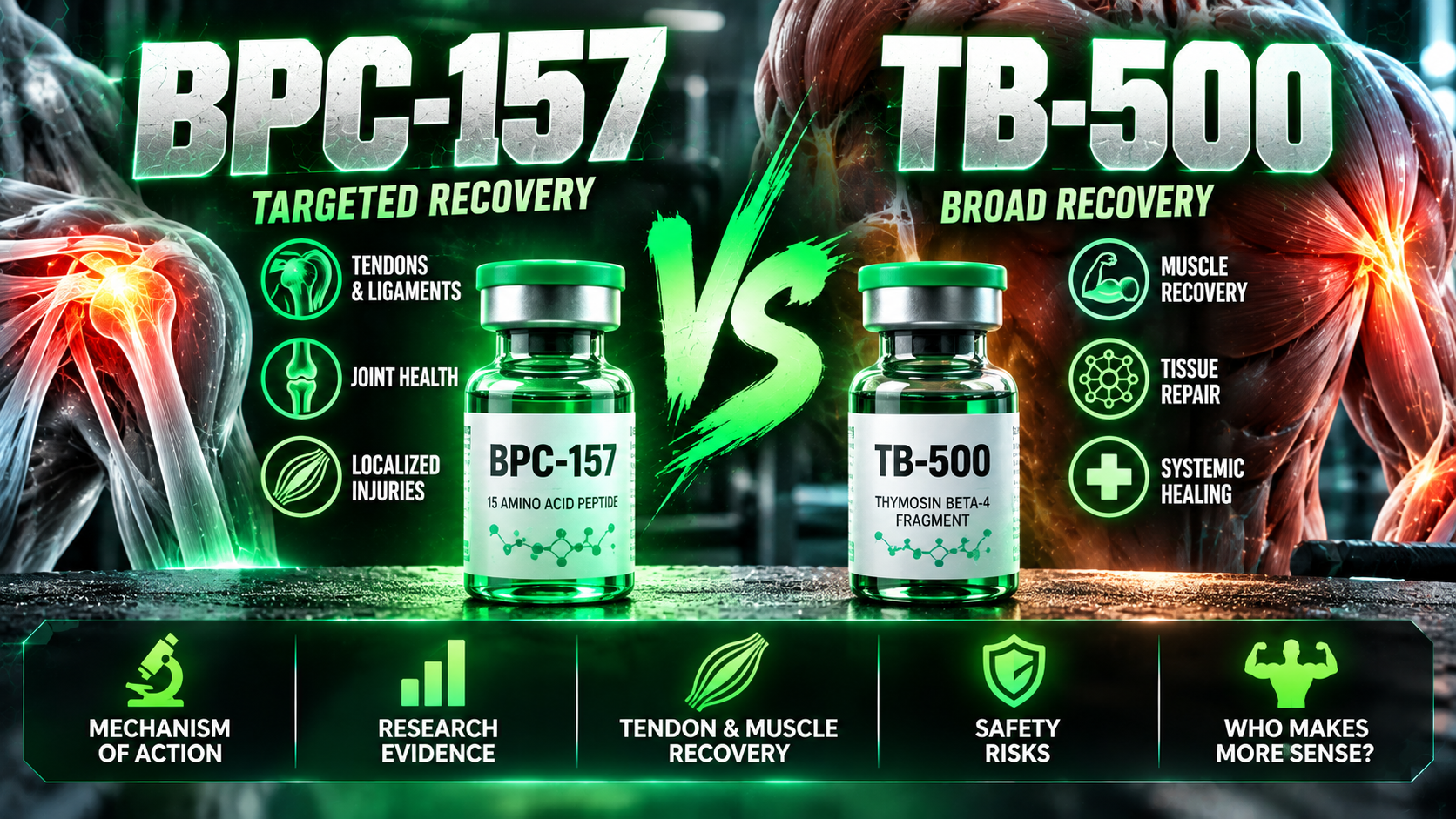
BPC-157 vs TB-500: Which Recovery Peptide Makes More Sense for Bodybuilders?
BPC-157 is famous for tendon recovery. TB-500 is promoted as a whole-body healing peptide. But which one actually makes more sense for bodybuilders dealing with stubborn injuries? Both have gained massive attention for their potential to accelerate muscle, tendon, and ligament repair—yet the human evidence remains surprisingly limited. A 2026 study directly comparing BPC-157 and TB-500 revealed an unexpected difference in tendon strength, while raising new questions about combining them. Let's break down the mechanisms, research, recovery claims, and safety risks to see which peptide deserves the hype—and which promises are still ahead of the science.
BPC-157 vs TB-500: Which Recovery Peptide Makes More Sense for Bodybuilders?
One peptide is famous for injured tendons. The other is marketed as a whole-body recovery solution. But a 2026 experiment comparing BPC-157 and TB-500 produced results that challenge the usual bodybuilding narrative.
Every serious lifter eventually meets the enemy that doesn't care how motivated you are.
Injury.
Maybe your elbow starts screaming during curls. Maybe your shoulder refuses to cooperate on bench press day. Or perhaps your hamstring feels fine during everyday activities but becomes a problem the moment you try to train hard again.
You can have your nutrition dialed in. Your sleep can be perfect. Your training program can be beautifully structured. But none of that guarantees an irritated tendon or injured muscle will recover on your preferred schedule.
That's why two names keep appearing in bodybuilding recovery discussions: BPC-157 and TB-500.
BPC-157 has developed a reputation as the peptide for stubborn, localized injuries—especially tendons and ligaments.
TB-500 is often promoted as the broader option, supposedly supporting recovery across muscles, tendons, and other tissues throughout the body.
Some lifters even talk about combining them. But here's the problem.
The reputation of these peptides has developed much faster than the human evidence supporting them.
And in July 2026, researchers published a direct comparison that made the debate considerably more interesting. One peptide produced a statistically significant improvement in a specific measure of tendon strength. The other didn't. Yet even that result doesn't establish which compound works better in human athletes.
So which recovery peptide actually makes more sense for bodybuilders? Let's separate the mechanisms, research, marketing claims, and real-world limitations.
BPC-157 vs TB-500: The Quick Comparison
Before diving into the studies, here's how the two compounds compare.
- 1| Category | BPC-157 | TB-500 |
- 2| What it is | Synthetic 15-amino-acid peptide | Commonly a synthetic seven-amino-acid fragment associated with thymosin beta-4 |
- 3| Popular reputation | Localized tendon, ligament, and joint recovery | Broader tissue repair and whole-body recovery |
- 4| Main research interest | Connective-tissue repair, cell migration, vascular and inflammatory signaling | Actin-related cell movement, tissue remodeling, and repair-associated processes |
- 5| Direct tendon research | Multiple preclinical studies | Much more limited direct research, including a 2026 rat comparison |
- 6| Human tendon-healing evidence | Not established | Not established |
- 7| Human muscle-recovery evidence | Not established | Not established |
- 8| FDA-approved for injury recovery? | No | No |
- 9| WADA status | Prohibited | Prohibited |
- 10| Proven better for bodybuilders? | No | No |
At first glance, this looks like a straightforward choice. One compound for a specific painful tendon. Another for more widespread recovery problems. But that's a description of the marketing narrative, not a scientifically validated treatment strategy.
And there's a detail about TB-500 that changes how its evidence should be interpreted.
What Is BPC-157?
BPC-157 stands for Body Protection Compound-157. It is a synthetic peptide consisting of 15 amino acids, investigated for potential effects on tissue protection and repair.
Much of the interest comes from animal experiments involving injuries to tendons, ligaments, muscles, and other tissues. Researchers have reported effects involving cell migration, blood-vessel-related signaling, and the organization of healing tissue.
That makes BPC-157 interesting from a musculoskeletal research perspective. But it doesn't make it an established recovery treatment.
Why Bodybuilders Associate BPC-157 With Localized Injuries
Imagine a lifter with persistent elbow pain. They can squat. They can train legs. They can perform some pulling movements. But heavy curls and certain pressing exercises trigger discomfort.
This is the kind of problem that makes BPC-157 appealing. Instead of chasing a general performance boost, the lifter is looking for one specific outcome: Get the injured area working normally again.
Online discussions often frame BPC-157 as a targeted solution for:
- 1Elbow and shoulder tendon problems.
- 2Achilles and patellar tendon injuries.
- 3Ligament sprains.
- 4Persistent joint discomfort.
- 5Muscle strains.
The trouble is that researchers have not demonstrated that BPC-157 selectively targets a particular injured tendon in humans. Its reputation as a localized recovery peptide is not proof of local targeting. Nor does it establish that the compound accelerates healing when used near a painful area.
That distinction matters because the marketing story often sounds more precise than the actual evidence.
What Is TB-500?
TB-500 is generally associated with thymosin beta-4, often abbreviated Tβ4. Thymosin beta-4 is a naturally occurring peptide containing 43 amino acids. It has attracted research interest because of its involvement in cellular movement, actin regulation, and tissue-repair processes.
TB-500, however, commonly refers to a much smaller synthetic fragment of that molecule. And that difference is crucial.
The Detail Most TB-500 Comparisons Get Wrong
TB-500 and full-length thymosin beta-4 are not automatically the same substance.
The TB-500 fragment identified by the FDA is the seven-amino-acid sequence LKKTETQ. Full-length thymosin beta-4 contains 43 amino acids. Those are different molecular structures.
Why should a bodybuilder care? Because a significant amount of the impressive research discussed online involves full-length thymosin beta-4, not the shorter TB-500 fragment marketed for athletic recovery.
You cannot simply take the results of an experiment involving one molecule and assume they apply equally to the other. That would be like claiming that a small fragment of a larger protein must reproduce every biological effect of the complete protein.
Sometimes a fragment retains important activity. Sometimes it doesn't. That requires testing. And in the TB-500 discussion, the distinction has too often been lost.
Why TB-500 Became Known as a Whole-Body Recovery Peptide
Unlike BPC-157's reputation for particular tendon problems, TB-500 is frequently described as supporting broader tissue repair. The claims often involve:
- 1Muscle recovery.
- 2Tendon and ligament repair.
- 3Soft-tissue regeneration.
- 4Recovery from training-related injuries.
- 5Reduced recovery time after demanding exercise.
Those claims draw heavily from research on thymosin beta-4 and its involvement in cellular repair processes. But broader biological activity does not automatically translate into better recovery across the entire human body.
A compound being involved in several repair-related pathways is not proof that it repairs every injured tissue.
That's the first major reality check in this comparison.
Round 1: BPC-157 vs TB-500 Mechanism of Action
Let's look at why researchers believe either compound might affect healing.
BPC-157: Cell Migration and Tissue-Repair Signaling
A 2011 study investigated BPC-157's effects on tendon fibroblasts. Fibroblasts participate in maintaining and repairing connective tissue. Researchers reported that BPC-157 increased fibroblast migration and improved survival under experimental stress.
They also observed activity involving the FAK-paxillin signaling pathway, which helps regulate how cells attach and move. Other preclinical investigations have explored effects on growth hormone receptor expression, vascular signaling, and inflammatory pathways.
These observations provide plausible explanations for some of BPC-157's experimental effects. But a plausible mechanism isn't equivalent to demonstrating faster recovery in a person with chronic elbow tendinopathy.
TB-500: The Thymosin Beta-4 Connection
Thymosin beta-4 is strongly associated with the regulation of actin, a protein essential for cell structure and movement. Actin dynamics help cells move, change shape, and participate in tissue-remodeling processes.
Researchers have also investigated thymosin beta-4's relationship with angiogenesis, inflammatory signaling, and cellular survival. That gives the full-length peptide an interesting biological profile.
But the crucial limitation remains: Most of those findings involve thymosin beta-4 itself. They do not automatically establish identical effects for the shorter TB-500 fragment.
Round 1 Verdict
BPC-157: An interesting set of preclinical mechanisms relevant to connective-tissue repair.
TB-500: A plausible biological rationale linked to thymosin beta-4, but less direct evidence for the commercially discussed fragment.
Neither has a proven human recovery advantage based on mechanism alone.
Winner: No clinical winner.
Round 2: Which Peptide Has Better Evidence for Tendon Recovery?
This is where the comparison becomes much more interesting. Tendon injuries are among the biggest obstacles to consistent bodybuilding progress.
A muscle can feel ready for another heavy session while the tendon involved in the movement remains painful. And for many lifters, persistent tendon problems last considerably longer than ordinary post-workout soreness.
The BPC-157 Tendon Studies
One widely cited experiment examined BPC-157 in rats with surgically transected Achilles tendons. Researchers reported improvements in functional recovery, tissue organization, and biomechanical outcomes compared with untreated controls.
The study helped establish BPC-157's reputation as a potential tendon-repair compound. Subsequent experimental research investigated related processes in tendon cells.
That is a meaningful preclinical research history. But it doesn't prove that BPC-157 treats human Achilles tendinopathy, rotator cuff injuries, or elbow pain. The distinction between an experimentally cut rat tendon and a chronic overuse injury in a human athlete is substantial.
TB-500 Has a Different Evidence Problem
TB-500's broader reputation often comes from thymosin beta-4 studies rather than direct experiments involving the TB-500 fragment.
In June 2026, researchers published a scoping review examining thymosin beta-4 and TB-500 in tissue healing. They included 80 studies from a search covering literature through March 2026.
Most involved preclinical research. Most focused on thymosin beta-4 rather than TB-500. Direct musculoskeletal research was relatively limited. And only one included study directly evaluated TB-500.
That doesn't mean TB-500 has no biological potential. It means the compound discussed in gyms has a much smaller direct evidence base than the wider thymosin beta-4 literature might suggest.
Then came an important new experiment.
Round 3: The 2026 Head-to-Head Study That Changed the Conversation
In July 2026, researchers published a study directly comparing BPC-157, TB-500, and their combination in a rat Achilles tendon injury model.
This is particularly relevant because most discussions comparing these peptides rely on studies that never tested them against each other. Here, the investigators actually did.
How the Experiment Worked
The researchers used 32 male rats. Each animal underwent a standardized Achilles tendon injury followed by surgical repair.
The animals were divided into four groups of eight:
- 1Control.
- 2BPC-157.
- 3TB-500.
- 4BPC-157 plus TB-500.
After approximately four weeks, the researchers evaluated the repaired tendons. They examined tissue structure, collagen organization, and mechanical strength.
For biomechanical testing, there were only four tendons per group. That small number is important when interpreting the findings.
The Results Might Surprise BPC-157 Fans
Researchers measured maximum load to failure. In simple terms, that is the force required to break the tendon during mechanical testing.
Here were the median values:
- 1| Group | Median maximum load to failure |
- 2| Control | 26.91 N |
- 3| BPC-157 | 37.16 N |
- 4| TB-500 | 37.41 N |
- 5| BPC-157 + TB-500 | 34.54 N |
Both individual treatment groups had higher numerical values than controls. But there was an important statistical difference.
Only TB-500 showed a statistically significant improvement compared with the control group in the biomechanical comparison.
The adjusted p-value for TB-500 versus control was approximately 0.041. For BPC-157 versus control, the adjusted p-value was 0.389.
The investigators also reported favorable results for TB-500 in certain histological scores. That sounds like a victory for TB-500. But hold on.
Does This Prove TB-500 Is Better Than BPC-157?
No. And understanding why is essential.
The TB-500 group achieved statistical significance against the control group. The BPC-157 group did not.
But that does not mean the direct difference between TB-500 and BPC-157 was statistically significant.
In fact, the study did not establish a statistically significant biomechanical difference between those two active-treatment groups. That's a critical distinction. The median mechanical results were also very similar.
And remember: the biomechanical analysis involved only four tendons per group. The experiment was exploratory, short-term, and conducted in surgically injured rats. It wasn't a clinical trial involving lifters returning to heavy training.
What About Combining BPC-157 and TB-500?
Here's another unexpected result. The combination did not demonstrate additional benefit over either compound alone.
In other words, the experiment did not support the assumption that two recovery peptides automatically produce better results than one.
That matters because combinations of BPC-157 and TB-500 are frequently promoted online as if their combined effectiveness were already established. It isn't.
This experiment also doesn't prove that every possible combination would fail. It simply did not demonstrate an additive benefit under the conditions tested.
Round 3 Verdict
TB-500 produced the clearest statistically significant biomechanical result against controls in this particular rat experiment.
But the study did not prove that TB-500 was statistically superior to BPC-157. And it didn't establish effectiveness in humans.
Winner: TB-500 against control in one experimental outcome—not a proven overall victory.
Round 4: Which Makes More Sense for Muscle Recovery?
Now let's move away from tendons. What about muscle injuries?
Because bodybuilders aren't just concerned with connective tissue. Heavy training can produce muscle strains, and a significant strain can interrupt training for weeks or longer.
BPC-157 and Muscle Repair
The 2025 systematic review of BPC-157 identified preclinical studies involving muscle injuries. Some animal experiments reported improvements in structural or functional recovery outcomes.
Those results contribute to the broader scientific interest in BPC-157. But they don't establish that the compound helps human bodybuilders recover from hamstring, quadriceps, or pectoral muscle strains.
There is also no reliable evidence that BPC-157 makes ordinary post-workout soreness disappear faster or permits safe increases in training frequency. An injured muscle and a muscle experiencing normal exercise-induced soreness are not the same clinical situation.
TB-500 and Broader Muscle-Recovery Claims
The biological effects attributed to thymosin beta-4 have also attracted attention in muscle-repair research. Actin regulation and cell migration are relevant to many tissues.
But once again, full-length thymosin beta-4 findings should not be casually assigned to the TB-500 fragment. And there is no convincing human clinical evidence showing that TB-500 accelerates recovery from muscle strains in lifters.
The idea of a peptide providing broad muscular recovery support is attractive. But currently, it remains more hypothesis than established outcome.
Round 4 Verdict
Neither compound has demonstrated an advantage in controlled human trials of bodybuilding-related muscle recovery.
Winner: No winner.
Round 5: Human Evidence—Which Peptide Is Actually Closer to Being Proven?
This is probably the most important round. Because the purpose of a recovery treatment isn't to produce interesting results in a Petri dish. It's to improve outcomes in real people.
BPC-157: Human Research Is Still Extremely Limited
A 2025 systematic review of BPC-157 included 36 studies. Thirty-five were preclinical. Only one was a human clinical study.
That study involved patients with knee pain, not a controlled experiment in athletes recovering from tendon injuries.
In the retrospective investigation, 11 of 12 patients who received BPC-157 alone reported significant improvement in knee pain. But there was no randomized placebo group. The patients had different potential causes of pain. And investigators did not demonstrate that BPC-157 regenerated damaged connective tissue.
Other small human reports have since been discussed, including an extremely limited safety pilot. They do not establish effectiveness for bodybuilding recovery.
TB-500: The Human Evidence Is Even Harder to Interpret
There have been clinical investigations involving full-length thymosin beta-4. Some have focused on wound healing. Others investigated ocular conditions using eye-drop formulations.
Those studies are scientifically relevant to thymosin beta-4 development. But they are not evidence that TB-500 repairs human tendons or muscles.
Different molecule. Different condition. Different formulation. Different outcome.
A 2026 sports-medicine review found no peer-reviewed human trials of TB-500 specifically for musculoskeletal indications. That's a major limitation for a compound marketed so heavily toward injury recovery.
The Evidence Gap That Matters Most
Neither BPC-157 nor TB-500 has established that it can:
- 1Get an injured bodybuilder back into training sooner.
- 2Improve healed tendon strength in humans.
- 3Reduce the risk of reinjury.
- 4Accelerate recovery from a diagnosed muscle tear.
- 5Safely replace established rehabilitation.
Those are the outcomes that would actually matter to athletes. And those are precisely the questions that remain unanswered.
Round 5 Verdict
BPC-157 has a tiny amount of direct human observational evidence involving musculoskeletal pain. TB-500 has even less direct human evidence for musculoskeletal applications.
But neither has demonstrated a meaningful injury-recovery benefit in reliable controlled human trials.
Winner: Neither has earned a clinical recommendation.
Round 6: Safety—Is One Recovery Peptide Less Risky?
One of the most persistent ideas in peptide communities is that peptides must be relatively safe because the body naturally produces many peptides.
That argument doesn't work.
Insulin is a peptide. So are numerous powerful biological signaling molecules. Being a peptide tells you something about chemical structure. It doesn't establish safety.
BPC-157 Safety Questions
BPC-157 remains an unapproved experimental compound. Human research is insufficient to establish a comprehensive safety profile.
Important uncertainties include:
- 1Possible immune responses.
- 2Long-term adverse effects.
- 3Interactions with other medications.
- 4Product purity and manufacturing consistency.
- 5Consequences of exposure through different formulations.
The FDA has raised concerns about possible immunogenicity and peptide-related impurities in the context of compounding. These concerns are not proof that every user will experience harm. They are evidence that essential safety questions remain unresolved.
TB-500 Has Additional Identity and Quality Problems
TB-500 faces similar concerns about inadequate human safety data. The FDA specifically identifies the thymosin beta-4 fragment LKKTETQ, also called TB-500, in its discussion of substances that may present significant safety risks in compounding.
The agency has noted a lack of human exposure data for drug products containing that fragment.
And there's another complication. Products marketed as TB-500 may differ in the molecular material they contain or claim to contain.
When a market loosely uses the same name for related but nonidentical peptides, interpreting research becomes even more difficult.
Could Repair-Related Signaling Have Unwanted Effects?
Both BPC-157 and thymosin beta-4 have been investigated for effects on biological pathways involved in cell movement, growth-related processes, and vascular signaling.
That sometimes leads to concerns about unintended biological activity. However, it would be misleading to claim that either peptide has been proven to cause cancer in humans. That evidence doesn't exist.
The more accurate conclusion is that comprehensive human safety assessment remains necessary.
Competitive Athletes Have Another Problem
Both substances are prohibited under World Anti-Doping Agency rules. BPC-157 falls under the S0 category for non-approved substances.
Thymosin beta-4 and its derivatives, including TB-500, are prohibited under the relevant growth-factor-related category.
For athletes competing under applicable testing rules, the risk isn't just biological uncertainty. It's eligibility.
Round 6 Verdict
Neither peptide has adequate evidence establishing long-term safety for bodybuilding recovery.
Winner: No winner.
Round 7: Does BPC-157 Plus TB-500 Make More Sense Than Either Alone?
This is one of the most popular theories surrounding these compounds. The argument sounds straightforward.
BPC-157 is supposedly better for a particular injured area. TB-500 is supposedly better for wider tissue repair. Combine them and get both benefits. Simple.
Except biological systems don't necessarily work like that.
Two compounds influencing repair-related processes may have overlapping effects. They may interact unpredictably. And a combination can fail to outperform either substance alone.
That is exactly why researchers must test combinations rather than assume they work.
What the 2026 Study Actually Found
In the direct rat Achilles tendon experiment, the combined BPC-157 and TB-500 group did not demonstrate additional benefit over the individual treatment groups.
The results do not establish that combination treatment is universally ineffective. But they directly challenge the claim that combining the two is an obvious upgrade.
There are no convincing controlled human trials showing that the combination accelerates tendon or muscle recovery. And combining two inadequately studied substances doesn't magically create an established safety profile.
Round 7 Verdict
No demonstrated additive benefit in the 2026 rat study and no proven human recovery advantage.
Winner: The combination hasn't earned its reputation.
BPC-157 vs TB-500: Which Makes More Sense for Different Bodybuilding Injuries?
Here's how the comparison looks when applied to common gym problems.
- 1| Bodybuilding problem | BPC-157 research relevance | TB-500 research relevance | What makes sense clinically? |
- 2| Persistent elbow tendinopathy | Tendon-related preclinical findings | Limited direct tendon evidence | Diagnose the condition and use appropriate progressive loading |
- 3| Rotator cuff-related shoulder pain | No proven shoulder-specific human benefit | No proven shoulder-specific human benefit | Individualized rehabilitation and load management |
- 4| Achilles tendon injury | Preclinical rat Achilles studies | 2026 rat comparison showed a significant benefit vs control in one mechanical outcome | Injury-specific assessment and rehabilitation |
- 5| Patellar tendon pain | General tendon hypotheses | General repair hypotheses | Progressive tendon-loading rehabilitation has human trial evidence |
- 6| Muscle strain | Some animal muscle-injury research | Broader thymosin beta-4-related biological rationale | Rehabilitation guided by injury severity and restored function |
- 7| Ordinary post-workout soreness | No proven benefit | No proven benefit | Training load management, nutrition, and recovery |
- 8| Multiple painful areas | No evidence of selective targeting or proven treatment | No evidence of validated whole-body injury recovery | Identify the underlying problems rather than assuming one systemic solution |
This table exposes the biggest weakness in the standard BPC-157 versus TB-500 argument. There is no scientific basis for confidently assigning one peptide to an elbow injury and the other to a hamstring strain as if they were established medications.
At most, the existing research suggests different questions worth investigating. That's not the same as knowing which treatment to use.
What Actually Has Better Evidence for Tendon Recovery?
Here's something that deserves more attention than the latest peptide comparison. Structured tendon rehabilitation has actual human clinical research behind it.
For example, a randomized clinical trial involving 76 patients with patellar tendinopathy compared progressive tendon-loading exercise with eccentric exercise therapy.
After 24 weeks, the progressive-loading group experienced greater average improvement in the primary clinical outcome. The average improvement in the VISA-P score was 28 points versus 18 points.
This wasn't a study of experimental peptides. It was a study involving real people with an actual tendon condition. That makes the evidence directly relevant to clinical decision-making.
Not every tendon injury is the same, and the right approach depends on the diagnosis. But principles such as appropriate loading, progressive strengthening, and functional testing have a stronger human evidence base than either BPC-157 or TB-500 for many common tendinopathies.
For bodybuilders, recovery also requires more than simply feeling less pain. An injured tendon or muscle must regain the capacity to tolerate the loads demanded by training.
That matters whether the eventual goal is a heavy squat, a strict overhead press, or a new bench press personal record.
Why Feeling Recovered Doesn't Mean You're Ready to Lift Heavy
Imagine two lifters with similar injuries. One experiences less discomfort after a few weeks. The other follows a structured rehabilitation process and gradually rebuilds strength.
Which one is ready to return to heavy training? You cannot answer that from pain levels alone.
Pain relief is valuable. But it isn't the same as restored tissue capacity. A shoulder that feels comfortable during daily activities may still struggle under a heavy barbell. A tendon that tolerates walking may not be ready for maximal sprinting. And a hamstring that feels normal at rest may still lack the strength needed for explosive movement.
The real recovery outcome isn't how quickly the pain disappears. It's whether the athlete can safely tolerate the demands of their sport again.
No controlled human evidence demonstrates that BPC-157 or TB-500 reliably improves that outcome.
So Which Peptide Makes More Sense Theoretically?
Let's answer the question without pretending the evidence is stronger than it is.
If You're Interested in Tendon and Ligament Research
BPC-157 has a more established history of direct preclinical investigation involving tendon and ligament injuries. That makes it a recognizable research candidate for connective-tissue questions.
However, the 2026 direct comparison found a statistically significant biomechanical improvement versus control for TB-500, not BPC-157, in a small rat Achilles repair experiment.
Neither observation establishes a treatment preference for humans.
If You're Interested in Broader Tissue-Repair Mechanisms
Full-length thymosin beta-4 has an interesting research history spanning several tissues and biological processes.
That may make the broader thymosin beta-4 pathway scientifically interesting for regenerative medicine. But TB-500 should not automatically inherit every result obtained with full-length thymosin beta-4.
The actual fragment needs to be investigated directly.
If You're a Bodybuilder Trying to Recover From an Injury Right Now
Neither peptide has sufficient human evidence to support choosing it as a proven recovery treatment.
That is the practical answer. The theoretical distinctions are interesting. But they don't establish meaningful clinical advantages, safe use, or reliable return-to-training timelines.
Final Verdict: BPC-157 vs TB-500—Who Actually Wins?
After examining the mechanisms, animal studies, human evidence, and safety concerns, the answer is much less straightforward than the internet makes it sound.
BPC-157 has an established preclinical research history involving connective-tissue repair. TB-500 has a different biological rationale, often borrowed from research on full-length thymosin beta-4.
And the July 2026 rat Achilles study delivered a genuinely interesting result: TB-500 achieved statistical significance against controls in a mechanical tendon-strength test, while BPC-157 did not.
But the study didn't establish a statistically significant difference between the two peptides themselves. It also didn't prove that either helps human athletes recover faster. The combination didn't deliver the additional benefit that many might have expected.
Meanwhile, human clinical evidence remains inadequate, and important safety questions remain unanswered.
The Scorecard
- 1| Category | Verdict |
- 2| Direct historical preclinical tendon research | BPC-157 |
- 3| Broader parent-peptide repair research | Thymosin beta-4, not automatically TB-500 |
- 4| Significant tendon-strength result versus control in the 2026 rat study | TB-500 |
- 5| Proven faster human tendon recovery | Neither |
- 6| Proven faster human muscle recovery | Neither |
- 7| Proven safe for long-term athletic recovery | Neither |
- 8| Proven combination advantage | Neither |
- 9| Evidence-based choice for a bodybuilder | Neither established |
The scientific winner? Still undecided.
The marketing winner? Probably whoever tells the better recovery story.
But the most important distinction is between a compound that might influence healing and a treatment that has actually been shown to improve recovery in humans.
For BPC-157 and TB-500, that gap remains wide. Both deserve further scientific investigation. Neither has yet earned the status of a proven bodybuilding recovery solution.
And here's the reality every injured lifter should remember:
Getting back to the gym faster sounds impressive. Getting back strong enough to stay there is what really matters.
Frequently Asked Questions
There is no convincing human evidence establishing that BPC-157 is better than TB-500 for tendon healing. BPC-157 has a longer history of direct preclinical tendon research, but a 2026 rat Achilles tendon study found a statistically significant improvement versus controls for TB-500 in one mechanical outcome. The study did not establish statistically significant superiority of TB-500 over BPC-157.
TB-500 is often promoted for broader muscle and tissue recovery, but controlled human studies have not established that it accelerates recovery from muscle strains or exercise-related muscle damage. Much of its proposed mechanism is extrapolated from research on full-length thymosin beta-4.
Not necessarily. Full-length thymosin beta-4 contains 43 amino acids, while TB-500 commonly refers to a seven-amino-acid fragment associated with its actin-binding region. The names are sometimes used inconsistently in commercial contexts, making it important to distinguish the actual molecules studied.
There is no convincing human evidence that combining them improves recovery. In a 2026 rat Achilles tendon study, the combination did not demonstrate additional benefit over the individual treatments under the conditions tested.
Neither BPC-157 nor TB-500 has been shown in controlled human clinical trials to accelerate recovery from rotator cuff injuries or other common bodybuilding-related shoulder problems. The underlying diagnosis and an appropriate rehabilitation plan are more clinically relevant than choosing between these experimental compounds.
There is no convincing human evidence establishing that BPC-157 selectively acts on an injured area or that localized administration produces better clinical recovery. Its reputation as a localized recovery peptide should not be confused with demonstrated site-specific effectiveness.
No. As of October 2026, neither BPC-157 nor TB-500 is an FDA-approved drug for human injury recovery. Research or regulatory discussions about these compounds should not be mistaken for approval, established effectiveness, or validated safety.
There is not enough reliable human safety evidence to determine whether BPC-157 or TB-500 is safer. Both have important uncertainties involving long-term effects, potential immune responses, and product quality. Both are prohibited under applicable WADA anti-doping rules.
Research and Sources
- 1Biçer O, et al. (2026). Effects of BPC-157 and TB-500 on Achilles Tendon Healing in Rats: A Histopathological and Biomechanical Study. Joint Diseases and Related Surgery. https://pubmed.ncbi.nlm.nih.gov/42542926/
- 2Vasireddi N, et al. (2025). Emerging Use of BPC-157 in Orthopaedic Sports Medicine: A Systematic Review. HSS Journal. https://pubmed.ncbi.nlm.nih.gov/40756949/
- 3McGuire F, et al. (2026). Thymosin Beta-4 and TB-500 in Tissue Healing, Regeneration, and Musculoskeletal Repair: A Scoping Review. Applied Sciences. https://doi.org/10.3390/app16126202
- 4Tewari K, et al. (2026). Peptide Supplements and Their Therapeutic Applications in Sports Medicine. American Journal of Sports Medicine. https://pubmed.ncbi.nlm.nih.gov/42578445/
- 5Krivic A, et al. (2003). Gastric Pentadecapeptide BPC 157 Accelerates Healing of Transected Rat Achilles Tendon and In Vitro Stimulates Tendocytes Growth. https://pubmed.ncbi.nlm.nih.gov/14554208/
- 6Chang CH, et al. (2011). The Promoting Effect of Pentadecapeptide BPC 157 on Tendon Healing Involves Tendon Outgrowth, Cell Survival, and Cell Migration. Journal of Applied Physiology. https://pubmed.ncbi.nlm.nih.gov/21030672/
- 7Lee E, Padgett B. (2021). Intra-Articular Injection of BPC 157 for Multiple Types of Knee Pain. Alternative Therapies in Health and Medicine. https://pubmed.ncbi.nlm.nih.gov/34324435/
- 8Breda SJ, et al. (2021). Effectiveness of Progressive Tendon-Loading Exercise Therapy in Patients With Patellar Tendinopathy: A Randomised Clinical Trial. British Journal of Sports Medicine. https://pubmed.ncbi.nlm.nih.gov/33219115/
- 9U.S. Food and Drug Administration. Certain Bulk Drug Substances for Use in Compounding That May Present Significant Safety Risks. https://www.fda.gov/drugs/human-drug-compounding/certain-bulk-drug-substances-use-compounding-may-present-significant-safety-risks
- 10U.S. Anti-Doping Agency. BPC-157: What Athletes Should Know About the Prohibited Experimental Peptide. https://www.usada.org/spirit-of-sport/education/bpc-157-peptide-prohibited/
- 11World Anti-Doping Agency. 2026 Prohibited List. https://www.wada-ama.org/sites/default/files/2025-09/2026list_en_final_clean_september_2025.pdf
Research status: October 8, 2026. This article is educational and compares investigational research findings; it does not recommend BPC-157, TB-500, or their combination as treatments. Neither compound has established clinical efficacy or long-term safety for bodybuilding-related injuries.
Dr. Andrii Kaleniuk
Comments (0)
Be the first to comment on this article.