What Is TB-500? Thymosin Beta-4 Fragment Explained
TB-500 is a synthetic thymosin beta-4 fragment never tested in humans, not FDA-approved and banned by WADA. Evidence, 2026 HHS policy and risks.
Written by Dr. Andrii Kaleniuk. Updated November 4, 2026.
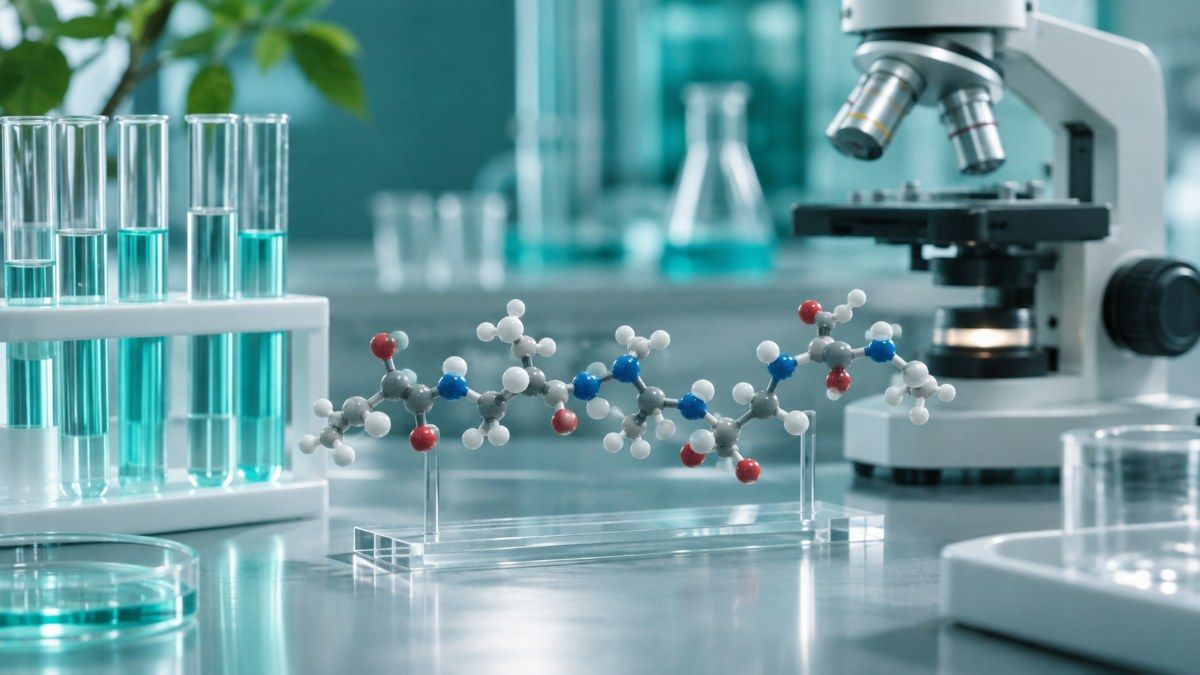
TB-500 is a synthetic peptide fragment of thymosin beta-4: when an anti-doping laboratory in Ghent analysed a product sold as TB-500, the active ingredient was Ac-LKKTETQ, a chain of just seven amino acids copied from positions 17 to 23 of the natural protein, sold as a veterinary or 'research' product, never tested in humans, not approved by the FDA, and banned in sport by the World Anti-Doping Agency (WADA) under class S2. Thymosin beta-4 itself is a small protein your body makes naturally. Most healing claims for TB-500 come from animal studies of that full-length protein, and the human trials that exist also used the full protein, not TB-500, and mostly missed their main goals. As of November 2026, a draft US policy would let some pharmacies compound TB-500 under conditions, but that is not FDA approval. This guide covers what TB-500 is, the evidence, its legal and sporting status, and the safety unknowns.
What Is TB-500? The Short Answer
- 1What it is: a synthetic seven-amino-acid fragment (Ac-LKKTETQ) of the natural protein thymosin beta-4, which has 43 amino acids.
- 2Human evidence: none for TB-500 itself; human trials used full thymosin beta-4 and mostly missed their primary endpoints.
- 3Animal evidence: faster wound healing, heart repair and ligament healing in rats and mice, almost all with the full protein.
- 4Legal status: not FDA-approved; an October 28, 2026 HHS draft policy lists it for possible pharmacy compounding, with comments due November 13, 2026.
- 5Sport: banned at all times under WADA class S2; athletes have received multi-year bans.
- 6Safety: largely unknown, with no direct cancer data for TB-500 and real concerns about grey-market product quality.
What Is Thymosin Beta-4, and What Does It Do in the Body?
Thymosin beta-4 is a 43-amino-acid protein, made from the TMSB4X gene and found in most cells. Its main job is to bind actin, the protein that forms the flexible scaffolding inside cells. By holding actin units in reserve, it helps cells reshape that scaffolding so they can move, which is why researchers studied it for wound healing: repair depends on cells migrating into damaged tissue.
The protein is also cut into smaller pieces in the body. One of these, a four-amino-acid fragment called Ac-SDKP from the very start of the chain, has anti-inflammatory and anti-scarring effects in lab studies. Ac-SDKP is not TB-500: it comes from positions 1 to 4, while TB-500 comes from positions 17 to 23.
Is TB-500 the Same as Thymosin Beta-4?
No, although the names are often used as if they were. In 2012, the Ghent doping-control laboratory analysed a product sold online as TB-500 and labelled 'for veterinary use only'. It contained no intact thymosin beta-4. Instead, the active ingredient was Ac-LKKTETQ, the acetylated stretch of residues 17 to 23 that the authors described as the major actin-binding site of the protein. An equine doping-control paper the same year likewise called TB-500 a synthetic version of an active region of thymosin beta-4. Some labels and documents use 'TB-500' loosely, so a vial with that name may not contain what you expect.
Thymosin beta-4 vs TB-500
What it is
Natural protein made by the body (TMSB4X gene)
Synthetic fragment, Ac-LKKTETQ (residues 17–23)
Length
43 amino acids, about 4,921 g/mol
7 amino acids, about 889 g/mol
Human trials
Phase 1 to Phase 3 (RegeneRx products)
None
Approval for human use
Not approved anywhere
Not approved anywhere
WADA status
Banned, class S2
Banned, class S2 (named as a derivative)
Where Did TB-500 Come From?
TB-500 appeared as a product rather than as a medicine developed through clinical trials. The Ghent analysis found it sold with a veterinary-only label but also marketed online to anyone. Laboratories that test racehorses published a detection method for it in 2012, a sign that it was already on the radar of racing regulators. Today it is mostly sold as a 'research peptide', a label that sidesteps medical claims. It never went through drug testing, so there is no official information on purity or long-term effects.
What Does TB-500 Do? What the Animal Studies Show
Most of what people say TB-500 does comes from animal experiments using full-length thymosin beta-4, not the fragment:
- 1Skin wounds in rats: thymosin beta-4 increased regrowth of the skin surface by 42% at day 4 and up to 61% at day 7 compared with saline, and wounds contracted at least 11% more (Malinda, 1999).
- 2Heart attack in mice: treated mice had an ejection fraction (the share of blood the heart pumps out with each beat) of about 58% four weeks after a heart attack, against about 28% in untreated mice, with less scarring (Bock-Marquette, Nature 2004).
- 3Heart cells in mice: a 2007 Nature study found it activated heart progenitor cells and new blood vessel growth.
- 4Ligament in rats: a tiny local dose improved fibre organisation and strength of a healing knee ligament after four weeks (Xu, 2013).
- 5Muscle in mice: injured muscle releases more thymosin beta-4, which attracts muscle precursor cells to the area (Tokura, 2011).
Animal results often fail to carry over to people, and these do not show that the fragment sold as TB-500 does the same. We cover the muscle angle in more depth in TB-500 for muscle recovery.
Has TB-500 Been Tested in Humans?
No. We found no published human trial of TB-500 itself. The Ghent researchers noted that data on how it behaves in the body were lacking. What has been tested in humans is full-length thymosin beta-4, developed by the company RegeneRx, and the results are much weaker than marketing suggests:
- 1Safety study: 40 healthy volunteers received intravenous thymosin beta-4 at four dose levels, then daily for 14 days. Side effects were mild to moderate, with no serious events (2010).
- 2Leg ulcers: in a Phase 2 trial of 72 people with venous leg ulcers, complete healing occurred in 33% on the middle gel dose against 24% on placebo; none of the differences was statistically significant (2009).
- 3Dry eye, Phase 2: in 72 people, both main endpoints missed significance, though some secondary measures of discomfort improved (2015).
- 4Dry eye, Phase 3 (ARISE-2): in 601 people the company said the trial did not reproduce earlier results, although eye discomfort improved at day 15 (2017).
- 5Dry eye, Phase 3 (ARISE-3): in about 700 people, eye discomfort improved at day 15; a pre-approval FDA meeting was planned for 2022, and no approval has followed as of November 2026.
A decade of human research on the parent protein produced, at best, modest effects on eye discomfort, and nothing on muscles, tendons or the heart.
What Does TB-500 Do for Bodybuilders? Claim vs Evidence
Lifters usually take TB-500 for injury recovery, often with BPC-157 in the so-called Wolverine stack. How the claims hold up:
TB-500 claims vs the evidence
Heals wounds and injuries faster
Rat skin wounds: +42% to +61% regrowth (full Tβ4)
Leg ulcer trial (n=72): 33% vs 24% healed, not significant (full Tβ4)
Repairs the heart
Mouse heart attack: ejection fraction about 58% vs 28% (full Tβ4)
No human heart trials
Heals tendons and ligaments
Rat knee ligament: better fibre organisation at 4 weeks (full Tβ4)
No human trials
Builds or repairs muscle
Mouse: attracts muscle precursor cells after injury (full Tβ4)
No human trials; no muscle-growth data
Is safe
Not established for TB-500
IV safety study in 40 volunteers (full Tβ4 only); nothing for TB-500
If you are comparing options, our guide to BPC-157 vs TB-500 sets out how thin the human evidence is for both, and BPC-157 for tendon recovery looks at the tendon claims specifically.
Is TB-500 Legal? FDA Status and the 2026 HHS Policy
TB-500 is not approved by the FDA or any other regulator for human use. After an April 2026 notice, the FDA planned to remove it from its list of compounding substances with safety concerns and sent it to an advisory committee, which met on July 23, 2026. Law firm Frier Levitt notes that removal does not, by itself, allow compounding.
On October 28, 2026, the Department of Health and Human Services (HHS) announced a draft enforcement-discretion policy, published in the Federal Register on October 30. According to a summary by law firm Arnold & Porter, it covers TB-500, BPC-157 and several other peptides, and would let licensed 503A pharmacies compound them for individual patients under ten conditions, including a patient-specific prescription, ingredients from FDA-registered manufacturers, a single active ingredient and reporting of side effects. Comments are due November 13, 2026. AJMC reports that the policy does not grant FDA approval or establish clinical safety and effectiveness, and that FDA career staff recommended against listing these peptides. It is still a draft and does not make 'research peptide' websites legal sources.
The picture for BPC-157 is similar, as explained in is BPC-157 legal.
Is TB-500 Banned in Sport?
Yes. WADA's 2026 Prohibited List names 'thymosin-beta-4 and its derivatives, e.g. TB-500' in class S2 (peptide hormones, growth factors and related substances). It is banned in and out of competition, and national anti-doping agencies say therapeutic use exemptions are not available. Verified cases include:
- 1USADA, September 2025: triathlete Anthony McCauley accepted a four-year ban for possessing and using BPC-157 and TB-500 and promoting them on social media.
- 2New Zealand, May 2025: surf lifesaver Morgan Foster received a three-year ban after customs intercepted TB-500, BPC-157, tesamorelin and ipamorelin.
- 3Essendon AFL, January 2016: the Court of Arbitration for Sport banned 34 players for two years over thymosin beta-4. The ruling concerned thymosin beta-4 and does not name TB-500.
What Are the Risks and Unknowns of TB-500?
Nobody knows the risks of TB-500 in people, because it has never been studied in them; the only human safety study used a different molecule. What we can say:
- 1Cancer: there are no direct cancer data for TB-500. Sport Integrity Australia flags concern that thymosin beta-4 may promote the spread and growth of cancer cells, and thymosin beta-4 levels have been studied as a marker of outcome in head and neck cancer. Because it encourages new blood vessels, it raises the same theoretical question discussed in does BPC-157 cause cancer.
- 2Product quality: the Ghent lab found a product sold as thymosin beta-4's 'active region' contained no thymosin beta-4 at all. Grey-market vials may be mislabelled, underdosed or contaminated.
- 3Injection risks: unsterile products injected under the skin or into muscle can cause infection or reactions.
- 4Stacking: combining unapproved peptides multiplies the unknowns; see BPC-157 side effects.
When to Talk to Your Doctor
- 1You use or are considering TB-500 and have a personal or family history of cancer.
- 2You notice redness, swelling, warmth or pus at an injection site, or you develop a fever.
- 3An injury is not improving after a few weeks.
- 4You are pregnant, trying to conceive or breastfeeding.
- 5You compete in a tested sport and are unsure whether something you take is banned.
What to Do Next: Questions to Ask Your Doctor
If an injury is driving your interest, start with a diagnosis, because a strain, a partial tear and tendinopathy are treated differently. Questions to ask:
- 1What is the injury, and what does the evidence say about rehab, loading programmes or physiotherapy for it?
- 2Are there approved treatments, such as specific injections or procedures, that fit my case?
- 3If I am considering a compounded peptide under the new HHS policy, what is known about its safety, and who would monitor me?
- 4Would my conditions or medicines make an experimental peptide riskier?
- 5Is anything I take banned by my sport's testing body?
For background on the peptide most often paired with TB-500, see what is BPC-157.
The Bottom Line
TB-500 is a short synthetic piece of thymosin beta-4 that has never been tested in humans. Its reputation rests on animal research with the full protein, whose human trials showed little beyond modest dry-eye effects. It is not FDA-approved; a draft HHS policy from October 2026 may open a narrow compounding route, but HHS itself says that is not approval. It is banned in sport, and its long-term safety, including any cancer risk, is unknown.
FAQ
No. TB-500 is a peptide, a short chain of amino acids, copied from part of the natural protein thymosin beta-4. It is not a steroid or SARM, but it is still banned in sport.
It can. Anti-doping laboratories have published detection methods for TB-500 in humans and horses, and athletes have been sanctioned for it. It is banned at all times under WADA class S2.
No. TB-500 is not approved by the FDA or any other regulator for human use. The October 2026 HHS draft policy on compounding does not grant approval, as of November 2026.
No. TB-500 is a fragment of thymosin beta-4, while BPC-157 is a 15-amino-acid peptide derived from a stomach protein. Neither is approved for human use.
It is unknown. There are no direct cancer studies of TB-500. Sport Integrity Australia has raised concern that thymosin beta-4 may promote cancer growth, so people with a cancer history should be especially cautious.
No. The draft policy, with comments due November 13, 2026, would only let licensed pharmacies compound it for individual patients with a prescription under conditions. It does not legalise 'research peptide' sales.
Sources
- 1Esposito S et al. Synthesis and characterization of the N-terminal acetylated 17-23 fragment of thymosin beta 4 identified in TB-500, a product suspected to possess doping potential, Drug Testing and Analysis, 2012
- 2Ho EN et al. Doping control analysis of TB-500, a synthetic version of an active region of thymosin beta-4, in equine urine and plasma, Journal of Chromatography A, 2012
- 3Safer D, Elzinga M, Nachmias VT. Thymosin beta 4 and Fx, an actin-sequestering peptide, are indistinguishable, Journal of Biological Chemistry, 1991
- 4Kumar N et al. The anti-inflammatory peptide Ac-SDKP is released from thymosin-beta-4 by renal meprin-alpha and prolyl oligopeptidase, American Journal of Physiology: Renal Physiology, 2016
- 5A randomized, placebo-controlled, single and multiple dose study of intravenous thymosin beta-4 in healthy volunteers, Annals of the New York Academy of Sciences, 2010
- 6Sosne G et al. Thymosin beta-4 ophthalmic solution for dry eye: a randomized, placebo-controlled Phase II trial, Clinical Ophthalmology, 2015
- 7Malinda KM et al. Thymosin beta-4 accelerates wound healing, Journal of Investigative Dermatology, 1999
- 8Bock-Marquette I et al. Thymosin beta-4 activates integrin-linked kinase and promotes cardiac cell migration, survival and cardiac repair, Nature, 2004
- 9Smart N et al. Thymosin beta-4 induces adult epicardial progenitor mobilization and neovascularization, Nature, 2007
- 10Xu B et al. Thymosin beta-4 enhances the healing of medial collateral ligament injury in rat, Regulatory Peptides, 2013
- 11Tokura Y et al. Muscle injury-induced thymosin beta-4 acts as a chemoattractant for myoblasts, Journal of Biochemistry, 2011
- 12Chi LH et al. Global proteomics-based identification and validation of thymosin beta-4 X-linked as a prognostic marker for head and neck squamous cell carcinoma, Scientific Reports, 2017
- 13RegeneRx. Results of ARISE-3 dry eye trial (SEC exhibit), RegeneRx Biopharmaceuticals, 2021
- 14RegeneRx JV announces results of ARISE-2 dry eye trial, BioSpace, 2017
- 15RegeneRx reports Phase II venous stasis trial results, Fierce Biotech, 2009
- 16Thymosin beta-4 substance education, Sport Integrity Australia
- 17Anthony McCauley accepts doping sanction, USADA, 2025
- 18Athlete sanctioned for trafficking banned substances, Sport Integrity Commission New Zealand, 2025
- 19Australian football rocked by dozens of drug bans, SBS News, 2016
- 20HHS announces draft enforcement discretion policy paving way for pharmacies, Arnold & Porter, 2026
- 215 things to know about HHS's interim peptide compounding policy, AJMC, 2026
- 22HHS lets pharmacies compound peptides as FDA writes official rule, Drug Topics, 2026
- 23FDA peptides do-not-compound list update 2026, Frier Levitt, 2026
This article summarizes published research and regulatory information for general information only; it is not medical advice. The human trials of thymosin beta-4 cited here were sponsored by RegeneRx, the company developing it.

Dr. Andrii Kaleniuk
Author
Comments (0)
Be the first to comment on this article.
More articles