Is BPC-157 Legal in 2026? FDA Status, the July Committee Vote, Sport Bans and the Rules by Country
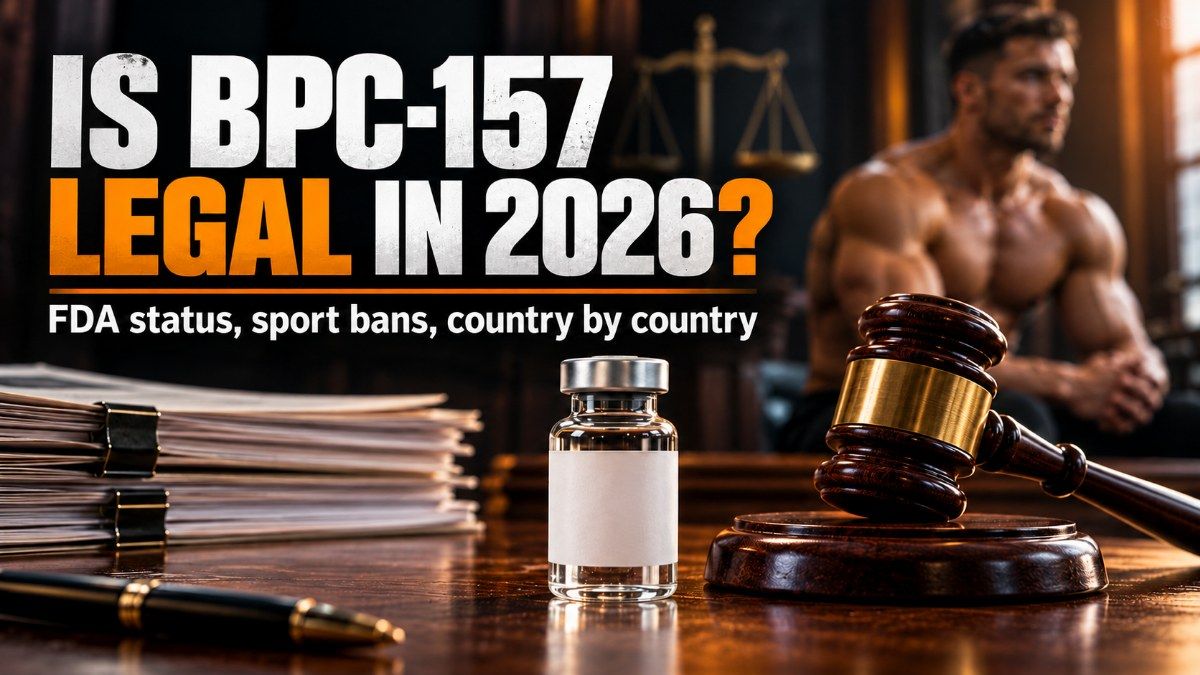
Is BPC-157 legal in 2026? Legal to possess in the US, illegal to sell for human use, not yet compoundable despite a July FDA committee vote, banned by WADA.
Written by Dr. Andrii Kaleniuk. Updated October 26, 2026.
BPC-157 is legal to possess in the United States in 2026, illegal to sell for human use, banned in every sport that follows the World Anti-Doping Agency list, and, as of this writing, in a regulatory limbo that an FDA advisory committee voted to end in July 2026 but the agency has not yet acted on. Those four statements are all true at once, which is why the question gets such different answers depending on who is asked. A lifter buying a vial labelled for research is not committing a crime. The company selling it is. A tested athlete using it will fail a doping control. A compounding pharmacy filling a prescription for it is, on current rules, outside the law. And a year from now, if the FDA follows its committee's advice, that last point may flip.
This article sets out the status for each kind of person who asks the question, the timeline from 2023 to the expected 2027 decision, what the July 2026 vote did and did not change, how other countries treat it, and what the legal position means for safety, which is a separate matter.
Is BPC-157 Legal in 2026? The Short Answer
- 1Not approved: BPC-157 has never been approved as a medicine anywhere. In the US it is an unapproved new drug, which makes marketing it for human use illegal.
- 2Not controlled: it is not a scheduled substance under the Controlled Substances Act. Buying or possessing it for personal use is not a federal crime.
- 3Not compoundable, for now: in April 2026 the FDA removed it from Category 2 of its compounding list (the category that signals safety concerns), but it has not been placed on the Category 1 or the final 503A bulks list that would allow pharmacies to compound it.
- 4Committee vote, July 23, 2026: the FDA's Pharmacy Compounding Advisory Committee voted 8 to 6, with one abstention, to recommend adding BPC-157 to the 503A bulks list. The vote is advisory. FDA staff had recommended against. Rulemaking typically takes 6 to 12 months or more.
- 5Banned in sport: prohibited by WADA since 2022 under the S0 category for non-approved substances, and on the US Department of Defense's prohibited list for service members.
- 6Elsewhere: prescription-only in Australia, unlicensed in the UK and EU, not approved in Canada.
Who Is Asking? Legal Status by Role
BPC-157 legal status in the United States, October 2026
An individual buying it for personal use
Possession is not a federal offence; no scheduling under the CSA
Not a crime, but you are buying an unapproved, untested product with no legal recourse if it is mislabelled
A tested athlete (WADA, USADA, NCAA, most pro leagues)
Prohibited at all times under S0
A positive test or an admission is a doping violation; 'research chemical' labelling is no defence
A US service member
On the DoD prohibited dietary supplement ingredient list
Use can be a disciplinary matter regardless of civilian legality
A clinic or doctor prescribing it
Prescribing is not itself illegal, but no legal source exists: it cannot be compounded under 503A and no approved product exists
Prescriptions filled from research-chemical suppliers expose the prescriber to FDA and state board action
A compounding pharmacy
Not on the 503A bulks list; no USP monograph; not an approved drug: all three 503A pathways are closed
Compounding it is unlawful until FDA completes rulemaking, if it does
A seller or 'research' supplier
Marketing for human use is marketing an unapproved new drug; 'research use only' labels do not protect sales intended for human use
FDA warning letters and seizures; a major online peptide seller received a warning letter in March 2026
A supplement company
Cannot be a dietary supplement ingredient: it was first studied as a drug and is not a food substance
Products listing it are adulterated
The Timeline: How BPC-157 Got Here
BPC-157 regulatory timeline, 2022 to 2027
January 2022
WADA Prohibited List explicitly lists BPC-157 as an example under S0, non-approved substances
Banned in all WADA-code sports at all times
September 2023
FDA places BPC-157 in Category 2 of the 503A bulk drug substances evaluation list, citing safety concerns and lack of human data
Compounding pharmacies told not to use it; clinics largely stopped
2024 to 2025
FDA warning letters to compounders and online sellers; FDA consumer notices on unapproved peptides
Enforcement targets sellers and pharmacies, not individual buyers
March 31, 2026
FDA warning letter to a prominent online peptide seller for marketing unapproved peptides, including BPC-157, for human use
Signals continued action against the 'research use only' model
April 15 to 22, 2026
FDA removes 12 peptides, including BPC-157, from Category 2 after the original nominators withdraw their nominations; effective April 22
A procedural change, not a safety clearance; BPC-157 is now in no category
July 23, 2026
Pharmacy Compounding Advisory Committee votes 8 to 6 (1 abstention) to recommend adding BPC-157 to the 503A bulks list, against FDA staff advice
Advisory only; starts a rulemaking process if FDA accepts it
Late 2026 to 2027
Expected: FDA decision and, if favourable, proposed rule, public comment, final rule
Until a final rule, nothing has changed for pharmacies
What the July 2026 Vote Actually Decided
The committee was not asked whether BPC-157 is safe and effective in the sense that an approved drug must be. It was asked whether the substance should be added to the list of bulk ingredients that licensed pharmacies may compound for individual patients under Section 503A, a lower bar that weighs physical characteristics, safety, effectiveness and historical use. FDA's own reviewers recommended against all seven peptides under consideration that week, pointing to the absence of controlled human trials; the evidence for BPC-157 is almost entirely from rodents. The committee split, and the supporters argued that the risks appeared low and that patients were already using black-market product with no quality control. Opponents warned that listing would create a false impression that the peptide had been evaluated to the standard of an approved medicine. An 8 to 6 vote with an abstention is not a strong mandate, and the FDA is not bound by it. Even if the agency agrees, the step from recommendation to a final rule involves a published proposal, a comment period and a final notice, which for previous substances has taken six to twelve months and frequently longer.
Two things did not change on July 23. BPC-157 did not become an approved drug and will not through this process; 503A listing only allows pharmacy compounding. And it did not become legal to compound or sell that day; lawyers advising clinics have been clear that the pause on prescribing and dispensing should hold until the substance actually appears on the list.
Why Removal From Category 2 Is Not a Green Light
The April 2026 removal has been widely misread as the FDA clearing BPC-157. It was nothing of the kind. Category 2 is where the agency puts nominated substances it considers to raise significant safety risks pending full review. The nominations for BPC-157 and eleven other peptides were withdrawn by the parties who had submitted them, and with no live nomination there was nothing to categorise. The agency said explicitly that this was not a safety determination. The result is a gap: BPC-157 is not in Category 1 (which permits compounding during review under enforcement discretion), not in Category 2, and not on the final list. For a pharmacy, no category is the same as no permission.
Is It Legal to Buy BPC-157 Online?
For the buyer, yes, in the narrow sense that no federal law criminalises possession of a non-scheduled unapproved drug for personal use, and prosecutions of individual purchasers do not happen. For the seller, no: the FDA's position is that peptides sold with dosing suggestions, injection instructions, or testimonials about human effects are being marketed for human use regardless of the 'research use only' sticker, and that makes them unapproved new drugs. Customs can seize imported shipments. None of this protects the buyer from the actual risk, which is the product: independent testing of grey-market peptides has repeatedly found underdosing, wrong peptides, bacterial contamination and endotoxin in vials intended for injection. The legal question and the safety question are different, and the second is covered in BPC-157 side effects. We do not provide sourcing or dosing guidance for unapproved products.
Is BPC-157 Legal in Sport?
No, anywhere that follows the WADA code, and the ban is total: in and out of competition, by any route. BPC-157 is one of the named examples under S0, the category for substances not approved for human use by any regulator. The practical trap for tested athletes is that S0 substances do not need a dedicated test; an admission on social media, a purchase record or a whereabouts investigation is enough for a violation, and several sanctions have followed exactly that path. The NCAA's banned-drug classes include peptide hormones and growth factors and, in practice, non-approved substances; most professional leagues incorporate the WADA list. US service members are covered separately by the Department of Defense's Operation Supplement Safety list, which prohibits BPC-157 outright. Non-tested lifters are not bound by any of this, but the ingredient-quality problem applies to them just the same; our bodybuilding peptides guide sets out the status of each compound.
How Other Countries Treat BPC-157
BPC-157 outside the United States
Australia
Schedule 4 (prescription-only) since 2023
Possession without a prescription is an offence; the TGA has issued warnings about online supply
United Kingdom
Unlicensed medicine
Selling or supplying for human use without authorisation is an offence; personal import for own use is a grey area; banned in UKAD-tested sport
European Union
Not authorised by the EMA or any national agency
Treated as an unapproved medicine; enforcement varies by member state
Canada
Not approved by Health Canada
Sale for human use is prohibited; Health Canada has seized products from online sellers
Worldwide sport
WADA S0 prohibited
Applies regardless of national law
The pattern is consistent: no country has approved it, several have moved to restrict it, and none treat personal possession as a serious crime. Rules change; the Australian scheduling is the clearest example of a country tightening quickly once online use became visible.
What Would Have to Happen for BPC-157 to Be Fully Legal?
Two separate paths exist and they lead to different places. The compounding path, now in motion, ends with pharmacies being allowed to make BPC-157 to order for patients with a prescription. That would make prescribing and dispensing lawful but would not make BPC-157 an approved drug, would not create a standard dose or indication, and would not change its sports status, because S0 covers substances not approved for human use. The approval path, which nobody is currently on, would require a company to run controlled human trials and submit a new drug application; given that the peptide is not patentable in its original form, there is little commercial incentive. The most likely 2027 outcome is therefore a legal compounded product with no approved use, which is roughly the position sermorelin has occupied for years. How BPC-157 compares with its usual companion in that market is in BPC-157 vs TB-500.
Does Legal Status Say Anything About Safety?
Less than people assume in both directions. Illegality of sale reflects the absence of approval, not evidence of harm; approval is a process, and BPC-157 has simply never been put through it. Equally, the committee's judgment that risks appear low rests on rodent studies, case reports and the absence of signals in a population that is not systematically monitored, which is a weak basis. What is known about adverse effects, interactions and the unanswered questions on long-term use is set out separately. The specific recovery claims that drive demand, for tendons, shoulders and muscle, are examined with the actual evidence in BPC-157 for tendon recovery and BPC-157 for shoulder pain, and the combination most often sold is discussed in the Wolverine stack.
When to Talk to Your Doctor
- 1If you are a tested athlete who has used or been offered BPC-157: an anti-doping violation can follow an admission as easily as a test
- 2If a clinic has offered you BPC-157 by prescription: ask where it will be dispensed from, since no lawful compounded source exists in the US as of October 2026
- 3If you have used a grey-market product and have fever, injection-site infection, unexplained symptoms or a new or growing lump: these need evaluation and the doctor needs to know what was injected
- 4If you are considering it for an injury: approved and evidence-based options for tendon and joint recovery exist and can be discussed first
- 5If you are outside the US: the rules in Australia and the UK differ materially from the American position described here
The Bottom Line
In October 2026, BPC-157 is legal to own, illegal to sell for human use, impossible to obtain lawfully through a pharmacy, and banned in tested sport. The April removal from Category 2 was procedural and the July committee vote was advisory; the first did not clear it and the second has not yet changed any rule. If the FDA accepts the recommendation and completes rulemaking, which could happen in 2027, compounding pharmacies will be able to make it on prescription, and that will be the first lawful route to the peptide in the US. It will still not be an approved medicine, and it will still be prohibited for athletes. Anyone using it today is using an unapproved product of unverifiable quality, and the law is the least of the things that should give them pause.
FAQ
Possessing it is not a federal crime, as it is not a controlled substance. Selling it for human use is illegal because it is an unapproved new drug. It cannot currently be compounded by pharmacies. An FDA advisory committee voted in July 2026 to recommend allowing compounding, but the FDA has not yet acted.
No. In April 2026 the FDA removed it from Category 2 of its compounding list after nominations were withdrawn, which was procedural, and in July 2026 an advisory committee recommended adding it to the compounding bulks list by an 8 to 6 vote. Neither step is an approval, and the committee's vote is not binding.
Yes. It is prohibited at all times under category S0 for non-approved substances and has been named as an example on the Prohibited List since 2022. Admissions or purchase records can be used as evidence of a violation.
A doctor can write the prescription, but as of October 2026 there is no lawful US source to fill it: no approved product exists and compounding pharmacies cannot make it until the FDA completes rulemaking. Prescriptions filled from research-chemical suppliers put the prescriber at regulatory risk.
In the UK it is an unlicensed medicine; supply for human use is an offence and it is banned in tested sport. In Australia it is a Schedule 4 prescription-only substance since 2023, so possession without a prescription is an offence.
If the FDA accepts its committee's July 2026 recommendation, it must publish a proposed rule, take public comment and issue a final rule, a process that has historically taken six to twelve months or longer. A 2027 decision is plausible but not guaranteed, and the FDA could also decline.
Sources
- 1FDA advisory committee votes to add popular peptide BPC-157 to drug compounding list, ABC News / Good Morning America, July 2026
- 2Regulatory alert: FDA's April 2026 update on BPC-157 and GHK-Cu, DJ Holt Law, 2026
- 3Bulk drug substances nominated for use in compounding under Section 503A, U.S. Food and Drug Administration
- 4BPC-157: experimental peptide creates risk for athletes, U.S. Anti-Doping Agency
- 5The Prohibited List, World Anti-Doping Agency
- 6BPC-157: a prohibited peptide and an unapproved drug found in health and wellness products, Operation Supplement Safety, U.S. Department of Defense
- 7Sikiric P et al. Stable gastric pentadecapeptide BPC 157: novel therapy in gastrointestinal tract, Current Pharmaceutical Design, 2011
This article describes the regulatory position as of October 2026 for general information. It is not legal advice, and rules change; check the FDA's current compounding lists and your sport's anti-doping rules.

Dr. Andrii Kaleniuk
Author
Comments (0)
Be the first to comment on this article.
More articles