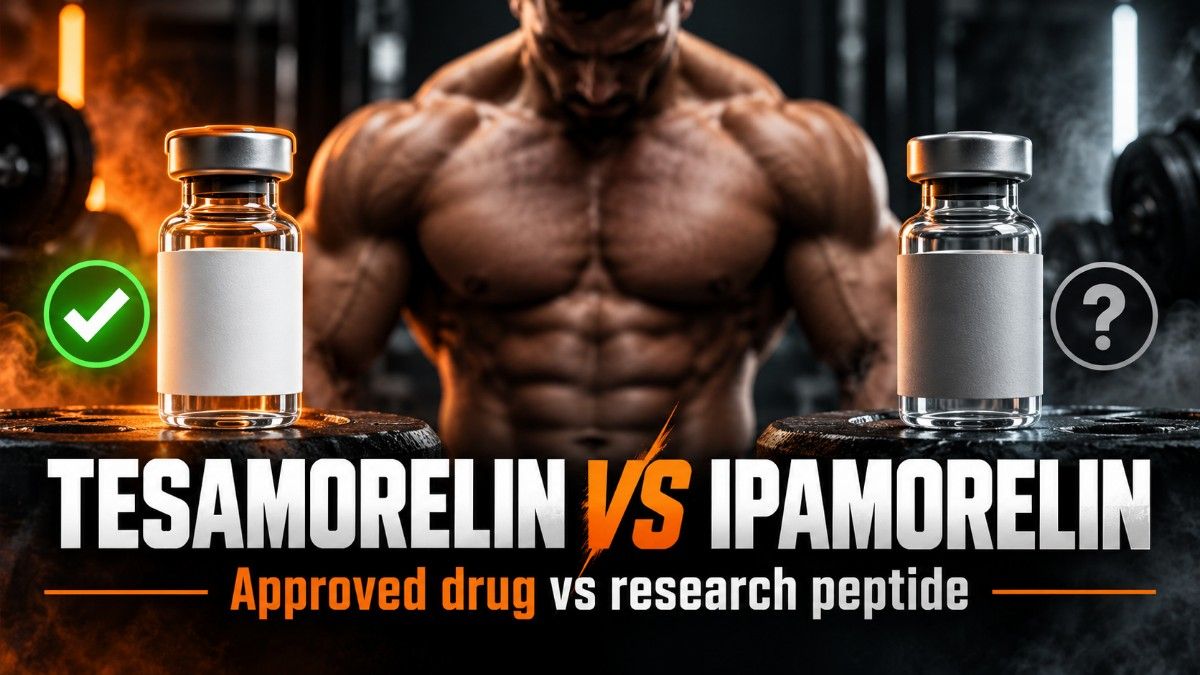
Tesamorelin vs Ipamorelin: Approved Drug vs Research Peptide, Compared on the Evidence
Tesamorelin vs ipamorelin: how each raises growth hormone, what trials prove for fat, muscle and sleep, side effects, FDA and WADA status in 2026, the stack.
Written by Dr. Andrii Kaleniuk. Updated October 24, 2026.
Tesamorelin and ipamorelin both raise your own growth hormone, but they are not in the same category. Tesamorelin is an FDA-approved prescription drug (Egrifta) with Phase 3 trials showing it cuts deep belly fat by about 15% in adults with HIV, and a newer weekly-reconstituted version approved in 2025. Ipamorelin is an abandoned drug candidate with one short placebo-controlled trial, no approval anywhere, and an FDA listing as a compounding substance that may present significant safety risks. Both are banned by WADA. No trial has ever tested them together.
This comparison lays out how each works, what the human evidence actually shows for fat loss, muscle, recovery and sleep, the side effects and legal status of each as of October 2026, and who should avoid them. It does not include dosing, because tesamorelin's only established dose is for a medical condition and ipamorelin has none.
Tesamorelin vs Ipamorelin: The Short Answer
- 1Tesamorelin is a GHRH analogue: it acts on the pituitary the way the hypothalamus does, producing natural pulses of growth hormone. Ipamorelin is a ghrelin mimetic (a GHRP): it acts on a different receptor to trigger a GH pulse.
- 2Evidence: tesamorelin has two Phase 3 trials (816 patients) and an FDA label; ipamorelin has one Phase 2 trial in surgical patients and animal data.
- 3What tesamorelin is proven to do: reduce visceral (deep abdominal) fat by about 15% over 26 weeks in people with HIV lipodystrophy, with modest improvements in triglycerides. Muscle gain is not an approved claim.
- 4What ipamorelin is proven to do in humans: raise growth hormone acutely and be well tolerated for a week. Nothing about fat, muscle or sleep has been shown in a controlled trial.
- 5Side effects: tesamorelin's are documented (joint pain, swelling, injection-site reactions, raised blood sugar); ipamorelin's come from user reports.
- 6Legal: tesamorelin is prescription-only and off-label outside HIV; ipamorelin is unapproved and sold as a "research chemical." Both are prohibited in sport under WADA section S2.
- 7Stacking them is a clinic protocol, not a studied one.
What Tesamorelin Is
Tesamorelin is a synthetic version of growth-hormone-releasing hormone (GHRH), the signal the hypothalamus sends to the pituitary gland to release growth hormone. It is 44 amino acids long with a modification that stops it being broken down within minutes, so one injection produces a sustained release of the body's own GH and, downstream, IGF-1. Because it works through the normal feedback system, GH does not rise to the levels seen with GH injections.
It was developed by Theratechnologies for a specific problem: the buildup of visceral fat in people with HIV on antiretroviral therapy (lipodystrophy). FDA approved it as Egrifta in November 2010 for that indication, and in March 2025 approved Egrifta WR, a formulation reconstituted once a week and injected daily, which replaced the older daily-reconstitution product. We cover its fat-loss data in tesamorelin for fat loss.
What Ipamorelin Is
Ipamorelin is a five-amino-acid peptide developed in the 1990s by Novo Nordisk as a growth hormone secretagogue. It mimics ghrelin, the hunger hormone, at the GHS-R1a receptor in the pituitary and hypothalamus, triggering a pulse of GH. Its selling point in animal studies was selectivity: unlike the older peptides GHRP-2 and GHRP-6, it raised GH without raising cortisol or ACTH, even at high doses.
Novo Nordisk later tested it in hospital patients for post-surgical bowel paralysis, and when that failed, development stopped. It has never been approved for anything. Everything sold today comes from peptide vendors or compounding pharmacies, and its reputation for muscle, recovery and sleep rests on theory and user reports. See ipamorelin for bodybuilding and ipamorelin side effects.
Tesamorelin vs Ipamorelin: Side by Side
Tesamorelin vs ipamorelin at a glance (October 2026)
Class
GHRH analogue
Ghrelin mimetic / GHRP
Receptor
GHRH receptor (pituitary)
GHS-R1a (pituitary and hypothalamus)
Regulatory status
FDA-approved (Egrifta, 2010; Egrifta WR, 2025)
Not approved anywhere; FDA compounding Category 2 (may present significant safety risks)
Approved use
Reduce excess abdominal fat in adults with HIV and lipodystrophy
None
Human trials
Two Phase 3 trials, 816 patients, 26 to 52 weeks; multiple smaller studies
One Phase 2 trial, 114 surgical patients, up to 7 days; small GH-release studies
Proven effect
Visceral fat down about 15%; triglycerides down; IGF-1 up
GH rises acutely; well tolerated for one week
Effect on muscle
Lean mass slightly up in trials, not an approved claim
Not studied in humans
Effect on sleep
Not studied as an outcome
Not studied; claims come from GH biology
Documented side effects
Joint pain, limb swelling, muscle pain, tingling, injection-site reactions, raised blood sugar; rare allergic reactions
User-reported: headache, flushing, nausea, water retention, hunger, injection-site reactions
Effect on cortisol / appetite
No increase
No cortisol increase in animals; hunger can rise (ghrelin effect)
How it is obtained
Prescription; expensive (list price several thousand dollars a month)
Unregulated vendors, some compounding pharmacies
WADA
Prohibited (S2)
Prohibited (S2)
Fat Loss: What the Evidence Says
This is tesamorelin's home ground. In two Phase 3 trials published in 2010, 816 adults with HIV and excess abdominal fat received tesamorelin or placebo for 26 weeks. Visceral fat, measured by CT scan, fell by about 15% with tesamorelin and rose slightly with placebo; triglycerides fell and waist size shrank. When treatment stopped, the fat came back within six months, so the effect depends on continued use. A separate study found tesamorelin also reduced liver fat in people with HIV and fatty liver disease.
Whether that translates to people without HIV is less certain. The mechanism, raising GH and IGF-1 to mobilize visceral fat, is not HIV-specific, and small studies in the general population have shown similar directions of effect, but there is no Phase 3 trial of tesamorelin for ordinary belly fat, and the drug is not approved for it. Ipamorelin, by contrast, has no human fat-loss data at all. Any claim that it "burns fat" is extrapolated from what GH does in general.
Muscle and Recovery: What the Evidence Says
Neither peptide has been shown to build muscle in a controlled human trial. Tesamorelin trials recorded a small increase in lean mass alongside fat loss, which is consistent with higher GH and IGF-1, but strength and performance were not measured. The broader GH literature is sobering: a 2008 systematic review of GH in healthy adults found more lean mass but no gain in strength or exercise capacity, with more swelling and fatigue. Ipamorelin's recovery and muscle reputation comes from forums and from clinics that sell it. We examine the stacking claims in CJC-1295 + ipamorelin for muscle growth and CJC-1295 for muscle growth.
Sleep: What the Evidence Says
Ipamorelin is often recommended for sleep on the theory that GH pulses during deep sleep and ghrelin mimetics given at night amplify them. Studies of GHRPs and ghrelin do show more slow-wave sleep in some settings, but no trial has tested ipamorelin for sleep quality. Tesamorelin has not been studied for sleep either. Both effects, if real, are modest and indirect.
Side Effects and Risks
Tesamorelin's side effects are known because they were recorded in trials: joint pain (about 13%), swelling of the arms and legs, muscle aches, tingling, injection-site redness and itching, and increases in blood sugar. It can raise IGF-1 above the normal range, so levels are monitored, and it is contraindicated in active cancer, pregnancy and pituitary disease. Rare allergic reactions have been reported. It should not be used by people with diabetes without close monitoring.
Ipamorelin's trial data cover one week in hospital patients, where it was no worse than placebo. Beyond that, users report headache, flushing, dizziness, nausea, water retention, tingling, increased hunger and injection-site lumps. The deeper concerns are the ones that apply to any sustained GH increase: fluid retention, carpal tunnel symptoms, insulin resistance and theoretical effects on existing cancers, none of which has been studied for ipamorelin over months. Add to that the product-quality problem: vendor ipamorelin is not checked for purity, sterility or dose.
Legal Status in 2026
- 1Tesamorelin (Egrifta, Egrifta WR): FDA-approved prescription drug. Doctors can prescribe it off-label, for example for abdominal fat in people without HIV, but insurance will not cover that and the cost is high. It is not available from compounding pharmacies as a bulk substance for human use in the same way peptides like BPC-157 were.
- 2Ipamorelin: not approved by FDA or any regulator. FDA has placed ipamorelin acetate in Category 2 of its compounding bulk substances list for outsourcing facilities, citing limited safety data and significant safety risks. Selling it as a supplement or for human use is illegal; it is marketed as "research use only".
- 3Sport: WADA prohibits all growth hormone releasing factors, including GHRH analogues (tesamorelin) and GH secretagogues (ipamorelin), at all times under section S2. A therapeutic use exemption is possible for tesamorelin with a genuine HIV lipodystrophy diagnosis.
Can You Stack Tesamorelin and Ipamorelin?
Clinics and vendors offer the combination on the logic that a GHRH analogue and a ghrelin mimetic act on different receptors and produce a bigger GH pulse together than either alone. That synergy is real in the sense that GHRH plus GHRP combinations have been shown to amplify GH release in physiology studies. But no trial has tested tesamorelin with ipamorelin for any outcome, in anyone. Combining a prescription drug with an unapproved peptide means stacking a documented side-effect profile on top of an unknown one, and it is not something any label or guideline supports. Our tesamorelin vs CJC-1295 vs ipamorelin guide covers the three-way comparison people usually mean.
Who Should Avoid Both
- 1Anyone with an active or recent cancer, because GH and IGF-1 promote cell growth
- 2People with diabetes or prediabetes, unless under specialist supervision with glucose monitoring
- 3People who are pregnant or breastfeeding
- 4Anyone with pituitary disease or after pituitary surgery or radiation
- 5Tested athletes
- 6Anyone under 18
- 7People with heart failure or significant kidney disease, because of fluid retention
Which One Fits Your Goal?
- 1Stubborn visceral fat with a medical diagnosis (HIV lipodystrophy): tesamorelin is the only option with evidence and an approval, prescribed and monitored by a doctor.
- 2Belly fat without HIV: tesamorelin off-label has mechanistic support but no Phase 3 evidence, and it is expensive. An approved GLP-1 drug such as tirzepatide has far stronger weight-loss data.
- 3Muscle, recovery or sleep: neither peptide has human trial evidence. Training, protein and sleep hygiene remain the evidence-based tools; see sermorelin vs ipamorelin for how the "gentle" peptides compare with each other.
- 4Any goal while subject to drug testing: neither.
When to Talk to Your Doctor
- 1You have HIV and are gaining abdominal fat on treatment; tesamorelin may be appropriate and covered
- 2You are considering either peptide and have diabetes, a history of cancer, or heart or kidney disease
- 3You have used ipamorelin or tesamorelin and have persistent swelling, numbness in the hands, unusual thirst or frequent urination, or an injection site that is spreading or painful
- 4You want IGF-1 or fasting glucose checked before or during use
The Bottom Line
Tesamorelin is an approved drug that does one thing well: it reduces visceral fat in people with HIV lipodystrophy, with documented side effects and a prescription-only route. Ipamorelin is an abandoned drug candidate with a selective, well-tolerated GH-release profile over one week and no evidence for any of the benefits it is sold for. Comparing them as if they were two brands of the same product misleads. If you have a medical reason for tesamorelin, a doctor can prescribe it; if you are looking at ipamorelin for muscle, recovery or sleep, you are looking at a product whose benefits, risks and contents are all unverified.
FAQ
Tesamorelin is an FDA-approved GHRH analogue that stimulates growth hormone through the GHRH receptor and is proven to reduce visceral fat in HIV lipodystrophy. Ipamorelin is an unapproved ghrelin mimetic that triggers growth hormone through a different receptor and has no human efficacy data beyond raising GH.
Tesamorelin is the only one with evidence: about 15% less visceral fat over 26 weeks in Phase 3 trials in people with HIV. Ipamorelin has never been tested for fat loss in humans.
Neither has been shown in a controlled trial to improve sleep, muscle or recovery. Ipamorelin's reputation for these comes from theory and user reports, not studies.
Clinics offer the stack, and GHRH-plus-GHRP combinations do amplify growth hormone release in lab studies, but no trial has tested tesamorelin with ipamorelin for any outcome. It combines a prescription drug's known side effects with an unapproved peptide's unknown ones.
Tesamorelin is a prescription drug (Egrifta, Egrifta WR) approved for HIV lipodystrophy and prescribable off-label. Ipamorelin is not approved anywhere and is listed by FDA as a compounding substance that may present significant safety risks. Both are banned in sport under WADA section S2.
Sources
- 1Effects of tesamorelin (TH9507), a growth hormone-releasing factor analog, in HIV-infected patients with excess abdominal fat: a pooled analysis of two multicenter, double-blind placebo-controlled phase 3 trials, J Clin Endocrinol Metab, 2010
- 2Metabolic effects of a growth hormone-releasing factor in patients with HIV, NEJM, 2007
- 3Egrifta WR (tesamorelin for injection) prescribing information, Drugs.com
- 4Theratechnologies receives FDA approval for Egrifta WR, Theratechnologies, March 2025
- 5Ipamorelin, the first selective growth hormone secretagogue, Eur J Endocrinol, 1998
- 6Prospective, randomized, controlled, proof-of-concept study of the ghrelin mimetic ipamorelin for the management of postoperative ileus, Int J Colorectal Dis, 2014
- 7Systematic review: the effects of growth hormone on athletic performance, Ann Intern Med, 2008
- 8Certain Bulk Drug Substances for Use in Compounding that May Present Significant Safety Risks, U.S. FDA
- 92026 Prohibited List, World Anti-Doping Agency
This article is for information only. It is not medical advice and does not recommend using either substance outside a doctor's care.

Dr. Andrii Kaleniuk
Author
Comments (0)
Be the first to comment on this article.
More articles