
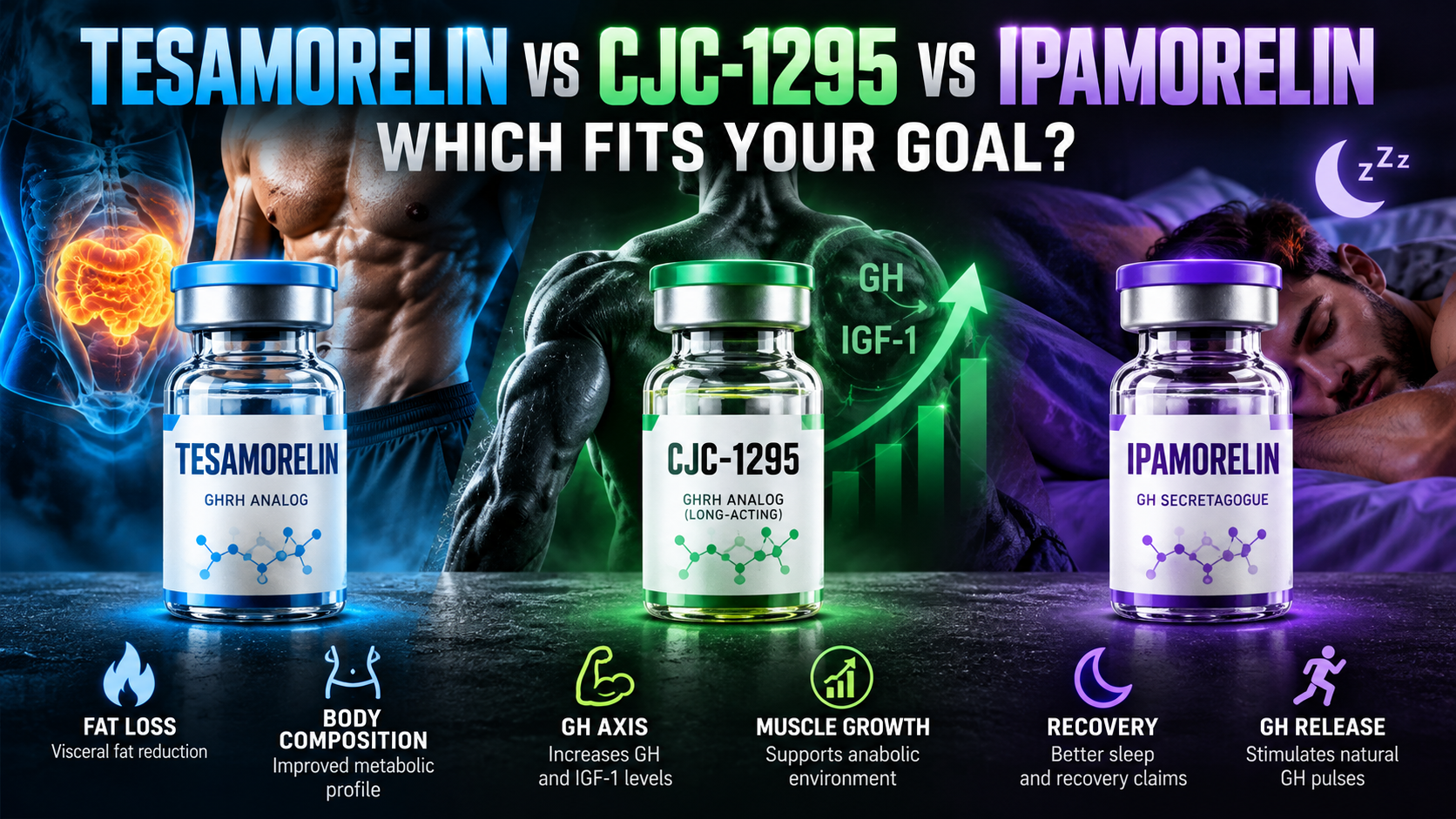
Tesamorelin vs CJC-1295 vs Ipamorelin: Which Fits Your Goal?
Three peptides, three different promises—but which one actually fits your bodybuilding goals? Tesamorelin has demonstrated significant visceral fat reduction in human clinical trials, CJC-1295 can dramatically increase growth hormone and IGF-1 levels, and Ipamorelin is promoted for recovery, sleep, and targeted GH release. But impressive hormonal effects don't automatically mean bigger muscles, faster recovery, or a shredded physique. So which peptide has the strongest scientific evidence for muscle growth, fat loss, and body composition? In this head-to-head comparison, we break down their mechanisms, real clinical results, potential benefits, side effects, and safety concerns to reveal where each compound stands—and why choosing based on proven outcomes matters more than following the hype.
Tesamorelin vs CJC-1295 vs Ipamorelin: Which Fits Your Goal?
Three peptides, three different reputations—and only one with strong human evidence for a specific fat-reduction outcome. Tesamorelin has reduced visceral fat in clinical trials. CJC-1295 can dramatically increase growth hormone and IGF-1. Ipamorelin triggers shorter GH-release responses. But does any of that translate into bigger muscles, visible abs, or faster recovery? Let's compare the science before choosing a winner.
If you're researching peptides for bodybuilding, you've probably encountered a familiar set of recommendations.
- 1Tesamorelin for fat loss.
- 2CJC-1295 for muscle growth.
- 3Ipamorelin for recovery and better sleep.
The labels sound helpful, but there's a scientific problem: they describe proposed uses, not necessarily demonstrated benefits.
All three compounds influence the growth hormone system, yet they do so through different pharmacological profiles. More importantly, the quality of the evidence varies dramatically.
Tesamorelin has large randomized trials measuring changes in abdominal fat. CJC-1295 has controlled human trials measuring hormonal responses. Ipamorelin has human research confirming GH release, alongside clinical investigations of an entirely different condition: postoperative gastrointestinal recovery.
That is not an equal evidence base.
To understand which compound fits a particular goal, we need to compare more than mechanisms. We need to compare actual outcomes, study populations, limitations, safety, and what remains unproven.
1. What Are Tesamorelin, CJC-1295, and Ipamorelin?
All three are synthetic peptides associated with stimulation of endogenous growth hormone secretion. But they are not interchangeable.
Growth hormone is released by the pituitary gland and participates in metabolism, body composition, and growth-related signaling. Its secretion is regulated by several interacting systems.
Two of those systems are particularly important here:
- 1The growth hormone-releasing hormone pathway, involving the GHRH receptor.
- 2The ghrelin/GH-secretagogue pathway, involving the GHSR-1a receptor.
Tesamorelin and CJC-1295 primarily target the first pathway. Ipamorelin targets the second.
Tesamorelin: A GHRH Analogue With Clinical Body-Composition Data
Tesamorelin mimics growth hormone-releasing hormone. By activating the GHRH receptor, it increases endogenous GH secretion and downstream IGF-1 concentrations.
It is the active ingredient in the FDA-approved prescription product EGRIFTA WR, used for reducing excess abdominal fat in adults with HIV-associated lipodystrophy.
That indication is narrow. Tesamorelin is not approved for general weight loss or cosmetic bodybuilding.
Nevertheless, its clinical evidence is unusual in the peptide world: it includes large, randomized, placebo-controlled trials measuring visceral fat by imaging.
CJC-1295: A Long-Acting GHRH Analogue
CJC-1295 also stimulates the GHRH receptor. The original long-acting form incorporates a Drug Affinity Complex, commonly called DAC, allowing prolonged association with albumin in the bloodstream.
This creates a longer-lasting endocrine effect than the natural GHRH signal.
Controlled studies have demonstrated large, sustained increases in GH and IGF-1. However, the landmark studies did not establish improvements in muscle size, muscular strength, or exercise recovery.
Ipamorelin: A Ghrelin-Receptor Agonist
Ipamorelin is a synthetic pentapeptide that acts as a growth hormone secretagogue. Rather than mimicking GHRH, it activates the ghrelin receptor, also known as GHSR-1a.
This produces a GH-release response through a different signaling pathway.
Ipamorelin has attracted attention because early research suggested relatively selective stimulation of GH compared with some older GH-releasing peptides.
But selectivity does not automatically mean superior safety. And a GH pulse does not automatically translate into faster recovery, better sleep, or more muscle.
2. The Mechanism Comparison: Two Receptors, Three Hormonal Profiles
The most useful way to understand these compounds is to separate the receptor from the duration and the resulting clinical effect.
- 1| Feature | Tesamorelin | CJC-1295 with DAC | Ipamorelin |
- 2| Pharmacological class | GHRH analogue | Long-acting GHRH analogue | GH secretagogue |
- 3| Primary receptor | GHRH receptor | GHRH receptor | GHSR-1a |
- 4| Natural signaling system mimicked | GHRH | GHRH | Ghrelin |
- 5| Main documented hormonal action | Increased GH and IGF-1 | Sustained GH and IGF-1 elevation | Acute GH release |
- 6| Distinguishing feature | Human visceral-fat outcome data | Prolonged hormonal exposure | Different receptor and relatively short GH-response profile |
- 7| Direct bodybuilding efficacy demonstrated | No | No | No |
How the GHRH Pathway Works
The hypothalamus normally releases GHRH. GHRH stimulates the pituitary gland to release growth hormone.
Growth hormone then acts throughout the body and stimulates IGF-1 production, particularly in the liver. Tesamorelin and CJC-1295 operate through this general pathway.
But their chemical structures and duration of action are different.
How Ipamorelin Works
Ipamorelin stimulates a receptor normally activated by ghrelin. This pathway also promotes growth hormone release.
Because the receptor differs from the GHRH receptor, it represents a distinct mechanism for stimulating the GH axis.
That's why some peptide enthusiasts discuss combining GHRH analogues with GH secretagogues.
Theoretically, activating complementary signaling pathways could affect GH secretion differently than activating either pathway alone. But a plausible combination mechanism is not proof of additional hypertrophy, fat loss, or recovery.
The biological distinction is real. The claimed bodybuilding advantage remains unproven.
3. Tesamorelin: The Strongest Evidence for a Specific Fat-Loss Outcome
If we're judging these three peptides by actual human body-composition outcomes, Tesamorelin has a clear advantage.
Its pivotal clinical research involved adults with HIV-associated abdominal fat accumulation. That matters because this condition is associated with abnormal distribution of adipose tissue, particularly excess visceral fat.
The 2010 Pooled Analysis: 806 Patients
A pooled analysis of two Phase 3 randomized clinical trials included 806 participants:
- 1543 received Tesamorelin.
- 2263 received placebo.
- 3The initial treatment phase lasted 26 weeks.
Researchers used CT imaging to measure abdominal visceral adipose tissue.
The Results
At 26 weeks:
- 1| Measurement | Tesamorelin | Placebo |
- 2| Visceral fat area change | −24 cm² | +2 cm² |
- 3| Abdominal subcutaneous fat change | −2 cm² | +2 cm² |
- 4| Triglyceride change | −37 mg/dL | +6 mg/dL |
- 5| IGF-1 change | +108 ng/mL | −7 ng/mL |
The reported placebo-adjusted treatment effect on visceral fat was approximately −15.4%. That is a meaningful clinical result.
Unlike research showing only an increase in hormone concentrations, these trials documented a change in an actual fat compartment.
But Here's the Catch
The same analysis did not establish significant reduction in abdominal subcutaneous fat. That distinction matters enormously for bodybuilding.
Visceral fat sits deep inside the abdomen, around internal organs. Subcutaneous fat sits beneath the skin.
The fat covering your lower abs and creating visible love handles is primarily subcutaneous. Tesamorelin has demonstrated effects on deep abdominal fat—not selective removal of the fat you can pinch.
Does Tesamorelin Cause Weight Loss?
Not in the way many people expect. The FDA prescribing information explicitly states that EGRIFTA WR is not indicated for weight-loss management because it has a weight-neutral effect.
In the pivotal trials, mean body-weight changes were small even when visceral fat decreased substantially.
That means Tesamorelin can alter a particular aspect of body composition without producing a dramatic reduction on the scale.
What Happens After Stopping?
The benefits may not persist. During trial extensions, participants who continued treatment generally maintained visceral-fat reductions.
Those who switched to placebo experienced reaccumulation of visceral fat. The findings make it difficult to justify treating Tesamorelin as a proven short-term, permanent fat-removal strategy.
The Bodybuilding Interpretation
Tesamorelin has the strongest direct body-composition evidence of the three. But that does not make it the best cosmetic cutting peptide.
Its strongest results come from a medically specific population, and the visible lower-ab fat many bodybuilders want to eliminate is not the tissue it has been shown to preferentially reduce.
Evidence verdict: Strong for its approved visceral-fat indication; insufficient for healthy bodybuilding cutting.
4. CJC-1295: Impressive GH Numbers, Missing Muscle-Growth Evidence
CJC-1295 is often promoted as a muscle-building peptide because of its effect on the growth hormone system. And the hormonal response is genuinely impressive.
The 2006 Controlled Human Trials
A study published in The Journal of Clinical Endocrinology & Metabolism investigated the pharmacokinetics and endocrine effects of long-acting CJC-1295.
The researchers conducted two randomized, placebo-controlled, double-blind trials lasting 28 and 49 days in healthy adults aged 21–61.
The results were notable. After a single administration:
- 1| Outcome | Reported result |
- 2| Mean GH concentration | Approximately 2- to 10-fold increase |
- 3| Duration of GH elevation | Six days or longer |
- 4| Mean IGF-1 concentration | Approximately 1.5- to 3-fold increase |
- 5| Duration of IGF-1 elevation | Approximately 9–11 days |
- 6| Estimated CJC-1295 half-life | Approximately 5.8–8.1 days |
- 7| IGF-1 after repeated administration | Remained above baseline for up to 28 days |
Those numbers demonstrate sustained activation of the GH/IGF-1 axis. But they do not demonstrate muscle growth.
What the Study Didn't Measure
The researchers did not establish that CJC-1295:
- 1Increased skeletal muscle cross-sectional area.
- 2Improved bench press or squat strength.
- 3Accelerated post-workout recovery.
- 4Increased contractile muscle protein.
- 5Improved sleep quality.
- 6Produced greater fat loss in trained athletes.
These are not minor details. They are precisely the outcomes bodybuilders care about.
The 2006 GH-Pulsatility Study
Another investigation examined how CJC-1295 affected GH secretion patterns.
The researchers reported that GH secretion remained pulsatile, while mean GH and IGF-1 concentrations increased.
Mean GH concentration increased approximately 46%, and mean IGF-1 approximately 45%. GH trough levels increased much more markedly.
That observation is scientifically interesting because it shows that sustained GHRH-receptor stimulation can alter GH concentrations while preserving aspects of pulsatile secretion.
But preserved pulsatility is not proof of superior safety or muscular adaptation.
What About CJC-1295 Without DAC?
This is a major source of confusion. The original long-acting CJC-1295 used in the landmark studies contains the DAC modification.
Products marketed as CJC-1295 without DAC commonly refer to a shorter-acting modified GHRH fragment, often called Modified GRF (1-29).
They should not be assumed chemically identical to the long-acting compound studied in 2006.
Therefore, the multi-day hormone results from CJC-1295 with DAC cannot automatically be transferred to commercially labeled no-DAC products.
The Bodybuilding Interpretation
If the question is whether long-acting CJC-1295 can substantially elevate GH and IGF-1, the answer is yes.
If the question is whether that produces greater muscle hypertrophy, the evidence is insufficient.
Evidence verdict: Demonstrated sustained hormonal effects; bodybuilding benefits not established.
5. Ipamorelin: A Short GH Pulse Is Not Proof of Faster Recovery
Ipamorelin's reputation is slightly different. It is frequently marketed as a relatively selective GH secretagogue associated with recovery and sleep.
But what do its human studies actually show?
The 1999 Human Pharmacology Study
Researchers investigated the pharmacokinetics and pharmacodynamics of Ipamorelin in healthy male volunteers.
The experiment used five dose-escalation levels, with eight men studied at each level.
Participants received the compound intravenously under controlled experimental conditions. Researchers measured both Ipamorelin concentrations and GH responses.
What Happened?
The study found:
- 1A terminal elimination half-life of approximately two hours.
- 2A distinct GH-release episode following administration.
- 3Peak GH response at approximately 0.67 hours, or 40 minutes.
- 4A subsequent decline in GH concentrations.
That establishes acute growth hormone stimulation. It doesn't establish faster recovery from resistance training.
Nor does it demonstrate changes in muscle size or body-fat distribution.
The Important Route-of-Administration Limitation
The 1999 study investigated intravenous administration. That makes it inappropriate to assume its precise timing and exposure measurements apply unchanged to commercially marketed products used through other routes.
Human pharmacology results are informative, but they are not a universal dosing or performance guide.
Is Ipamorelin More Selective?
Early pharmacological research suggested that Ipamorelin produced GH release with relatively limited additional ACTH and cortisol stimulation compared with older GH secretagogues such as GHRP-2 and GHRP-6.
This finding helped establish its reputation for GH selectivity. However, much of the foundational selectivity research involved experimental and animal models.
And the fact that a compound produces fewer changes in certain hormones does not establish comprehensive human safety.
Relatively selective GH release does not equal risk-free GH release.
6. The Surprising Ipamorelin Trial That Had Nothing to Do With Bodybuilding
There is another important piece of human evidence that rarely appears in peptide marketing.
Ipamorelin was investigated for postoperative ileus—a condition involving delayed gastrointestinal recovery after abdominal surgery.
The reason was its action on the ghrelin receptor. Ghrelin-related signaling can influence gastrointestinal motility.
The 2014 Phase 2 Trial
A multicenter, randomized, placebo-controlled study enrolled 117 patients undergoing bowel resection.
Of these, 114 were included in the safety and modified intention-to-treat populations.
Investigators evaluated whether Ipamorelin improved gastrointestinal recovery after surgery.
The Results
- 1| Outcome | Ipamorelin | Placebo |
- 2| Median time to tolerate a standardized solid meal | 25.3 hours | 32.6 hours |
- 3| Treatment-emergent adverse events | 87.5% | 94.8% |
The difference in time to the first tolerated meal did not reach statistical significance: p = 0.15.
The researchers found no significant difference in the key efficacy outcome or secondary efficacy analyses.
Why This Matters
Ipamorelin has been investigated in humans for more than GH release. But that doesn't mean it has demonstrated useful clinical benefits in every area studied.
The postoperative ileus trial did not establish gastrointestinal recovery benefits. And it certainly did not investigate delayed-onset muscle soreness, muscle hypertrophy, or strength recovery between gym sessions.
Postoperative gastrointestinal recovery and exercise recovery are fundamentally different outcomes.
A peptide's name appearing in a recovery-related clinical trial does not establish it as a workout recovery treatment.
Evidence verdict: Human GH release demonstrated; muscle recovery, better sleep, and bodybuilding performance not established.
7. Which Is Better for Muscle Growth?
This is arguably the biggest question in the comparison. And it's where the marketing claims become weakest.
Why GH Elevation Sounds Anabolic
Growth hormone and IGF-1 participate in growth-related processes. That makes it tempting to assume that any compound increasing GH will automatically increase skeletal muscle mass.
But adult skeletal muscle adaptation is more complicated.
Muscle hypertrophy depends on training stimulus, muscle protein turnover, nutritional status, recovery, and tissue-specific signaling.
Increasing a circulating hormone doesn't necessarily increase the contractile proteins that make muscle fibers bigger.
The 2008 Systematic Review
A systematic review published in Annals of Internal Medicine evaluated GH administration and athletic performance.
The investigators analyzed 44 articles representing 27 study samples. Across those studies, 303 participants received GH.
On average, GH treatment increased lean body mass by approximately 2.1 kg compared with controls. The reported 95% confidence interval was 1.3–2.9 kg.
That sounds impressive. But the review did not find convincing improvements in muscular strength or exercise capacity.
GH recipients experienced soft-tissue edema and fatigue more frequently.
The Lean-Mass Illusion
Lean body mass includes more than contractile skeletal muscle. It also includes water and other nonfat tissues.
GH can influence fluid balance. That means a person can gain measured lean mass without gaining an equivalent amount of muscle capable of producing additional force.
The 2010 Collagen Study
Another human experiment investigated the effects of 14 days of recombinant GH administration.
Researchers found that GH increased several measures of collagen synthesis in tendon and skeletal muscle. But myofibrillar protein synthesis did not increase.
The distinction is crucial. Myofibrillar proteins are central to the contractile machinery of muscle.
A change in connective-tissue protein metabolism does not automatically represent muscle hypertrophy.
What This Means for All Three Peptides
These experiments investigated administered GH, not Tesamorelin, CJC-1295, or Ipamorelin directly.
So their results cannot be treated as proof that the three peptides have identical effects.
However, they challenge the central assumption that increasing GH necessarily increases contractile muscle.
Muscle-Growth Verdict
- 1| Peptide | Human evidence for stimulating GH | Human evidence for increasing muscle hypertrophy in bodybuilders |
- 2| Tesamorelin | Yes | Not established |
- 3| CJC-1295 | Yes | Not established |
- 4| Ipamorelin | Yes | Not established |
Winner for proven bodybuilding muscle growth: None. The strongest mechanistic argument is not the same as the strongest evidence for results.
8. Which Is Better for Fat Loss and Getting Shredded?
Here the comparison becomes clearer. Tesamorelin has demonstrated a specific fat-reduction effect.
CJC-1295 and Ipamorelin have not demonstrated comparable human bodybuilding fat-loss outcomes. But we need to define the goal.
Goal A: Reduce Excess Visceral Fat
Visceral fat is stored deep inside the abdominal cavity. Tesamorelin has demonstrated reductions in this compartment in adults with HIV-associated lipodystrophy.
In its pivotal trials, the reductions were substantial. CJC-1295 has not demonstrated equivalent VAT reductions in comparable human outcome trials. Neither has Ipamorelin.
Strongest clinical evidence: Tesamorelin, but only for the studied indication.
Goal B: Remove Pinchable Lower-Ab Fat
The fat covering abdominal muscles is primarily subcutaneous. Tesamorelin's pivotal clinical research did not demonstrate significant reductions in abdominal subcutaneous fat.
CJC-1295 and Ipamorelin have also not established selective removal of this fat in healthy bodybuilders.
Proven winner: None.
Goal C: Lose Significant Body Weight
Tesamorelin is described as weight-neutral in its FDA prescribing information. It is explicitly not indicated for weight-loss management.
CJC-1295 and Ipamorelin have not demonstrated substantial, reliable weight loss in appropriate controlled bodybuilding trials.
Proven winner: None.
Goal D: Preserve Muscle During a Cut
Muscle retention is a major concern for bodybuilders in an energy deficit. But none of these three compounds has convincing direct human evidence showing superior preservation of contractile skeletal muscle during bodybuilding contest preparation.
Changes in GH, IGF-1, or measured lean mass do not resolve that question.
Proven winner: None.
The Fat-Loss Comparison
- 1| Goal | Tesamorelin | CJC-1295 | Ipamorelin |
- 2| Reduce visceral fat in HIV-associated lipodystrophy | Demonstrated | Not demonstrated | Not demonstrated |
- 3| Reduce visceral fat in healthy athletes | Not established | Not established | Not established |
- 4| Remove lower-ab subcutaneous fat | Not established | Not established | Not established |
- 5| Remove love handles | Not established | Not established | Not established |
- 6| Produce major weight loss | Not an approved indication | Not established | Not established |
- 7| Preserve muscle during a competitive cut | Not established | Not established | Not established |
This is the answer many bodybuilding peptide rankings miss.
Tesamorelin is the evidence leader for a particular fat compartment. That does not establish it as the best peptide for getting stage-ready.
9. Which Is Better for Recovery?
Recovery is a broad term. It can refer to several different outcomes:
- 1Faster restoration of strength after training.
- 2Reduced muscle soreness.
- 3Improved tendon healing.
- 4Better sleep quality.
- 5Reduced fatigue.
- 6Greater tolerance of training volume.
- 7Shorter recovery time after an injury.
These are not interchangeable. A treatment might affect one without improving the others.
Tesamorelin and Recovery
Tesamorelin stimulates the GH/IGF-1 axis. But its strongest clinical trials focused on visceral fat and metabolic outcomes.
They did not demonstrate faster recovery between resistance-training sessions.
CJC-1295 and Recovery
CJC-1295 produces prolonged GH and IGF-1 elevations. That mechanism has led to claims about recovery and tissue repair.
But direct human evidence demonstrating faster post-workout recovery is lacking.
There is no convincing controlled study showing that CJC-1295 lets trained athletes recover strength faster or complete more productive training volume.
Ipamorelin and Recovery
Ipamorelin's reputation is closely associated with short GH pulses and its relatively selective receptor activity.
But the human pharmacology studies measured hormones, not workout recovery. The postoperative gastrointestinal trial did not study sports recovery.
There is no convincing human evidence that Ipamorelin reduces soreness, repairs damaged muscle faster, or improves training readiness.
What About Tendons?
GH administration has stimulated collagen synthesis in human experiments. That is biologically interesting.
However, increased collagen synthesis is not equivalent to clinically demonstrated healing of an injured tendon.
No compound in this comparison has been established as an effective bodybuilding tendon-recovery treatment.
Recovery Verdict
No winner. Ipamorelin may be the peptide most frequently associated with recovery marketing.
CJC-1295 may have the more dramatic documented hormone-duration profile. But neither observation establishes a recovery benefit.
The distinction between recovery-related mechanisms and measured recovery outcomes is essential.
10. Which Is Better for Sleep?
Many bodybuilding claims about GH peptides involve deep sleep.
The reasoning usually starts with a real physiological observation: natural GH secretion is associated with sleep, particularly slow-wave sleep.
But the relationship cannot simply be reversed. The fact that deep sleep is associated with GH secretion does not mean that pharmacologically raising GH necessarily improves deep sleep.
Tesamorelin
Its pivotal trials did not establish better sleep architecture in healthy bodybuilders.
CJC-1295
Human research demonstrates GH/IGF-1 changes, but not a validated improvement in sleep quality or sleep efficiency.
Ipamorelin
A GH pulse is not a direct measurement of deep sleep. There is no convincing controlled human evidence demonstrating that Ipamorelin improves sleep architecture or next-day athletic recovery.
Sleep Verdict
No proven winner. Any perceived improvement reported online remains separate from controlled evidence establishing clinical benefit.
11. CJC-1295 + Ipamorelin: Does Combining Them Make More Sense?
This is one of the most popular combinations in GH-peptide discussions. And the theoretical argument is understandable.
CJC-1295 activates the GHRH receptor. Ipamorelin activates the ghrelin receptor.
Because these receptors participate in different aspects of GH regulation, stimulating both pathways may produce a different GH response than stimulating either one independently.
But this is a mechanistic argument. It is not proof of a better physique.
What Has Not Been Established?
Appropriate controlled human studies have not demonstrated that combining CJC-1295 with Ipamorelin:
- 1Produces greater muscle hypertrophy than training alone.
- 2Improves strength.
- 3Reduces fat more effectively.
- 4Accelerates workout recovery.
- 5Improves sleep.
- 6Produces a better long-term safety profile.
Why Two Peptides Can Mean More Uncertainty
Combining compounds introduces additional questions about:
- 1Cumulative GH/IGF-1 exposure.
- 2Potential metabolic effects.
- 3Product quality and molecular identity.
- 4Immunogenicity and impurities.
- 5Unknown interactions and long-term safety.
It also complicates interpretation. If someone experiences a change in body weight, sleep, or recovery while using several compounds, it becomes harder to identify which factor caused the effect.
Two complementary mechanisms do not equal twice the benefits.
And combining experimental peptides does not solve the absence of controlled bodybuilding outcome data.
12. Side Effects: Which Peptide Carries the Greatest Risks?
There's a major scientific trap in comparing these three compounds. Tesamorelin has undergone substantially more extensive clinical development.
That means its side effects are better characterized. CJC-1295 and Ipamorelin have less comprehensive human safety data.
But fewer documented adverse events do not automatically mean a safer compound. Sometimes they simply mean fewer people have been studied adequately.
Tesamorelin: Better-Characterized Risks
FDA prescribing information identifies important warnings and adverse reactions, including:
- 1Elevated IGF-1. Tesamorelin increases circulating IGF-1. In pivotal clinical data, a substantial proportion of treated patients had IGF-1 concentrations above the reference range.
- 2Glucose intolerance and diabetes. The prescribing information reports that approximately 5% of Tesamorelin recipients developed HbA1c levels of at least 6.5%, compared with approximately 1% receiving placebo. The reported hazard ratio was about 3.3.
- 3Fluid retention. Peripheral edema, joint pain, muscle pain, and carpal tunnel syndrome can occur.
- 4Injection-site and hypersensitivity reactions. These were documented during clinical development.
- 5Malignancy-related precautions. Active malignancy is a contraindication, and a history of malignancy requires careful clinical consideration.
- 6Other contraindications. The product is contraindicated in certain patients with hypothalamic-pituitary axis disruption, hypersensitivity, and pregnancy.
Long-term cardiovascular safety has not been established.
CJC-1295: Limited Human Safety Data
The early controlled trials reported no serious adverse reactions during their relatively short observation periods. But that does not establish long-term safety.
The FDA has identified potential safety concerns involving compounded CJC-1295, including:
- 1Increased heart rate.
- 2Systemic vasodilatory reactions.
- 3Potential immunogenicity.
- 4Peptide-related impurities and characterization issues.
There is insufficient evidence to quantify long-term metabolic or cardiovascular risks in healthy bodybuilders.
The prolonged GH/IGF-1 stimulation is a legitimate reason for further safety investigation.
Ipamorelin: A Less Complete Safety Picture
The 2014 postoperative ileus trial reported treatment-emergent adverse events in both study groups.
In the surgical population, these occurred in 87.5% of Ipamorelin recipients and 94.8% of placebo recipients.
These results must be interpreted in the context of patients recovering from major bowel surgery. They do not establish the frequency of adverse reactions during bodybuilding use.
The FDA has identified concerns involving compounded Ipamorelin acetate, particularly potential immunogenicity, peptide aggregation, and impurities.
It has also noted serious adverse events reported in intravenous clinical research, including deaths, without establishing that Ipamorelin caused those outcomes.
The agency has stated that safety information is insufficient for certain other administration routes. That is a significant evidence gap.
Safety Comparison
- 1| Safety factor | Tesamorelin | CJC-1295 | Ipamorelin |
- 2| Extensive clinical safety development | Relatively greater | Limited | Limited |
- 3| Long-term bodybuilding safety established | No | No | No |
- 4| Elevated IGF-1 documented | Yes | Yes | Not equally characterized |
- 5| Glucose-related concern | Explicit FDA warning | GH-axis concern; specific risk insufficiently quantified | Specific long-term risk insufficiently quantified |
- 6| Fluid-retention concerns | Documented | Possible GH-axis concern | Insufficient characterization |
- 7| FDA safety concerns involving compounded material | Product-specific regulatory framework; nonapproved products still pose risks | Yes | Yes |
- 8| Safe to assume for cosmetic use | No | No | No |
Which Is Safest?
There is no reliable head-to-head human safety trial allowing these three compounds to be ranked confidently for healthy bodybuilding use.
Tesamorelin has more detailed clinical safety information. CJC-1295 and Ipamorelin have greater uncertainty surrounding many long-term outcomes.
Less safety data should not be mistaken for less risk.
13. FDA Approval and WADA Rules: A Major Difference
The regulatory comparison is straightforward.
Tesamorelin
Tesamorelin is the active ingredient in FDA-approved prescription medicines for reducing excess abdominal fat in adults with HIV-associated lipodystrophy.
Its approval does not extend to general weight loss or bodybuilding.
Different approved formulations, including EGRIFTA WR and EGRIFTA SV, have product-specific requirements and are not interchangeable.
CJC-1295
CJC-1295 is not FDA-approved for muscle growth, anti-aging, recovery, or body composition.
The existence of research studies does not constitute drug approval.
Ipamorelin
Ipamorelin is also not FDA-approved for bodybuilding, muscle growth, fat loss, or workout recovery.
Its previous clinical investigation for postoperative gastrointestinal dysfunction does not make it an approved treatment for that condition.
What Does WADA Say?
The 2026 World Anti-Doping Agency Prohibited List explicitly identifies all three compounds.
Under section S2.2.4:
- 1CJC-1295 and Tesamorelin appear among GHRH analogues.
- 2Ipamorelin appears among GH secretagogues and their mimetics.
These categories are prohibited in and out of competition.
The existence of a legitimate prescription indication for Tesamorelin does not automatically make its use permissible for an athlete competing under WADA-based rules.
14. The Complete Comparison Table
- 1| Category | Tesamorelin | CJC-1295 | Ipamorelin |
- 2| Primary goal associated with compound | Visceral fat/body composition | Prolonged GH-axis stimulation | GH release/recovery claims |
- 3| Primary receptor | GHRH receptor | GHRH receptor | GHSR-1a |
- 4| Human GH stimulation demonstrated | Yes | Yes | Yes |
- 5| Human IGF-1 elevation demonstrated | Yes | Yes | Not equally characterized in the cited human studies |
- 6| Human clinical outcome evidence | Yes, visceral fat reduction in a defined medical population | Mainly endocrine outcomes | Mainly endocrine outcomes; postoperative efficacy not established |
- 7| Visceral fat reduction demonstrated | Yes, in HIV-associated lipodystrophy | No | No |
- 8| Subcutaneous fat reduction demonstrated | Not significantly in pivotal pooled trials | No | No |
- 9| Muscle hypertrophy demonstrated in trained athletes | No | No | No |
- 10| Strength improvement demonstrated | No | No | No |
- 11| Workout recovery improvement demonstrated | No | No | No |
- 12| Better sleep demonstrated | No | No | No |
- 13| FDA-approved indication | Yes, narrowly defined | No | No |
- 14| Long-term bodybuilding safety established | No | No | No |
- 15| WADA prohibited | Yes | Yes | Yes |
- 16| Most scientifically distinctive feature | Actual visceral-fat clinical outcomes | Sustained GH/IGF-1 pharmacology | Distinct ghrelin-receptor mechanism and acute GH response |
The most important difference is not simply which peptide can release more GH.
It is which peptide has demonstrated a meaningful outcome beyond changing a hormone measurement.
15. Choosing by Goal: What Does the Evidence Actually Support?
Let's apply the evidence to common bodybuilding objectives.
Goal: Build More Muscle During a Bulk
Evidence-based choice among these three: None established.
CJC-1295 can raise GH and IGF-1 substantially. Ipamorelin can trigger GH release. Tesamorelin also stimulates the GH/IGF-1 axis.
But none has convincing controlled human evidence proving greater resistance-training hypertrophy in healthy bodybuilders.
Choosing a peptide based solely on its hormonal response is not an evidence-based strategy for muscle growth.
Goal: Lose Excess Visceral Fat
Strongest evidence: Tesamorelin, within its approved medical population.
It has randomized clinical trials demonstrating meaningful VAT reduction.
The result should not be generalized automatically to healthy athletes, people with little excess visceral fat, or cosmetic cutting goals.
Goal: Lose Stubborn Lower-Belly Fat
Evidence-based choice among these three: None established.
Subcutaneous lower-ab fat is not the same as visceral fat. Tesamorelin's strongest clinical data do not demonstrate meaningful reductions in abdominal SAT.
CJC-1295 and Ipamorelin lack comparable evidence for this outcome.
Goal: Recover Faster Between Heavy Workouts
Evidence-based choice among these three: None established.
There are mechanistic hypotheses, but no convincing controlled human bodybuilding studies establishing faster recovery or better training performance.
Goal: Improve Sleep
Evidence-based choice among these three: None established. Changes in GH do not demonstrate better sleep quality.
Goal: Study Sustained GH/IGF-1 Stimulation
Strongest directly relevant pharmacology: CJC-1295 with DAC.
Its controlled human trials documented sustained GH and IGF-1 elevations over multiple days.
This is an endocrine research distinction, not a recommendation for bodybuilding use.
Goal: Study Acute GH Release Through the Ghrelin Receptor
Directly relevant compound: Ipamorelin.
Its human pharmacology studies documented acute GH release through a different receptor pathway.
Again, a demonstrated endocrine mechanism is not a proven performance benefit.
16. What Actually Has Stronger Evidence for Muscle Growth, Cutting, and Recovery?
For healthy bodybuilders, the most reliable strategies remain less exotic.
For Muscle Growth
Progressive resistance training, adequate training volume, and sufficient protein intake have stronger human outcome evidence than any bodybuilding application of these three peptides.
The International Society of Sports Nutrition recommends roughly 1.4–2.0 grams of daily protein per kilogram of body weight for most exercising individuals, although requirements vary.
Energy availability and training consistency also matter.
For Fat Loss
Appropriate calorie management, resistance training, and cardiovascular exercise have substantial evidence supporting improvements in body composition.
For people with excess visceral fat, aerobic exercise and other structured activity can reduce VAT.
For already-lean athletes, the approach needs to be adapted to preserve muscle and avoid excessive fatigue.
For Recovery
Effective recovery includes appropriate sleep, sufficient nutritional intake, training load management, and treatment of actual injuries when present.
If a tendon or joint is injured, proper assessment and rehabilitation provide a clearer clinical framework than assuming that a GH secretagogue will accelerate healing.
These strategies may not produce dramatic hormone graphs. But they have much stronger connections to the outcomes athletes actually want.
17. What Studies Would Finally Settle This Debate?
The most useful future research would compare compounds using measurable bodybuilding endpoints—not just endocrine biomarkers.
A meaningful randomized trial would need to establish:
- 1The exact compound and formulation. CJC-1295 with DAC and products marketed without DAC cannot be treated as identical.
- 2An appropriate population. Resistance-trained adults rather than only healthy sedentary volunteers or people with unrelated medical conditions.
- 3Standardized training and nutrition. Otherwise, changes in muscle size and body composition are difficult to interpret.
- 4Direct muscle measurements. Muscle thickness, cross-sectional area, or validated imaging-based outcomes.
- 5Strength and performance results. Meaningful functional outcomes, not just body weight.
- 6Precise fat-compartment assessment. Distinguishing visceral from subcutaneous fat.
- 7Validated recovery and sleep endpoints. Strength recovery, soreness, sleep architecture, and training performance rather than anecdotes.
- 8Adequate safety follow-up. Glucose regulation, IGF-1 concentrations, edema, cardiovascular outcomes, and longer-term adverse events.
A three-way comparison would be especially informative.
But until such evidence exists, declaring one of these peptides the best muscle-building or recovery compound remains speculation.
Final Verdict: Tesamorelin vs CJC-1295 vs Ipamorelin
There is no universal winner. And the reason is that the three compounds do not have equally convincing evidence for the goals they're advertised to achieve.
Tesamorelin has demonstrated clinically meaningful visceral fat reduction in adults with HIV-associated excess abdominal fat. That's a real outcome.
CJC-1295 has demonstrated substantial, sustained GH and IGF-1 elevation. That's a real hormonal effect.
Ipamorelin has demonstrated acute GH release through the ghrelin receptor. That's a real pharmacological effect.
But these three accomplishments are not equivalent.
The Final Scorecard
- 1| Your goal | Scientific verdict |
- 2| Reduce excess visceral fat in the population Tesamorelin was approved for | Tesamorelin has the strongest clinical evidence |
- 3| Get visibly shredded as a healthy bodybuilder | No proven winner |
- 4| Eliminate love handles | No proven winner |
- 5| Increase actual skeletal muscle hypertrophy | No proven winner |
- 6| Improve maximal strength | No proven winner |
- 7| Recover faster from heavy training | No proven winner |
- 8| Improve deep sleep | No proven winner |
- 9| Demonstrate prolonged GH/IGF-1 stimulation | CJC-1295 with DAC has direct human evidence |
- 10| Demonstrate an acute GH-release response | Ipamorelin has direct human evidence |
- 11| Choose a WADA-permitted bodybuilding peptide | None of the three |
The Bottom Line
Tesamorelin wins on direct evidence for a specific body-composition outcome. CJC-1295 stands out for sustained GH-axis stimulation. Ipamorelin stands out for a different receptor mechanism and short-term GH release.
But if your actual goal is muscle growth, contest conditioning, or faster recovery, none of these compounds has earned a clear victory in controlled bodybuilding trials.
That's the distinction worth remembering. Choose compounds by proven outcomes, not by impressive mechanisms.
A hormone spike isn't a bigger biceps. A decrease in visceral fat isn't automatically a visible six-pack. And a peptide associated with GH release isn't automatically a recovery breakthrough.
The best peptide on paper is not necessarily the best peptide for your physique. The evidence—not the hype—should decide.
Frequently Asked Questions
Tesamorelin has the strongest direct human evidence for a specific fat-loss outcome: reduction of excess visceral abdominal fat in adults with HIV-associated lipodystrophy. Its pivotal trials found an approximately 15.4% placebo-adjusted VAT reduction over 26 weeks. However, this does not establish that it is effective for general weight loss, love handles, or cosmetic cutting in healthy bodybuilders. Neither CJC-1295 nor Ipamorelin has demonstrated comparable controlled human fat-loss benefits.
None of the three has convincing controlled human evidence demonstrating increased skeletal muscle hypertrophy in resistance-trained athletes. CJC-1295 and Ipamorelin stimulate GH, while Tesamorelin also increases GH and IGF-1. But hormonal responses cannot be treated as proof of additional contractile muscle growth or strength.
They act through different receptors, so comparing their potency as though they were interchangeable is misleading. The original long-acting CJC-1295 with DAC produced sustained GH and IGF-1 elevation over multiple days in controlled human studies. Ipamorelin produced an acute GH-release response, with a peak around 40 minutes in one intravenous pharmacology study. These observations do not establish which one produces better bodybuilding outcomes.
Those benefits have not been convincingly demonstrated in controlled human bodybuilding trials. Ipamorelin can stimulate GH release, but its published human pharmacology results do not prove that users sleep more deeply, recover strength faster, or experience less post-workout muscle soreness.
Tesamorelin has stronger clinical evidence for reducing visceral abdominal fat. CJC-1295 has not demonstrated a comparable VAT reduction in appropriate controlled human trials. However, the fat that covers the lower abs is primarily subcutaneous fat, and Tesamorelin has not been shown to selectively eliminate that tissue in healthy bodybuilders.
The combination has a plausible mechanistic rationale because CJC-1295 stimulates the GHRH receptor while Ipamorelin stimulates the ghrelin receptor. However, convincing controlled human studies have not demonstrated that combining them increases muscle hypertrophy, improves recovery, or reduces body fat more effectively. Combining compounds also introduces additional safety uncertainties.
There is insufficient head-to-head evidence to rank their safety confidently for healthy bodybuilding use. Tesamorelin has a better-characterized clinical safety profile because it underwent extensive drug development, but it carries risks including elevated IGF-1, glucose intolerance, fluid retention, and hypersensitivity. CJC-1295 and Ipamorelin have substantially less complete long-term human safety data. Less safety information does not mean lower risk.
Tesamorelin is FDA-approved for reducing excess abdominal fat in adults with HIV-associated lipodystrophy, not for general bodybuilding or weight loss. CJC-1295 and Ipamorelin are not FDA-approved for bodybuilding purposes. All three are explicitly prohibited under the 2026 WADA Prohibited List, including during out-of-competition periods.
Research and Sources
- 1Falutz J, et al. (2010). Effects of Tesamorelin (TH9507), a Growth Hormone-Releasing Factor Analog, in HIV-Infected Patients with Excess Abdominal Fat: A Pooled Analysis of Two Multicenter, Double-Blind Placebo-Controlled Phase 3 Trials with Safety Extension Data. Journal of Clinical Endocrinology & Metabolism, 95(9), 4291–4304. https://pubmed.ncbi.nlm.nih.gov/20554713/
- 2Falutz J, et al. (2007). Metabolic Effects of a Growth Hormone-Releasing Factor in Patients with HIV. New England Journal of Medicine, 357, 2359–2370. https://pubmed.ncbi.nlm.nih.gov/18057338/
- 3U.S. National Library of Medicine, DailyMed. (Updated July 29, 2026). EGRIFTA WR (Tesamorelin) — Official U.S. Prescribing Information. Indication, clinical outcomes, contraindications, elevated IGF-1, glucose intolerance, and other safety warnings. https://dailymed.nlm.nih.gov/dailymed/drugInfo.cfm?setid=839334d3-8c1d-4c26-9036-2ab524a6ea75
- 4Teichman SL, et al. (2006). Prolonged Stimulation of Growth Hormone and Insulin-Like Growth Factor I Secretion by CJC-1295, a Long-Acting Analog of GH-Releasing Hormone, in Healthy Adults. Journal of Clinical Endocrinology & Metabolism, 91(3), 799–805. https://pubmed.ncbi.nlm.nih.gov/16352683/
- 5Ionescu M, Frohman LA. (2006). Pulsatile Secretion of Growth Hormone Persists During Continuous Stimulation by CJC-1295, a Long-Acting GH-Releasing Hormone Analog. Journal of Clinical Endocrinology & Metabolism, 91(12), 4792–4797. https://pubmed.ncbi.nlm.nih.gov/17018654/
- 6Gobburu JV, Agersø H, Jusko WJ, Ynddal L. (1999). Pharmacokinetic-Pharmacodynamic Modeling of Ipamorelin, a Growth Hormone Releasing Peptide, in Human Volunteers. Pharmaceutical Research, 16(9), 1412–1416. https://pubmed.ncbi.nlm.nih.gov/10496658/
- 7Raun K, et al. (1998). Ipamorelin, the First Selective Growth Hormone Secretagogue. European Journal of Endocrinology, 139(5), 552–561. https://pubmed.ncbi.nlm.nih.gov/9849822/
- 8Beck DE, Sweeney WB, McCarter MD, et al. (2014). Prospective, Randomized, Controlled, Proof-of-Concept Study of the Ghrelin Mimetic Ipamorelin for the Management of Postoperative Ileus in Bowel Resection Patients. International Journal of Colorectal Disease, 29, 1527–1534. https://pubmed.ncbi.nlm.nih.gov/25331030/
- 9Liu H, et al. (2008). Systematic Review: The Effects of Growth Hormone on Athletic Performance. Annals of Internal Medicine, 148(10), 747–758. https://pubmed.ncbi.nlm.nih.gov/18347346/
- 10Doessing S, et al. (2010). Growth Hormone Stimulates the Collagen Synthesis in Human Tendon and Skeletal Muscle Without Affecting Myofibrillar Protein Synthesis. The Journal of Physiology, 588(2), 341–351. https://pubmed.ncbi.nlm.nih.gov/19933753/
- 11U.S. Food and Drug Administration. Certain Bulk Drug Substances for Use in Compounding That May Present Significant Safety Risks. Includes agency safety assessments concerning CJC-1295 and Ipamorelin acetate. https://www.fda.gov/drugs/human-drug-compounding/certain-bulk-drug-substances-use-compounding-may-present-significant-safety-risks
- 12World Anti-Doping Agency. (2026). The 2026 Prohibited List. Section S2.2.4 explicitly identifies Tesamorelin, CJC-1295, and Ipamorelin. https://www.wada-ama.org/sites/default/files/2025-09/2026list_en_final_clean_september_2025.pdf
- 13Jäger R, et al. (2017). International Society of Sports Nutrition Position Stand: Protein and Exercise. Journal of the International Society of Sports Nutrition, 14, 20. https://pubmed.ncbi.nlm.nih.gov/28642676/
Research status: October 8, 2026. This article is intended for educational purposes only. Tesamorelin is a prescription medication approved for a specific medical indication, not a general bodybuilding treatment. CJC-1295 and Ipamorelin lack FDA approval for bodybuilding use. The muscle-growth, cosmetic fat-loss, and recovery benefits discussed in bodybuilding communities have not been established in appropriate human clinical trials. All three compounds are prohibited under the 2026 WADA Prohibited List.
Dr. Andrii Kaleniuk
Comments (0)
Be the first to comment on this article.
