
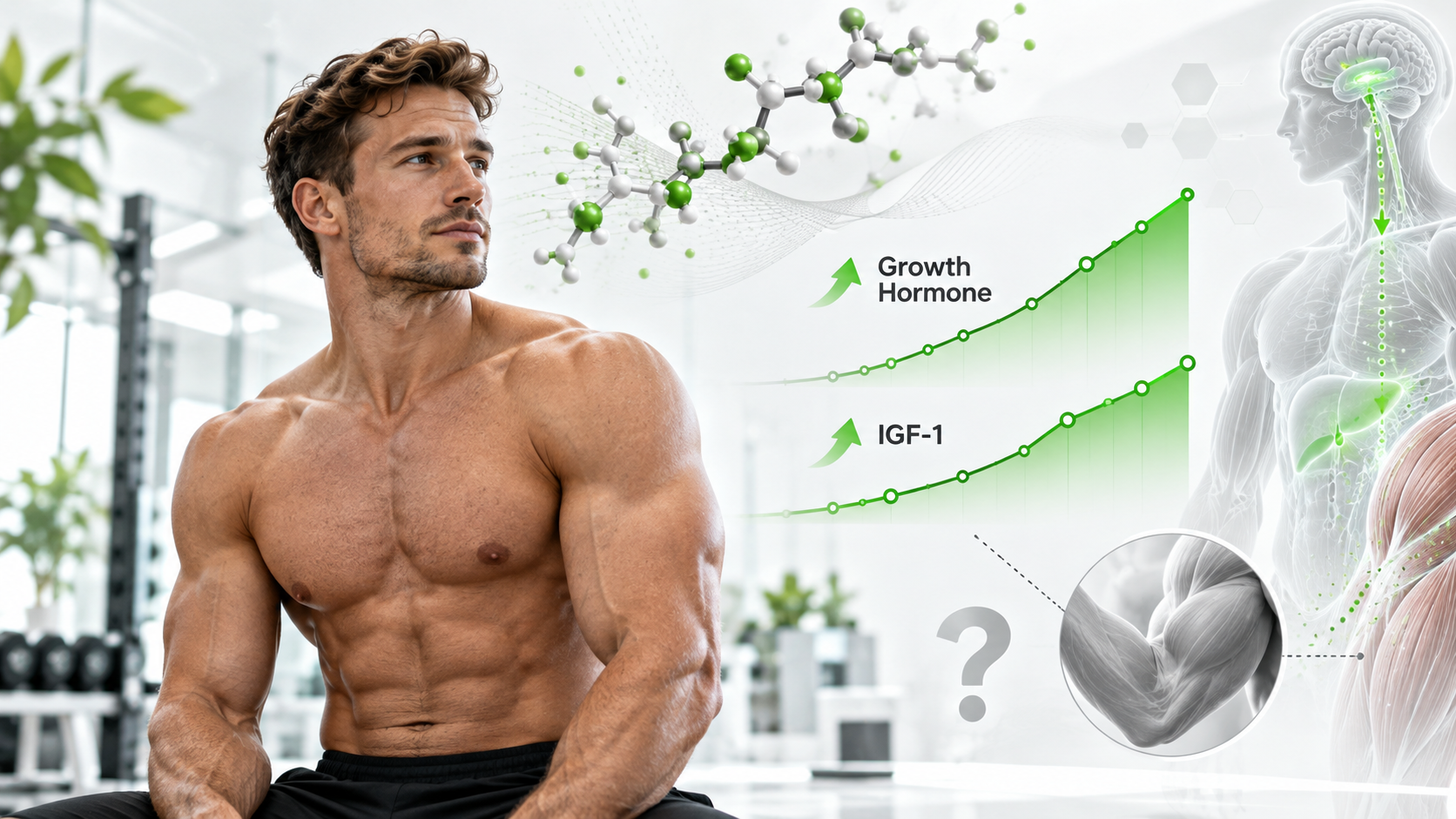
CJC-1295 for Muscle Growth: Does More Growth Hormone Mean More Muscle?
What if you could increase your growth hormone levels by up to tenfold—but still have no proof that you've built more muscle? That's the fascinating contradiction behind CJC-1295, an experimental peptide that stimulates the GH/IGF-1 axis and has become a popular topic in bodybuilding. Human studies show impressive increases in growth hormone and IGF-1, but do those hormonal changes actually translate into bigger muscles, greater strength, or faster recovery? Research on growth hormone reveals a surprising twist: increased lean body mass can reflect water retention rather than genuine muscle growth. So is CJC-1295 a promising anabolic breakthrough
CJC-1295 for Muscle Growth: Does More Growth Hormone Mean More Muscle?
Imagine increasing your growth hormone levels by up to tenfold—and still having no proof that you've built an extra gram of muscle. That's the fascinating contradiction behind CJC-1295, an experimental peptide that genuinely stimulates the GH/IGF-1 axis but has never convincingly demonstrated the bodybuilding results people expect from it.
In bodybuilding, few words are as powerful as growth hormone.
Growth means bigger muscles. Hormone means anabolic potential. And more growth hormone? That sounds like the ultimate shortcut to a more muscular physique.
At least, that's the theory.
CJC-1295 has become popular because it promises to stimulate the body's own growth hormone production rather than supply GH directly.
And unlike many experimental peptides, it has something genuinely interesting behind it: controlled human studies.
In one 2006 investigation, a single administration of long-acting CJC-1295 increased average growth hormone concentrations approximately 2- to 10-fold and IGF-1 concentrations approximately 1.5- to 3-fold.
Those are impressive numbers. But there's a problem.
The researchers didn't demonstrate that participants built more muscle. They didn't measure gains in squat strength, bench press performance, or muscle thickness. They measured hormones.
Meanwhile, other human studies have found that increasing growth hormone can raise measured lean body mass without reliably improving muscular strength. Some of that additional lean mass may simply be water.
So what does CJC-1295 really offer a bodybuilder? Is it a legitimate muscle-building breakthrough? A potentially interesting metabolic compound? Or a perfect example of how impressive hormone results can create bigger expectations than the evidence supports?
Let's examine the mechanism, the human studies, the lean-mass illusion, and the real science behind the hype.
What Is CJC-1295?
CJC-1295 is a synthetic analogue of growth hormone-releasing hormone, commonly abbreviated as GHRH.
GHRH is a natural signaling hormone produced by the hypothalamus. Its job is to stimulate the pituitary gland to release growth hormone.
CJC-1295 was developed to interact with this same signaling pathway while remaining active for much longer than natural GHRH.
The original long-acting compound uses a chemical modification designed to associate with albumin, a protein found in the bloodstream.
This modification is commonly described as a Drug Affinity Complex, or DAC.
That albumin-binding capability is central to the prolonged hormonal effects documented in human studies.
CJC-1295 at a Glance
- 1| Characteristic | CJC-1295 |
- 2| Compound type | Synthetic GHRH analogue |
- 3| Primary target | GHRH receptor on pituitary somatotroph cells |
- 4| Main documented action | Increased endogenous GH secretion |
- 5| Downstream effect | Increased circulating IGF-1 |
- 6| Best-studied form | Long-acting CJC-1295 with DAC |
- 7| Direct human muscle-growth evidence | Not established |
- 8| FDA-approved for bodybuilding | No |
- 9| WADA status | Prohibited |
The crucial distinction is that CJC-1295 is not growth hormone itself. It stimulates an upstream signaling pathway that controls GH secretion.
But that doesn't mean its effects are automatically physiological, harmless, or beneficial for muscle growth.
A drug can stimulate a natural process while producing exposure patterns the body would not normally experience. And that's particularly relevant to long-acting CJC-1295.
How Does CJC-1295 Affect Growth Hormone and IGF-1?
To understand the bodybuilding claims, first understand the growth hormone axis. The process begins in the brain.
The hypothalamus releases GHRH, which stimulates cells in the anterior pituitary gland. The pituitary then releases GH into the bloodstream.
Growth hormone acts on multiple tissues and stimulates IGF-1 production, particularly in the liver.
IGF-1 stands for insulin-like growth factor 1. It participates in several growth-related processes, but its biological effects depend on tissue, local signaling, metabolic conditions, and numerous other factors.
The GH/IGF-1 Pathway
- 1Hypothalamus: Produces GHRH and other signals regulating GH secretion.
- 2Pituitary gland: Releases growth hormone in response to GHRH and other inputs.
- 3Growth hormone: Circulates throughout the body and interacts with GH receptors.
- 4Liver and other tissues: Produce IGF-1 in response to relevant signaling.
- 5Target tissues: Respond through complex growth-related, metabolic, and repair-associated processes.
CJC-1295 acts near the beginning of this pathway. It stimulates GHRH receptors, increasing endogenous GH secretion.
The downstream increase in GH can then increase circulating IGF-1. That is a scientifically credible mechanism.
But now comes the assumption behind almost every CJC-1295 bodybuilding advertisement: If GH and IGF-1 are associated with growth, raising them must make muscles grow faster.
Unfortunately, the human evidence does not support such a simple equation.
The First Important Distinction: Hormone Levels Are Not Muscle Gains
Imagine two results from a clinical experiment.
- 1Result A: A participant's average GH concentration increases fivefold.
- 2Result B: A participant gains measurable contractile muscle tissue, increases strength, and maintains those improvements over time.
Those results may sound related. But they are not interchangeable.
Result A establishes that a drug affects a hormone pathway. Result B establishes that it produces a meaningful muscular adaptation.
A compound can achieve Result A without achieving Result B. And with CJC-1295, most of the direct human evidence concerns Result A.
This is the central reason its reputation as a muscle-building peptide deserves scrutiny.
The 2006 CJC-1295 Human Study: GH Increased Up to Tenfold
The most important clinical study of CJC-1295 was published in The Journal of Clinical Endocrinology & Metabolism in 2006.
Researchers conducted two randomized, placebo-controlled, double-blind trials involving healthy adults between 21 and 61 years old. The studies lasted 28 and 49 days.
Their purpose was to investigate CJC-1295's pharmacokinetics, hormonal effects, and short-term tolerability.
Participants received the long-acting CJC-1295 compound or placebo under experimental conditions. The main measurements included circulating GH, IGF-1, and the duration of CJC-1295 exposure.
What Did Researchers Find?
The results were striking.
- 1| Measurement | Reported finding |
- 2| Mean GH after a single administration | Approximately 2- to 10-fold increase |
- 3| Duration of elevated mean GH | Six days or longer |
- 4| Mean IGF-1 after a single administration | Approximately 1.5- to 3-fold increase |
- 5| Duration of elevated IGF-1 | Approximately 9–11 days |
- 6| Estimated elimination half-life | Approximately 5.8–8.1 days |
- 7| IGF-1 following repeated administration | Remained above baseline for up to 28 days |
- 8| Serious adverse reactions in these trials | None reported |
These findings demonstrated that long-acting CJC-1295 could stimulate sustained GH and IGF-1 responses in healthy adults. The study also found evidence of accumulation with repeated exposure.
From a pharmaceutical research perspective, that was meaningful. Natural GHRH is rapidly cleared. The modified compound could exert a prolonged effect.
What the Study Did Not Demonstrate
Here's where the bodybuilding interpretation becomes much less convincing. The investigators did not establish that CJC-1295:
- 1Increased skeletal muscle hypertrophy.
- 2Improved maximal strength.
- 3Increased resistance-training performance.
- 4Produced measurable fat loss.
- 5Improved workout recovery.
- 6Increased muscle protein synthesis.
- 7Enhanced sleep quality.
Those outcomes were not the clinical endpoints of the study. The researchers demonstrated prolonged endocrine activity. Not a superior physique.
A tenfold hormonal increase is not evidence of tenfold muscle growth—or any measurable additional muscle growth.
That is not a criticism of the study. The study answered the question it was designed to answer.
The problem begins when its hormone results are repackaged as proof of bodybuilding benefits.
The Second 2006 Study: GH Pulses Continued, but Baseline Levels Rose
Another 2006 investigation by Ionescu and Frohman examined whether CJC-1295 changed the normal pulsatile pattern of GH secretion.
This distinction matters because GH is not normally released at one constant level throughout the day. Its secretion rises and falls in pulses.
Researchers measured GH frequently overnight in healthy men before and after administration of the long-acting compound.
The investigators found that GH secretion remained pulsatile. However, several hormone measurements changed significantly.
The Numbers
- 1GH trough levels: Increased approximately 7.5-fold.
- 2Mean GH concentration: Increased approximately 46%.
- 3Mean IGF-1 concentration: Increased approximately 45%.
- 4GH pulse frequency and magnitude: Did not show significant changes under the studied conditions.
An important nuance appears here. The massive increase in trough GH does not mean every GH pulse became 7.5 times larger.
Instead, the background concentration of GH rose substantially while the pulsatile pattern was preserved. That is a different physiological result.
Does Preserved Pulsatility Mean CJC-1295 Is Safer?
Not necessarily. Preserving a pulsatile pattern in a small experiment does not establish comprehensive safety.
Nor does it demonstrate that the body responds to that pattern with greater muscle hypertrophy. The study provides useful information about hormone dynamics.
It does not establish a bodybuilding benefit. And the distinction between hormone behavior and muscular adaptation remains unresolved.
CJC-1295 With DAC vs. Without DAC: Why the Difference Matters
One of the most important details in the CJC-1295 discussion is also one of the most frequently misunderstood.
Products are often marketed under two names: CJC-1295 with DAC and CJC-1295 without DAC. These terms are not interchangeable.
What Does DAC Mean?
DAC stands for Drug Affinity Complex. The original long-acting CJC-1295 molecule includes a chemical modification that enables association with circulating albumin.
That association prolongs its presence in the body. The landmark 2006 human studies investigated the long-acting compound.
What Is CJC-1295 Without DAC?
Products marketed as CJC-1295 without DAC generally refer to a shorter-acting modified growth hormone-releasing factor fragment, commonly called Modified GRF (1-29).
The nomenclature is inconsistent in commercial settings. Consequently, a product advertised as CJC-1295 without DAC should not automatically be treated as chemically identical to the compound investigated in the published DAC studies.
CJC-1295 Formulation Comparison
- 1| Feature | CJC-1295 with DAC | Commonly marketed CJC-1295 without DAC |
- 2| Albumin-binding modification | Yes | No |
- 3| Duration of exposure | Prolonged | Expected to be shorter |
- 4| Studied in landmark 2006 human trials | Yes | No |
- 5| Multi-day IGF-1 increase demonstrated for that form | Yes | Not established by those studies |
- 6| Proven muscle-growth benefit | No | No |
- 7| Established long-term safety for bodybuilding | No | No |
This creates an obvious scientific problem. If a seller advertises a no-DAC product while citing the multi-day results of the 2006 CJC-1295 studies, the evidence is being applied to a different compound.
A shorter exposure pattern might have different physiological effects. But different does not automatically mean better, safer, or more anabolic.
The original CJC-1295 trials cannot be used as direct proof that a commercially labeled no-DAC product produces the same hormonal effects.
More GH Doesn't Automatically Mean More Muscle: The Lean-Mass Illusion
Now we arrive at the central bodybuilding misconception. When people hear that GH can increase lean body mass, they often interpret that phrase as muscle growth.
But lean body mass is not the same thing as contractile muscle. It includes:
- 1Skeletal muscle.
- 2Water.
- 3Blood.
- 4Organs.
- 5Connective tissue.
- 6Other nonfat tissues.
That distinction becomes especially important when a hormone affects fluid balance.
An increase in extracellular water can appear as increased lean body mass during body-composition testing. Yet water retention does not necessarily mean that additional muscle fibers have developed.
Why This Matters in the Gym
Consider a hypothetical bodybuilder whose measured lean mass increases by two kilograms. There are several possibilities.
Some of that change could reflect genuine muscle growth. Some could reflect glycogen and associated water. Some could reflect changes in extracellular fluid. And some could reflect normal measurement variability.
Without appropriate methods and additional outcomes, the number alone cannot identify how much new contractile muscle tissue was gained.
That creates a major problem for GH-related marketing. More lean mass is not automatically more muscle. More muscle is not automatically more strength. And more GH is not automatically either one.
The 2008 Systematic Review: More Lean Mass, No Clear Strength Benefit
A systematic review published in Annals of Internal Medicine evaluated the effects of growth hormone administration on athletic performance.
The researchers analyzed 44 articles representing 27 study samples. Across the studies, 303 participants received growth hormone.
The average treatment duration in studies lasting longer than one day was approximately 20 days.
The Most Important Finding
Compared with controls, GH recipients gained an average of approximately 2.1 kilograms of lean body mass. The reported 95% confidence interval was 1.3 to 2.9 kilograms.
That's exactly the sort of statistic that gets attention in bodybuilding communities.
But the review did not find convincing improvements in muscle strength or exercise capacity. GH recipients also experienced soft-tissue edema and fatigue more frequently.
Why This Matters for CJC-1295
This review did not study CJC-1295. It investigated GH administration. That distinction must be preserved.
But the findings challenge the assumption that stimulating the GH axis necessarily produces practical muscular benefits.
If even direct GH administration fails to reliably improve strength in healthy people, then CJC-1295 cannot be assumed to improve strength merely because it stimulates endogenous GH.
There is another limitation worth remembering: many GH trials were relatively short. Those studies do not prove that every longer-term intervention would have no effect.
They do show that the expected anabolic benefit is far from automatic.
The 2010 Athlete Trial: 96 Participants and a Surprising Result
A randomized, placebo-controlled trial published in 2010 investigated GH administration in 96 recreationally trained athletes.
The study included 63 men and 33 women. Participants received treatment for eight weeks, followed by a six-week period without treatment.
Researchers measured:
- 1Fat mass.
- 2Lean body mass.
- 3Extracellular water.
- 4Strength.
- 5Endurance.
- 6Jumping performance.
- 7Sprint capacity.
What Happened to Body Composition?
GH significantly reduced fat mass and increased lean body mass. However, the lean-mass increase was explained by increased extracellular water.
That's a critical detail. The body-composition results looked more impressive than the changes in functional performance.
Did the Athletes Get Stronger?
The study did not demonstrate statistically significant improvements in the measured strength, endurance, or jump-performance outcomes.
There was one notable exception. Growth hormone increased sprint capacity by approximately 3.9% in the combined male and female analysis.
And among men receiving both GH and testosterone, the measured improvement in sprint capacity was larger.
However, the sprint benefit did not persist six weeks after treatment stopped.
The Lesson for Bodybuilders
It would be inaccurate to claim that GH never affects performance. This trial identified an effect on one anaerobic performance measure.
But it did not demonstrate the broad improvements in muscular strength that bodybuilders might expect from a powerful anabolic intervention.
And it demonstrated how fluid changes can complicate the interpretation of lean-body-mass measurements.
Once again, this was a GH trial, not a CJC-1295 trial. But the result makes the marketing equation of more GH = more muscle much harder to defend.
The 2017 Meta-Analysis: A Similar Conclusion
A 2017 systematic review and meta-analysis investigated GH administration in healthy young adults. It included 11 placebo-controlled trials involving 254 participants.
The researchers found that GH increased lean body mass and reduced fat mass. But it did not significantly improve muscle strength or maximal oxygen uptake over the studied periods.
The reported p-values were:
- 1| Outcome | Reported finding |
- 2| Lean body mass | Significant increase, p less than 0.01 |
- 3| Fat mass | Significant reduction, p less than 0.01 |
- 4| Muscle strength | No significant improvement, p = 0.36 |
- 5| Maximum oxygen uptake | No significant improvement, p = 0.89 |
The authors also identified a positive effect on anaerobic exercise capacity in the single included study that investigated that outcome.
The overall conclusion was that GH administration changed body composition without reliably increasing muscular strength or aerobic exercise capacity.
Again, that does not directly predict the effect of CJC-1295. But it strongly challenges the idea that elevating GH is sufficient to create meaningful hypertrophy.
The Most Revealing Study: GH Increased Collagen Synthesis, Not Myofibrillar Protein Synthesis
Here's where the biology becomes especially interesting. Muscle tissue is not made up exclusively of contractile proteins.
It also contains connective tissue and extracellular structures that help transmit force and support the muscle.
Growth hormone can affect these systems differently.
A human study published in The Journal of Physiology in 2010 investigated the effects of GH administration over 14 days in healthy young individuals.
Researchers examined collagen-related changes in tendon and skeletal muscle alongside myofibrillar protein synthesis.
Myofibrillar proteins are central to the muscle's force-generating machinery.
What Did Researchers Observe?
GH administration increased circulating GH and IGF-1. It also stimulated several markers of connective-tissue metabolism.
The study reported:
- 1Tendon collagen I gene expression: Approximately 3.9-fold increase.
- 2Tendon collagen protein synthesis: Approximately 1.3-fold increase.
- 3Muscle collagen I gene expression: Approximately 2.3-fold increase.
- 4Muscle collagen protein synthesis: Approximately 5.8-fold increase, although this particular result did not meet the conventional threshold for statistical significance (p = 0.06).
- 5Myofibrillar protein synthesis: No increase attributable to the GH intervention.
That final result is the headline. Despite elevated GH and IGF-1, myofibrillar protein synthesis did not increase.
Why This Study Is So Important
It demonstrates that growth-related hormone signaling can affect connective-tissue processes without necessarily stimulating the contractile protein synthesis associated with muscle hypertrophy.
That doesn't mean connective tissue is unimportant. It plays an essential role in normal movement, force transmission, and tissue function.
But increased collagen synthesis is not the same as increased muscle fiber size. And the experiment did not establish that CJC-1295 accelerates tendon healing or produces stronger muscles.
It studied administered GH, not CJC-1295.
Still, it gives us a clear physiological explanation for why changes in GH-related biomarkers may not produce the muscle growth bodybuilders expect.
Growth-related signaling can increase without directly increasing the proteins responsible for muscular contraction.
That's a much more nuanced story than simply calling GH an anabolic hormone.
What About IGF-1? Isn't That a Muscle-Growth Signal?
IGF-1 is involved in pathways relevant to growth and adaptation. But the relationship between circulating IGF-1 and resistance-training hypertrophy is complex.
Skeletal muscle is influenced by both systemic hormonal signals and local processes activated by mechanical loading.
Exercise itself produces signaling changes within muscle tissue. Those local signals do not necessarily follow circulating IGF-1 concentrations in a simple one-to-one relationship.
Blood IGF-1 vs. Muscle Adaptation
A blood test measures circulating IGF-1. It does not directly measure muscle protein accretion.
It does not establish how strongly local muscle-growth pathways have responded to training. And it does not tell you whether an intervention will improve long-term strength or hypertrophy.
This doesn't make circulating IGF-1 irrelevant. It makes it an imperfect proxy for the bodybuilding outcome that matters.
Why Raising IGF-1 Isn't Automatically Better
Higher IGF-1 is not a universally beneficial target. IGF-1 participates in cell-growth signaling throughout the body.
The long-term implications of sustained pharmacological GH/IGF-1 stimulation require proper investigation.
The limited CJC-1295 clinical literature cannot establish those consequences over months or years of bodybuilding use. That uncertainty is particularly important when a compound is being promoted to otherwise healthy individuals.
Can CJC-1295 Help With Cutting and Fat Loss?
Muscle growth isn't the only reason bodybuilders discuss CJC-1295. Some use the GH/IGF-1 connection to argue that it may improve body recomposition.
The theory is that GH affects lipid metabolism and that increasing GH might help reduce body fat while preserving muscle.
There is a biological reason to investigate this question. And controlled trials involving administered GH have observed reductions in fat mass.
But there is no convincing controlled human trial showing that CJC-1295 itself produces clinically meaningful fat loss in trained bodybuilders.
Nor has it been demonstrated to preserve more muscle during a calorie deficit.
Most importantly, changes in measured lean body mass must be interpreted carefully because of the fluid-retention effects observed in GH studies.
The GH fat-loss literature is not direct proof of CJC-1295 body-recomposition benefits.
Does CJC-1295 Improve Recovery, Tendon Health, or Sleep?
These claims are common, but they face similar evidence gaps.
Workout Recovery
GH-related signaling participates in tissue metabolism and repair-associated processes.
However, no convincing controlled human study has demonstrated that CJC-1295 reduces delayed-onset muscle soreness, restores strength faster between workouts, or enables a greater productive training volume.
Tendon and Connective Tissue
The human GH study involving collagen synthesis provides an interesting mechanistic clue. But a short-term increase in collagen synthesis is not the same as demonstrating faster recovery from an injured tendon.
CJC-1295 has not been clinically established as a treatment for tendinopathy, muscle tears, or sports-related connective-tissue injuries.
Sleep
Natural GH secretion is closely linked to sleep physiology, particularly slow-wave sleep. But the relationship cannot simply be reversed.
The fact that deep sleep is associated with GH secretion does not mean that pharmacologically increasing GH will improve deep sleep.
Controlled human trials have not established that CJC-1295 improves sleep efficiency, deep-sleep duration, or subjective sleep quality in bodybuilders.
These claims may sound attractive. But without direct outcome studies, they remain speculative.
Does CJC-1295 Work Better in People With Low Growth Hormone?
There's an important clinical distinction to make. Growth hormone deficiency is a recognized medical condition.
Adults with confirmed GH deficiency may experience abnormal body composition, reduced exercise capacity, and other health effects.
Appropriate GH replacement therapy can provide benefits in that population. But this does not establish that CJC-1295 is an effective treatment for GH deficiency.
And it certainly doesn't mean that increasing GH above normal physiology will improve muscle growth in healthy bodybuilders.
Replacing a missing hormone and increasing a normal hormone signal are two fundamentally different clinical situations.
Symptoms such as fatigue, poor sleep, and difficulty gaining muscle are not specific evidence of GH deficiency.
Proper endocrine assessment requires clinical context and appropriate testing. A random GH measurement is generally not sufficient because normal GH secretion is pulsatile.
Why CJC-1295 Is So Easy to Overhype
CJC-1295 has all the ingredients of a compelling bodybuilding story. It targets a well-known growth-related hormone pathway.
It has controlled human pharmacology data. And the results feature attention-grabbing numerical increases.
But several assumptions are often stacked on top of one another.
The Marketing Chain
- 1CJC-1295 increases GH.
- 2GH increases IGF-1.
- 3IGF-1 is involved in growth.
- 4Therefore, CJC-1295 increases muscle growth.
- 5Therefore, it should improve strength and recovery.
The first two steps have support for the studied long-acting compound. The third is an accurate but incomplete description of IGF-1 biology.
The fourth and fifth steps are where the direct bodybuilding evidence is missing.
This doesn't prove that CJC-1295 could never have an effect on muscle growth. It means that the expected clinical outcome has not been demonstrated.
And that distinction separates a hypothesis from a proven benefit.
The Evidence Table: What We Know and What We Don't
- 1| Claim | Type of supporting evidence | Scientific verdict |
- 2| Long-acting CJC-1295 increases GH | Controlled human studies | Demonstrated |
- 3| Long-acting CJC-1295 increases IGF-1 | Controlled human studies | Demonstrated |
- 4| GH secretion remains pulsatile after long-acting CJC-1295 | Small human study | Demonstrated under studied conditions |
- 5| CJC-1295 increases skeletal muscle hypertrophy | No convincing controlled human outcome trial | Not established |
- 6| CJC-1295 improves strength | No convincing controlled human strength trial | Not established |
- 7| CJC-1295 improves fat loss | Indirect evidence from GH studies | Not established for CJC-1295 |
- 8| CJC-1295 improves workout recovery | Mechanistic speculation | Not established |
- 9| CJC-1295 improves sleep | Indirect sleep-GH physiology | Not established |
- 10| CJC-1295 increases connective-tissue synthesis | Indirect evidence from GH experiments | Not demonstrated directly |
- 11| CJC-1295 is safe for long-term bodybuilding use | Inadequate long-term human data | Not established |
The pattern is obvious. The evidence is strongest for hormone stimulation.
It becomes much weaker when the promised outcome is actual muscle growth or performance.
What Are the Potential Side Effects of CJC-1295?
The absence of major problems in small, short-duration studies does not establish long-term safety.
The early CJC-1295 trials were encouraging in terms of short-term tolerability. But they were not designed to evaluate years of exposure in healthy bodybuilders.
And regulatory authorities have identified additional concerns.
1. Increased Heart Rate and Vasodilatory Reactions
The U.S. Food and Drug Administration has identified reports of serious adverse events associated with CJC-1295, including increased heart rate and systemic vasodilatory reactions.
Those reports should not be interpreted as a precise estimate of risk. They do establish that the safety profile cannot be described as comprehensively understood.
2. Potential Immunogenicity
The FDA has also highlighted possible immunogenicity concerns involving compounded CJC-1295.
Immunogenicity refers to the potential for a substance to provoke an immune response. Peptide aggregation, impurities, and formulation characteristics may contribute to safety concerns.
3. Peptide Purity and Product Identity
Products sold as research peptides may differ in actual composition, purity, and concentration.
The confusion surrounding CJC-1295 with DAC versus without DAC adds another layer of uncertainty. A product label alone is not proof of molecular identity.
4. Potential GH-Axis Metabolic Effects
Growth hormone can influence fluid balance and insulin sensitivity. These are relevant biological considerations when evaluating any intervention that substantially affects the GH axis.
However, the known adverse-event rates for direct GH therapy cannot simply be assigned to CJC-1295. The specific magnitude of those risks with CJC-1295 remains insufficiently characterized.
5. Unknown Long-Term Effects of Sustained IGF-1 Stimulation
IGF-1 participates in cellular growth and signaling processes. That makes prolonged pharmacological elevation a legitimate subject for safety research.
But there is not enough evidence to quantify the long-term consequences of sustained CJC-1295 exposure in healthy adults.
It would be inappropriate to claim that the compound is proven harmless. It would also be inappropriate to claim that a particular long-term disease outcome has been established without supporting evidence.
The appropriate conclusion is uncertainty. And uncertainty is a meaningful risk when the expected bodybuilding benefits have not been demonstrated.
Is CJC-1295 FDA-Approved?
No. As of October 2026, CJC-1295 is not FDA-approved for muscle growth, bodybuilding performance, fat loss, recovery, or anti-aging treatment.
Discussions about peptide compounding should not be confused with formal drug approval.
Compounding and drug approval involve different legal and scientific considerations.
Regulatory evaluation of a bulk substance does not demonstrate that a finished product is safe and effective for a particular indication.
For bodybuilding use, there is no established FDA-approved CJC-1295 treatment protocol.
Is CJC-1295 Banned in Tested Bodybuilding?
Yes. The 2026 World Anti-Doping Agency Prohibited List explicitly names CJC-1295 among GHRH analogues under section S2.2.4, covering growth hormone-releasing factors.
The applicable category is prohibited at all times under WADA rules. That includes both in-competition and out-of-competition periods.
Athletes who compete under relevant anti-doping regulations should not assume that a compound is permitted simply because it does not contain exogenous growth hormone.
Stimulating endogenous GH through a prohibited substance can still violate anti-doping rules.
What Would Prove CJC-1295 Actually Builds Muscle?
To move beyond hormone speculation, researchers would need to study the outcomes bodybuilders actually care about.
An appropriate randomized trial could compare CJC-1295 with placebo in resistance-trained adults following standardized training and nutrition programs.
The investigators would need to define the exact molecular form being studied. And they would need to measure more than GH and IGF-1.
Important Trial Endpoints
- 1Changes in muscle thickness or cross-sectional area using validated methods.
- 2Changes in muscular strength.
- 3Changes in body composition, including fluid compartments.
- 4Differences in muscle protein synthesis or other relevant physiological measures.
- 5Training performance and recovery.
- 6Adverse events and longer-term safety.
- 7Persistence of any effects after treatment stops.
The key is demonstrating meaningful improvement beyond what training and nutrition alone produce.
If GH rises dramatically but muscle size and strength do not improve, the compound has produced a hormonal effect rather than a demonstrated bodybuilding advantage.
That's the distinction that should determine how CJC-1295 is evaluated.
What Actually Has Stronger Evidence for Muscle Growth?
If the goal is increasing muscle size rather than hormone concentrations, several strategies have far stronger clinical support.
Progressive Resistance Training
Muscle growth requires an appropriate mechanical training stimulus. Progressive overload, sufficient training volume, consistent technique, and long-term adherence are central to hypertrophy.
Adequate Protein Intake
Protein supplies the amino acids necessary for muscle protein synthesis.
The International Society of Sports Nutrition recommends approximately 1.4–2.0 grams of protein per kilogram of body weight per day for most exercising individuals, with needs varying by circumstances.
Appropriate Energy Intake
Training adaptations are influenced by energy availability. Muscle growth can be more difficult when calorie intake is inadequate to support the training stimulus and recovery demands.
Recoverable Training Volume
More training is not always better. A program needs enough stimulus to promote adaptation without creating excessive fatigue that prevents productive progression.
Sufficient Sleep
Sleep supports normal physiological regulation and training readiness. A GH-related peptide has not been shown to compensate reliably for insufficient sleep or poor recovery practices.
These fundamentals may lack the excitement of an experimental hormone-stimulating compound. But they are supported by substantially stronger human outcome evidence.
Final Verdict: Does More Growth Hormone Mean More Muscle?
CJC-1295 is not a fake peptide with an imaginary mechanism. The original long-acting compound has demonstrated measurable endocrine effects in controlled human studies.
GH increased. IGF-1 increased. And the hormonal effects persisted for days.
Those findings are scientifically legitimate. But they do not establish that CJC-1295 builds more muscle.
That question requires a different type of evidence.
Human studies involving growth hormone itself provide several reasons to be skeptical of simplistic anabolic claims. They show that:
- 1Lean body mass can increase without equivalent improvements in strength.
- 2Some increases in lean body mass can reflect extracellular water.
- 3GH can stimulate connective-tissue collagen synthesis without increasing myofibrillar protein synthesis.
- 4Hormonal changes do not necessarily translate into meaningful athletic performance improvements.
None of these results proves that CJC-1295 could never affect muscle growth.
But together, they make it scientifically unjustified to treat GH elevation as proof of hypertrophy.
The Final Scorecard
- 1| Question | Answer |
- 2| Does long-acting CJC-1295 increase GH? | Yes |
- 3| Does it increase circulating IGF-1? | Yes |
- 4| Does it preserve GH pulsatility in studied conditions? | Yes |
- 5| Does it build more muscle in bodybuilders? | Not established |
- 6| Does it increase muscular strength? | Not established |
- 7| Does it meaningfully improve fat loss? | Not established for CJC-1295 |
- 8| Does it improve workout recovery? | Not established |
- 9| Does it improve sleep? | Not established |
- 10| Is long-term safety established? | No |
- 11| Is it FDA-approved for bodybuilding? | No |
- 12| Is it permitted under WADA rules? | No |
The final scientific verdict is simple: CJC-1295 can make the GH/IGF-1 numbers bigger. It has not been shown to make your muscles bigger.
And for a bodybuilder, those are two very different achievements.
Because an impressive hormone result may look great in a laboratory report. But the real test is what happens to your muscle size, your training performance, your strength, and your long-term health.
Until controlled human trials demonstrate those outcomes, CJC-1295 remains an interesting experimental GH-axis compound—not a proven shortcut to greater muscular hypertrophy.
More growth hormone is not the same as more muscle. That's the hype the evidence refuses to confirm.
Frequently Asked Questions
There is no convincing controlled human clinical evidence demonstrating that CJC-1295 increases skeletal muscle hypertrophy in healthy bodybuilders. Small studies show that the original long-acting compound raises GH and IGF-1, but those studies did not establish increased muscle size or strength.
In controlled human studies published in 2006, the long-acting DAC-containing compound increased mean GH concentrations approximately 2- to 10-fold for six days or longer after a single administration. Mean IGF-1 concentrations increased approximately 1.5- to 3-fold for nine to eleven days. These are hormonal results, not measurements of muscle growth.
There is no convincing human muscle-growth evidence establishing that either version is superior. The original long-acting compound contains an albumin-binding DAC modification and was investigated in the landmark 2006 human studies. Products marketed as CJC-1295 without DAC generally refer to a different, shorter-acting modified GHRH fragment. Their clinical effects should not be assumed identical.
No. Circulating IGF-1 is involved in growth-related signaling, but blood concentrations alone do not establish that skeletal muscle has increased its contractile protein content. Muscle hypertrophy depends on training-related and local tissue processes as well as systemic physiology.
GH influences lipid metabolism, and studies involving direct GH administration have reported reductions in fat mass. However, no convincing controlled human trial has established CJC-1295 as an effective fat-loss intervention for bodybuilders. Findings from GH trials cannot be directly transferred to CJC-1295.
There is no convincing controlled human evidence that CJC-1295 accelerates post-workout recovery, reduces muscle soreness, or heals tendon injuries. Research involving administered GH has shown effects on collagen synthesis, but that does not demonstrate that CJC-1295 produces faster healing or a clinically meaningful recovery benefit.
Its long-term safety for bodybuilding has not been established. Early human studies reported no serious adverse reactions during short observation periods, but the FDA has identified potential concerns including increased heart rate, systemic vasodilatory reactions, immunogenicity, and peptide-related impurities. Short-term tolerability does not prove long-term safety.
CJC-1295 is not FDA-approved for muscle growth or bodybuilding. It is also explicitly prohibited under the 2026 World Anti-Doping Agency Prohibited List as a GHRH analogue. Athletes subject to applicable anti-doping regulations should consider it a prohibited substance.
Research and Sources
- 1Teichman SL, Neale A, Lawrence B, Gagnon C, Castaigne JP, Frohman LA. (2006). Prolonged Stimulation of Growth Hormone (GH) and Insulin-Like Growth Factor I Secretion by CJC-1295, a Long-Acting Analog of GH-Releasing Hormone, in Healthy Adults. Journal of Clinical Endocrinology & Metabolism, 91(3), 799–805. https://pubmed.ncbi.nlm.nih.gov/16352683/
- 2Ionescu M, Frohman LA. (2006). Pulsatile Secretion of Growth Hormone (GH) Persists During Continuous Stimulation by CJC-1295, a Long-Acting GH-Releasing Hormone Analog. Journal of Clinical Endocrinology & Metabolism, 91(12), 4792–4797. https://pubmed.ncbi.nlm.nih.gov/17018654/
- 3Liu H, Bravata DM, Olkin I, et al. (2008). Systematic Review: The Effects of Growth Hormone on Athletic Performance. Annals of Internal Medicine, 148(10), 747–758. https://pubmed.ncbi.nlm.nih.gov/18347346/
- 4Meinhardt U, Nelson AE, Hansen JL, et al. (2010). The Effects of Growth Hormone on Body Composition and Physical Performance in Recreational Athletes: A Randomized Trial. Annals of Internal Medicine, 152(9), 568–577. https://pubmed.ncbi.nlm.nih.gov/20439575/
- 5Hermansen K, Bengtsen M, Kjær M, Vestergaard P, Jørgensen JOL. (2017). Impact of GH Administration on Athletic Performance in Healthy Young Adults: A Systematic Review and Meta-Analysis of Placebo-Controlled Trials. Growth Hormone & IGF Research, 34, 38–44. https://pubmed.ncbi.nlm.nih.gov/28514721/
- 6Doessing S, Heinemeier KM, Holm L, et al. (2010). Growth Hormone Stimulates the Collagen Synthesis in Human Tendon and Skeletal Muscle Without Affecting Myofibrillar Protein Synthesis. The Journal of Physiology, 588(2), 341–351. https://pubmed.ncbi.nlm.nih.gov/19933753/
- 7Jäger R, Kerksick CM, Campbell BI, et al. (2017). International Society of Sports Nutrition Position Stand: Protein and Exercise. Journal of the International Society of Sports Nutrition, 14, 20. https://pubmed.ncbi.nlm.nih.gov/28642676/
- 8U.S. Food and Drug Administration. Certain Bulk Drug Substances for Use in Compounding That May Present Significant Safety Risks. Regulatory safety information addressing CJC-1295. https://www.fda.gov/drugs/human-drug-compounding/certain-bulk-drug-substances-use-compounding-may-present-significant-safety-risks
- 9World Anti-Doping Agency. (2026). The 2026 Prohibited List. Section S2.2.4 explicitly identifies CJC-1295 among prohibited GHRH analogues. https://www.wada-ama.org/sites/default/files/2025-09/2026list_en_final_clean_september_2025.pdf
Research status: October 8, 2026. This article is for educational purposes only. CJC-1295 is not an FDA-approved bodybuilding treatment, and its effectiveness for muscular hypertrophy, strength, fat loss, or workout recovery has not been established in appropriate human clinical trials. Its long-term safety is also uncertain.
Dr. Andrii Kaleniuk
Comments (0)
Be the first to comment on this article.
