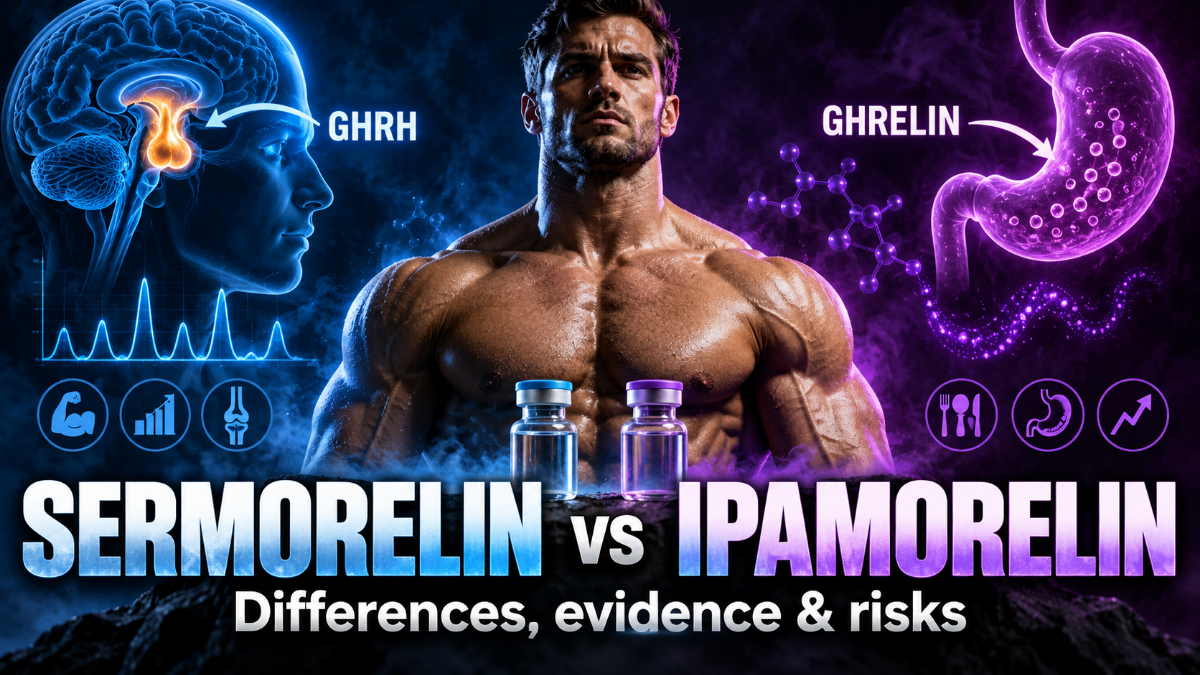
Sermorelin vs Ipamorelin: Differences, Evidence & Risks
Sermorelin vs ipamorelin: how each raises growth hormone, FDA history, what research shows for muscle, side effects, and 2026 legal and WADA status.
Sermorelin and ipamorelin are both marketed to lifters and "anti-aging" clinics as ways to raise growth hormone (GH) without taking GH itself. They are often mentioned in the same breath, but they work through different receptors, have very different regulatory histories, and neither has good evidence for building muscle in healthy adults.
This guide compares how each one works, what the research shows, their side effects, and their legal and anti-doping status in 2026. It does not cover dosing or combining them, because neither is approved for bodybuilding and no safe protocol for that use exists.
The Short Answer
- 1Sermorelin is a lab-made copy of the active part of growth hormone-releasing hormone (GHRH). It acts on the GHRH receptor in the pituitary.
- 2Ipamorelin is a small synthetic peptide that mimics ghrelin and acts on the growth hormone secretagogue receptor, a different pathway.
- 3Sermorelin was FDA-approved in the 1990s as Geref for diagnosing and treating growth hormone deficiency in children. It was discontinued in 2008, and FDA later confirmed that this was not for safety or effectiveness reasons.
- 4Ipamorelin has never been approved anywhere. Its largest published human trial, in bowel recovery after surgery, found it was well tolerated but no better than placebo.
- 5Neither has been shown to increase muscle or strength in healthy adults. Both are prohibited at all times by the World Anti-Doping Agency.
Sermorelin vs Ipamorelin at a Glance
How sermorelin and ipamorelin compare
Type
GHRH analogue (first 29 amino acids of GHRH)
Ghrelin mimetic, 5 amino acids
Receptor
GHRH receptor
Growth hormone secretagogue receptor (ghrelin receptor)
FDA history
Approved 1990 (diagnostic) and 1997 (pediatric GH deficiency) as Geref; discontinued 2008
Never approved
Human research
Pediatric GH deficiency studies from the 1980s and 1990s
Small studies; phase 2 trial in post-surgical ileus showed no benefit over placebo
Evidence for muscle gain in healthy adults
None of good quality
None of good quality
WADA status
Prohibited (S2, GHRH analogues)
Prohibited (S2, GH secretagogues)
How Sermorelin Works
Your hypothalamus releases GHRH in pulses, which tells the pituitary gland to release growth hormone. Sermorelin is a 29-amino-acid version of GHRH, the shortest fragment that keeps full activity. It binds the same receptor and triggers a GH pulse. Because it works through the body's own control system, GH release is still limited by feedback from somatostatin and IGF-1, which is the main argument people make for it over GH injections.
Sermorelin is broken down quickly, so its effect is short. That is one reason longer-acting GHRH analogues such as CJC-1295 were developed. We cover CJC-1295 in CJC-1295 for muscle growth.
How Ipamorelin Works
Ipamorelin acts on the ghrelin receptor, the same receptor targeted by older growth hormone-releasing peptides such as GHRP-2 and GHRP-6. What made ipamorelin interesting to researchers was its selectivity: in a 1998 animal study it released GH without significantly raising cortisol or ACTH, even at high doses, unlike GHRP-2 and GHRP-6.
Because ipamorelin and sermorelin act on different receptors, they are often marketed together on the theory that they add to each other. That idea has not been tested in controlled human studies for muscle or fat loss. Our guide to ipamorelin for bodybuilding covers its claimed benefits in more detail.
What the Research Shows
Both peptides have limited human research, and almost none of it looks at the goals lifters care about.
Sermorelin Research
Sermorelin's human evidence comes mainly from children with idiopathic growth hormone deficiency, where it increased growth rates, although generally less than GH itself. There are no good-quality trials showing that sermorelin builds muscle, improves strength or speeds recovery in healthy adults. Claims about anti-aging benefits in adults rest on small, older studies and on the general idea that raising GH should help, which has not been confirmed.
Ipamorelin Research
Ipamorelin was developed as a drug candidate but never reached approval. In a randomized, placebo-controlled phase 2 trial of 114 patients recovering from bowel surgery, ipamorelin was well tolerated, but it did not shorten the time to tolerating a solid meal compared with placebo. There are no published controlled trials of ipamorelin for muscle growth, fat loss or sleep in healthy adults.
Does More Growth Hormone Build Muscle?
This is the key question for lifters, and the evidence is discouraging. A systematic review in the Annals of Internal Medicine found that GH itself increased lean body mass in healthy, young, active adults, but it did not improve strength or exercise capacity, and people taking it more often had fluid retention and fatigue. Part of the extra lean mass appears to be water. If injecting GH directly does not make healthy people stronger, there is little reason to expect peptides that cause smaller, shorter GH pulses to do so. We discuss this in CJC-1295 + ipamorelin for muscle growth.
Side Effects
Neither peptide has been studied in long-term trials in healthy adults, so the full side-effect picture is unknown. Reported and expected effects include:
- 1Injection-site reactions such as pain, redness and swelling, which were the most common effects reported with sermorelin in clinical use
- 2Flushing, headache and dizziness
- 3Fluid retention, joint pain and tingling or numbness in the hands, which are typical of raised growth hormone
- 4Increased hunger, a known effect of some ghrelin-receptor peptides
- 5Higher blood sugar and reduced insulin sensitivity with sustained GH elevation
There are also concerns specific to how these peptides are obtained. Products sold online as "research peptides" are not made to pharmaceutical standards, and their content and sterility are not verified. Raising GH and IGF-1 is also a concern for anyone with a history of cancer, and these peptides are not suitable during pregnancy or for anyone under 18 unless prescribed by a specialist.
Legal and Anti-Doping Status in 2026
- 1Sermorelin: Not currently marketed as an approved product in the United States. Because it was once FDA-approved and was not withdrawn for safety reasons, it can be prepared by compounding pharmacies with a prescription, which is how most clinics provide it.
- 2Ipamorelin: Not approved anywhere. FDA has listed ipamorelin acetate in Category 2 of its interim compounding lists for outsourcing facilities, meaning it may present significant safety risks. Its status for traditional compounding pharmacies remains uncertain as FDA reviews peptide nominations.
- 3Both: Prohibited at all times under section S2 of the WADA Prohibited List, which covers GHRH analogues and growth hormone secretagogues. Tested athletes should not use either.
Peptide rules have been changing quickly in 2026, so check current FDA guidance before assuming anything is permitted.
Which One Makes Sense?
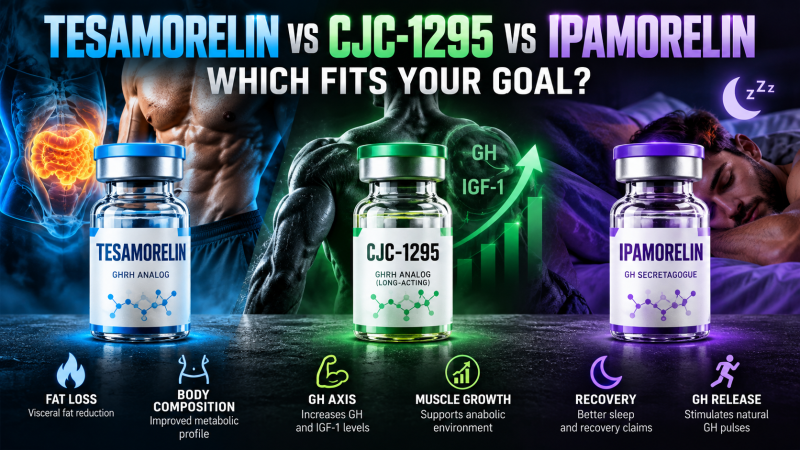
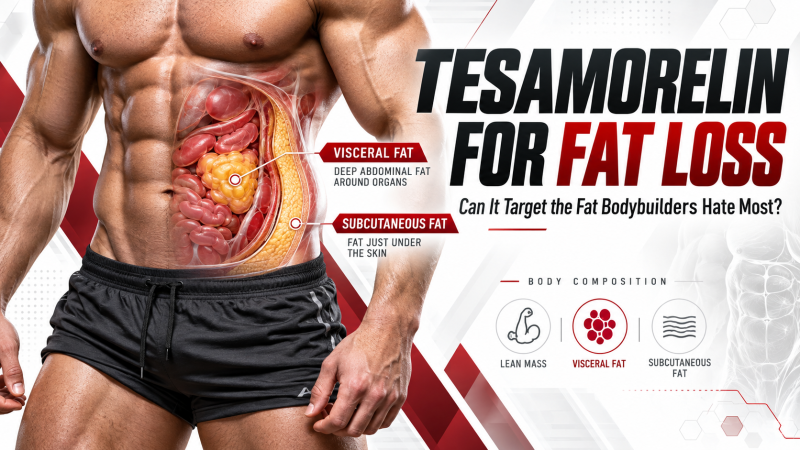
For building muscle or getting lean, neither has the evidence to recommend it. If you are an adult concerned about low growth hormone, the right step is testing with an endocrinologist, because true adult GH deficiency is diagnosed with specific stimulation tests and treated with approved therapies. If your goal is visceral fat, tesamorelin is the only GHRH analogue currently FDA-approved, and only for a specific condition; see tesamorelin for fat loss. For a three-way comparison, read tesamorelin vs CJC-1295 vs ipamorelin.
FAQ
Sermorelin mimics GHRH and acts on the GHRH receptor. Ipamorelin mimics ghrelin and acts on the growth hormone secretagogue receptor. Both cause the pituitary to release growth hormone, but through different pathways.
It was approved as Geref for children with growth hormone deficiency, but the product was discontinued in 2008. FDA later confirmed it was not withdrawn for safety or effectiveness reasons. Today it is available mainly through compounding pharmacies.
No. Ipamorelin has never been approved, and its main phase 2 trial did not show a benefit over placebo for its intended use.
There is no good evidence that either builds muscle or strength in healthy adults. Even GH itself increases lean mass in healthy people without improving strength.
Yes. Both are prohibited at all times under section S2 of the WADA Prohibited List.
Sources
- 1Sermorelin: a review of its use in the diagnosis and treatment of children with idiopathic growth hormone deficiency, BioDrugs, 1999
- 2Determination That GEREF (Sermorelin Acetate) Was Not Withdrawn From Sale for Reasons of Safety or Effectiveness, Federal Register, March 2013
- 3Ipamorelin, the first selective growth hormone secretagogue, Eur J Endocrinol, 1998
- 4Prospective, randomized, controlled, proof-of-concept study of the ghrelin mimetic ipamorelin for the management of postoperative ileus, Int J Colorectal Dis, 2014
- 5Systematic review: the effects of growth hormone on athletic performance, Ann Intern Med, 2008
- 6Certain Bulk Drug Substances for Use in Compounding that May Present Significant Safety Risks, U.S. FDA
- 72026 Prohibited List, World Anti-Doping Agency
This article is for information only. It is not medical advice and does not recommend using sermorelin or ipamorelin. Talk to a doctor before using any hormone-related treatment.

Dr. Andrii Kaleniuk
Author
Comments (0)
Be the first to comment on this article.
More articles