
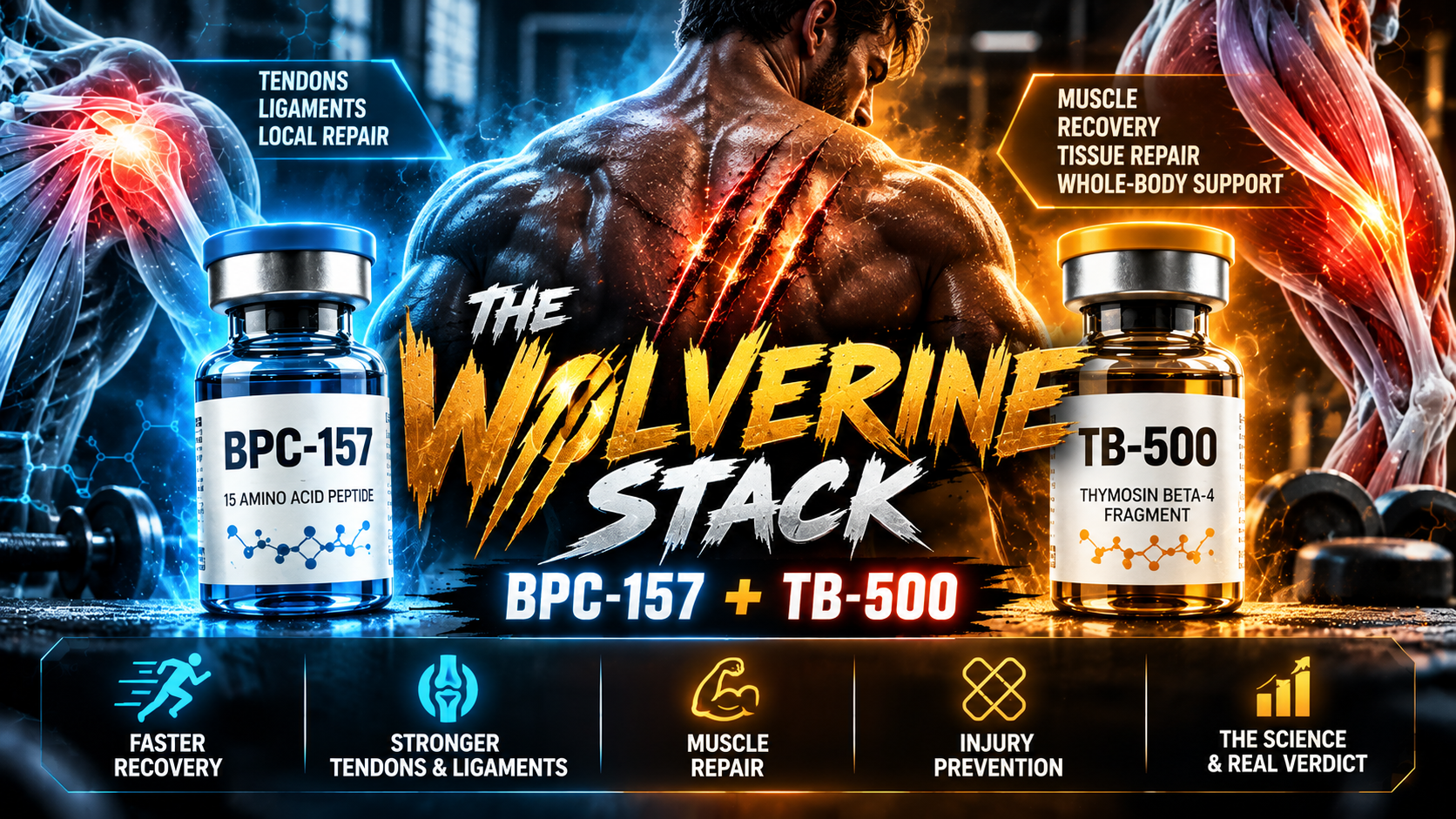
The Wolverine Stack: Why Bodybuilders Combine BPC-157 and TB-500
Two experimental peptides. One superhero-inspired nickname. The Wolverine Stack combines BPC-157 and TB-500, promising faster tendon healing, muscle recovery, and a quicker return to heavy lifting. It's become one of bodybuilding's most talked-about recovery combinations—but does stacking two peptides actually make them more effective? A 2026 study directly tested BPC-157, TB-500, and their combination, revealing a surprising result that challenges the hype. Let's break down why the Wolverine Stack went viral, what the science really shows, and whether this controversial peptide duo deserves its reputation.
The Wolverine Stack: Why Bodybuilders Combine BPC-157 and TB-500
Two experimental peptides. One superhero-inspired nickname. And a promise that sounds almost too good to be true: recover from injuries faster and get back to heavy lifting. But a 2026 study delivered an unexpected result that challenges the entire idea behind the Wolverine Stack.
Your shoulder hurts every time you bench. Your elbow has been complaining for months. Your training partner is dealing with an Achilles tendon injury that refuses to settle down. And then someone at the gym mentions the Wolverine Stack.
Not a new pre-workout. Not another supplement promising better pumps. A combination of two peptides supposedly capable of accelerating tissue repair.
BPC-157 + TB-500.
The name is inspired by Wolverine, the fictional superhero famous for recovering from injuries at an almost impossible speed. It's a brilliant nickname. Who wouldn't want that kind of recovery ability? Especially when an injury is standing between you and your next personal record.
But there's one detail the name doesn't tell you. The Wolverine Stack has a superhero-sized reputation and a surprisingly small body of direct scientific evidence.
And in July 2026, researchers finally published something bodybuilding forums had been missing: an experiment that tested the two peptides together. The results? Not what the combination's biggest fans might have expected.
So what is the Wolverine Stack, why did it become so popular, and does combining BPC-157 with TB-500 actually make more sense than using either compound alone? Let's investigate.
What Is the Wolverine Stack?
The Wolverine Stack is an unofficial name for combining two experimental peptides:
- 1BPC-157: Commonly associated with tendon, ligament, and localized injury-recovery claims.
- 2TB-500: Commonly associated with broader tissue-repair and muscle-recovery claims.
The idea is straightforward. BPC-157 is supposed to help an injured area repair itself. TB-500 is supposed to support biological processes involved in tissue repair more broadly. Combine them, according to the theory, and you might get a more powerful recovery effect.
Sounds logical. But here's the first problem. A plausible theory is not a demonstrated treatment effect.
The Wolverine Stack isn't a recognized medical treatment. It doesn't have an FDA-approved indication. And there is no clinically established protocol showing that the combination accelerates recovery from bodybuilding injuries.
The name comes from gym, peptide, and biohacking culture—not from an established clinical therapy. That distinction becomes even more important when you look at why the combination became popular.
Why Did the Wolverine Stack Go Viral?
The Wolverine Stack has nearly everything required for a successful fitness trend. A memorable name. A problem millions of athletes recognize. Scientific language that makes it sound credible. And a promise that goes directly to the heart of bodybuilding frustration.
What if you could recover faster without losing months of progress?
Injury Recovery Is an Emotional Selling Point
Think about what happens when a dedicated lifter gets injured. It's rarely just physical discomfort. Their training routine changes. Strength numbers begin slipping. Favorite exercises disappear. Progress becomes unpredictable.
For competitive athletes, injuries can affect entire seasons. For recreational bodybuilders, they can disrupt months of disciplined work. A compound claiming to shorten that disruption has immediate appeal. And a combination claiming to work even better is particularly tempting.
The Name Does Half the Marketing
Calling something the Wolverine Stack creates an expectation before anyone looks at a study. Wolverine doesn't spend months rebuilding tendon strength. He heals almost instantly. That association makes a scientific hypothesis feel like an outcome.
But no human clinical evidence shows that BPC-157 and TB-500 together reproduce anything resembling accelerated superhero-style healing. The name is branding. Not biology.
Online Testimonials Make the Story More Convincing
Peptide discussions often include claims such as:
- 1A painful shoulder improved after several weeks.
- 2Elbow discomfort disappeared.
- 3A stubborn tendon problem finally settled down.
- 4Training resumed sooner than expected.
- 5Combining both peptides seemed more effective than using one.
Those experiences may be sincerely reported. But testimonials cannot determine whether the stack caused the improvement. Injured athletes frequently change multiple things at once. They may reduce training volume, avoid painful movements, sleep more, start physical therapy, or simply allow additional time for recovery.
Without a proper comparison group, identifying the effect of the peptides becomes extremely difficult. A comeback story can be real without proving which intervention caused the comeback. And that brings us to the two ingredients.
BPC-157: The Supposed Local Repair Specialist
BPC-157 stands for Body Protection Compound-157. It is a synthetic peptide made of 15 amino acids. Researchers have investigated it in experimental models of tissue protection and repair.
Some studies have examined tendon healing, ligament injuries, muscle damage, and other forms of tissue injury. The results have attracted genuine scientific interest. But almost all of that research is preclinical.
What Researchers Have Observed
In animal and laboratory studies, BPC-157 has been associated with changes involving:
- 1Tendon fibroblast migration.
- 2Cell survival under experimental stress.
- 3Tissue organization during repair.
- 4Blood-vessel-related signaling.
- 5Inflammation-related processes.
A 2011 study, for example, found that BPC-157 promoted the migration of tendon fibroblasts. The researchers also observed changes involving the FAK-paxillin signaling pathway, which participates in cell movement and adhesion.
Those findings provide possible biological explanations for some experimental healing effects. But they do not establish that BPC-157 heals human rotator cuff injuries or chronic elbow tendinopathy.
Does BPC-157 Really Target One Injured Area?
Here's an important correction to the bodybuilding narrative. BPC-157 is frequently described as the local component of the Wolverine Stack. That makes it sound as though the peptide can selectively identify an injured tendon and concentrate its effects there.
That targeting ability has not been demonstrated in convincing human clinical research.
Its reputation for localized injuries comes largely from the kinds of problems people discuss and the preclinical tissues researchers have studied. It should not be confused with proof of site-specific action.
TB-500: The Supposed Whole-Body Recovery Specialist
TB-500 has a different reputation. Instead of being associated primarily with one painful tendon, it is marketed as a broader recovery compound.
Claims frequently include improved recovery of:
- 1Muscles.
- 2Tendons.
- 3Ligaments.
- 4Other soft tissues.
- 5Multiple injured areas.
The biological story usually revolves around thymosin beta-4. And that's where an important scientific distinction appears.
TB-500 Is Not Automatically the Same as Thymosin Beta-4
Full-length thymosin beta-4 is a naturally occurring peptide containing 43 amino acids. It has been investigated for its involvement in cell movement, actin regulation, vascular processes, and tissue repair.
TB-500 is commonly identified as a shorter synthetic fragment associated with thymosin beta-4. The FDA has specifically described a seven-amino-acid fragment, LKKTETQ, as TB-500. Those structures are not identical.
Why does that matter? Because much of the research used to promote TB-500 actually investigates full-length thymosin beta-4. Results obtained with the complete 43-amino-acid molecule cannot automatically be applied to the shorter fragment.
Researchers must establish which specific compound produces which specific effects.
The 2026 Review That Exposed the Evidence Gap
A 2026 scoping review investigated thymosin beta-4 and TB-500 research through March 2026. The authors included 80 studies. Of those, 70 evaluated thymosin beta-4. Only one directly evaluated TB-500.
Human evidence was concentrated mainly in settings such as wound or eye-related research, rather than athletic tendon and muscle recovery. A newer rat tendon experiment appeared after that review's literature cutoff.
But the central distinction remains. The scientific literature on thymosin beta-4 is much larger than the direct evidence for TB-500 itself. That matters when TB-500 is presented as the second half of a supposedly powerful recovery stack.
Why Combining BPC-157 and TB-500 Sounds So Logical
The Wolverine Stack is built on the idea of complementary mechanisms. In simplified online explanations: BPC-157 supposedly supports repair-related signaling and tendon-cell activity. TB-500 supposedly supports cell movement and broader tissue remodeling.
The conclusion sounds obvious. If both influence healing through different pathways, why not combine them? The answer is that different mechanisms don't automatically produce additive benefits.
Two compounds can affect overlapping downstream processes. One may already produce most of the effect possible under particular conditions. Their effects may not add together. And a combination may introduce new risks without producing greater benefits.
Synergy Is Something Researchers Must Demonstrate
There are three different possibilities when two experimental compounds are combined.
- 1Additive effects: Together, they produce a greater effect than either one alone.
- 2Synergistic effects: Together, they produce an effect greater than expected from simply adding their individual effects.
- 3No additional benefit: The combination performs similarly to one or both individual treatments.
All three are biologically possible. You cannot determine which applies just by reading separate studies about the individual compounds. You need a direct comparison. And in 2026, researchers finally conducted one.
The 2026 Wolverine Stack Study: The Plot Twist Nobody Expected
On July 23, 2026, researchers published a study in Joint Diseases and Related Surgery examining BPC-157, TB-500, and their combination in a rat Achilles tendon injury model.
This is the most directly relevant published experiment for the Wolverine Stack's central promise. Because the researchers weren't simply studying one peptide and speculating about the other. They tested both. Separately. And together.
How the Study Worked
Researchers used 32 male rats. Each underwent a standardized Achilles tendon injury followed by surgical repair. The animals were divided into four groups of eight:
- 1Control group.
- 2BPC-157 group.
- 3TB-500 group.
- 4BPC-157 plus TB-500 group.
After approximately four weeks, investigators examined tendon healing. They measured mechanical strength and evaluated tissue structure using laboratory techniques.
An important detail: only four tendons per group were used for biomechanical testing, and four for histological analysis. So although 32 animals participated, the individual outcome measurements involved very small groups. That matters when interpreting statistical results.
The Tendon Strength Results
One of the most interesting measurements was maximum load to failure. This measures how much force a tendon can withstand before breaking during a controlled mechanical test. The reported median values were:
- 1| Treatment group | Median maximum load to failure |
- 2| Control | 26.91 N |
- 3| BPC-157 | 37.16 N |
- 4| TB-500 | 37.41 N |
- 5| BPC-157 + TB-500 | 34.54 N |
Both individual peptide groups had higher numerical values than the control group. But only the TB-500 group showed a statistically significant improvement compared with control in the study's adjusted pairwise analysis.
The adjusted p-values were:
- 1TB-500 vs control: 0.0406.
- 2BPC-157 vs control: 0.389.
That result is interesting. But it needs careful interpretation. TB-500 reaching statistical significance against control does not establish that TB-500 was statistically better than BPC-157.
In fact, the experiment did not find a significant direct difference between the two individual peptide groups. Their median load-to-failure results were also very close.
So this isn't proof that TB-500 wins the recovery-peptide competition. It's a small animal experiment showing a particular pattern of results.
What Happened When Researchers Combined Them?
Here's the result that matters most for the Wolverine Stack. The combination did not demonstrate additional benefit over either compound alone.
The median maximum load-to-failure result for the combined group was 34.54 N. That was lower than the corresponding medians for both individual treatment groups.
The combination wasn't established as mechanically superior to the control group in the adjusted pairwise comparisons. In other words, the experiment did not support the assumption that combining the peptides creates a stronger tendon. And that's a serious challenge to the popular stacking theory.
Did the Stack Show Any Positive Findings?
Yes—and this is where the story requires nuance. The study didn't show that the combined treatment had no biological activity whatsoever. Researchers also evaluated tendon tissue under the microscope.
The combination group showed a statistically significant improvement versus control in the total Movin histopathology score. But it did not demonstrate a clear advantage over the individual treatment groups.
That distinction is important. Showing some improvement compared with an untreated control is not the same as proving the combination is better than either peptide alone. The evidence for a special stacking advantage was missing.
Does This Mean the Wolverine Stack Is Scientifically Dead?
No. The experiment was small. It involved rats. The investigators studied a surgically repaired Achilles tendon over a relatively short period.
They did not investigate chronic shoulder pain, elbow tendinopathy, or muscle strains in humans. The researchers also did not establish whether different experimental conditions might produce different results.
So the study cannot prove that all possible combinations are ineffective. But it directly challenges the confident claim that stacking BPC-157 and TB-500 must produce better recovery.
The experiment tested the logic behind the Wolverine Stack—and did not demonstrate the extra benefit its reputation implies.
What About Human Evidence for the Wolverine Stack?
This is where things become even more limited. As of October 2026, there is no convincing controlled human trial demonstrating that the BPC-157 and TB-500 combination accelerates healing of muscles, tendons, or ligaments.
No reliable clinical trial has established that the Wolverine Stack gets lifters back to heavy training faster. And no rigorous human study has established the long-term safety of using the two together.
But there is an older human report worth discussing.
The 2021 Knee Pain Study
A retrospective study published in 2021 examined patients who received BPC-157 for knee pain, either alone or with thymosin beta-4.
Of 17 patients identified, 16 were contacted for follow-up. Twelve had received BPC-157 alone. The remaining four had received BPC-157 together with thymosin beta-4.
Among those four combination recipients, three reported significant improvement in knee pain. That sounds encouraging. But look at the limitations.
- 1There were only four people in the combination subgroup.
- 2There was no randomized control group.
- 3There was no placebo comparison.
- 4The researchers relied on retrospective symptom reports.
- 5The study did not demonstrate structural healing of damaged tendons or ligaments.
Most importantly, it investigated BPC-157 with thymosin beta-4—not a clearly established trial of the shorter TB-500 fragment commonly discussed in Wolverine Stack marketing.
It would be misleading to describe that tiny subgroup as proof that the modern Wolverine Stack works.
The Difference Between Pain Relief and Tissue Repair
This is especially relevant to bodybuilders. Imagine someone with chronic knee pain who reports feeling much better after an experimental treatment. That's a meaningful experience. But did the tendon actually recover?
Did its mechanical strength improve? Could the person tolerate heavier training loads? Was reinjury risk reduced? Those questions weren't answered.
For athletes, symptom improvement and structural recovery are not interchangeable. And when the goal is returning to heavy training, that difference matters.
Wolverine Stack Claims vs. What the Evidence Actually Shows
Let's put the biggest claims side by side with the research.
- 1| Popular Wolverine Stack claim | What the evidence actually supports |
- 2| Two peptides heal injuries faster than one | Not demonstrated in human trials; the 2026 rat study found no additional combination benefit |
- 3| BPC-157 targets the injured area | Selective targeting has not been established in convincing human research |
- 4| TB-500 provides whole-body muscle recovery | No convincing human athletic-recovery evidence |
- 5| The stack repairs torn tendons | Experimental animal tendon findings; no demonstrated human treatment efficacy |
- 6| Combining the peptides prevents reinjury | No reliable evidence |
- 7| The stack can replace rehabilitation | No evidence supports this |
- 8| The combination is safe because both are peptides | Human safety of the combination remains insufficiently characterized |
There is an important pattern here. The claims sound clinical. The evidence is still overwhelmingly experimental. And those are two very different things.
The Hidden Risks of the Wolverine Stack
Even if the combination's benefits are uncertain, its risks deserve attention. Both BPC-157 and TB-500 are experimental substances. Neither has FDA approval as a treatment for bodybuilding injuries. And there are no established long-term human safety data for their combined use.
1. Two Experimental Compounds Mean More Unknowns
BPC-157 has not undergone the kind of large, rigorous human safety testing expected of an approved medication. TB-500 faces similar limitations. Combining them introduces additional unanswered questions.
Could they affect some of the same biological pathways? Could their effects interact? Could a combination change the way either compound is processed? We don't have reliable human studies establishing those answers.
It would be incorrect to assume a combination is safe merely because each compound has produced encouraging results in some animal experiments.
2. Product Identity and Purity Matter
Another problem involves products marketed online as research peptides. The advertised label doesn't prove that a product contains exactly what it claims. Nor does it establish freedom from relevant impurities or contamination.
TB-500 creates a particular identification challenge because the name is sometimes used imprecisely in commercial discussions. Research involving full-length thymosin beta-4 should not automatically be treated as evidence about a product containing a shorter fragment.
And uncertainty about the contents of a combination product makes its effects even harder to evaluate.
3. The FDA Has Identified Safety Concerns
The FDA has identified potential safety concerns involving BPC-157 and the thymosin beta-4 fragment commonly called TB-500. These include possible immunogenicity for certain routes of administration and complications involving peptide-related impurities.
For TB-500, the agency has also highlighted the lack of identified human exposure data for drug products containing the relevant fragment. These concerns don't prove that every exposure causes harm. They mean the evidence needed to characterize safety adequately is missing.
4. The 2026 FDA Compounding Discussion Was Not Drug Approval
Both BPC-157-related and TB-500-related substances were discussed at an FDA Pharmacy Compounding Advisory Committee meeting in July 2026. That regulatory discussion involved potential pharmacy-compounding uses.
It did not establish that either peptide is an FDA-approved treatment for tendon or muscle injuries. It also didn't demonstrate that combining them improves healing.
A regulatory committee considering a substance and a clinical trial proving its effectiveness are completely different events.
5. Competitive Bodybuilders Face Anti-Doping Issues
Both BPC-157 and TB-500 are prohibited under applicable World Anti-Doping Agency rules. BPC-157 has been identified under the category for non-approved substances.
Thymosin beta-4 and derivatives, including TB-500, have also been specifically identified as prohibited. For athletes competing in tested organizations, the Wolverine Stack can create eligibility consequences regardless of whether its recovery benefits have been established.
Could the Wolverine Stack Actually Make Recovery Worse?
There is no strong human clinical evidence demonstrating that the combination systematically worsens tendon healing. And the 2026 rat study does not establish that the stack damages recovering tendons.
But there's another concern that doesn't require the peptides themselves to directly damage tissue. What happens if an athlete feels better and mistakes that for complete recovery?
Imagine a bodybuilder with persistent shoulder pain. After several weeks, their discomfort decreases. They assume the Wolverine Stack accelerated healing. They return to heavy pressing. But their shoulder strength and load tolerance haven't fully recovered.
A reduction in pain doesn't guarantee that a tendon is ready for maximal loading. That is true regardless of whether the improvement came from an experimental compound, rehabilitation, or the natural course of recovery.
The danger lies in treating symptom relief as proof that the underlying tissue has regained its previous capacity.
What Actually Helps Bodybuilders Return to Training?
Here's something that rarely gets a superhero nickname. Progressive rehabilitation. It isn't as exciting as an experimental two-peptide combination. But it has a much stronger foundation in human clinical research for certain tendon problems.
Human Trials Support Progressive Tendon Loading
A randomized trial involving 76 people with patellar tendinopathy compared progressive tendon-loading exercise with eccentric exercise therapy. After 24 weeks, the progressive-loading group showed greater average improvement in the primary clinical outcome.
The trial involved real patients with diagnosed tendon problems. That's a fundamentally different level of evidence from measuring tendon healing in a handful of rats.
It doesn't mean every injury needs the same rehabilitation program. A torn tendon, a muscle strain, and chronic tendinopathy are different clinical problems. But appropriate load management, strengthening, functional assessment, and gradual return to activity remain important elements of recovery.
The Goal Isn't Simply to Feel Better
For bodybuilders, successful recovery involves several things:
- 1Understanding which structure is actually injured.
- 2Restoring appropriate movement and strength.
- 3Rebuilding tolerance to progressively heavier loads.
- 4Adjusting training when symptoms or function indicate a problem.
- 5Returning to demanding exercises without repeatedly provoking setbacks.
An athlete's ability to train consistently depends on more than whether pain has disappeared. And no controlled clinical evidence shows that the Wolverine Stack can replace these recovery principles.
Why the Wolverine Stack Is Such a Powerful Marketing Idea
There's a bigger lesson here. The Wolverine Stack isn't just a story about two peptides. It's a story about how experimental science becomes a fitness trend.
First, researchers observe an interesting biological effect. Then people speculate about potential applications. Anecdotal recovery stories appear. Two compounds with different theoretical mechanisms get paired together. Someone gives the combination an unforgettable name.
And before long, the language shifts.
- 1May influence tissue repair becomes supports healing.
- 2Promising animal findings becomes works for injuries.
- 3Two possible mechanisms becomes powerful synergy.
But those leaps require evidence. A clever combination isn't automatically a clinically effective combination. And an impressive nickname doesn't change what the experiments found.
What Would It Take to Prove the Wolverine Stack Works?
A convincing human trial would need more than patients reporting that they felt better. Ideally, researchers would study people with a clearly defined injury and compare several groups:
- 1Standard rehabilitation with an appropriate control or placebo.
- 2BPC-157 with otherwise equivalent care.
- 3TB-500 with otherwise equivalent care.
- 4BPC-157 plus TB-500 with otherwise equivalent care.
They would need to measure outcomes such as pain, strength, physical function, return-to-training time, adverse events, and possibly validated tissue-healing measures.
Most importantly, the study would need to establish whether the combination performs better than either peptide alone. Because that's the central promise of stacking.
Without that comparison, even positive findings wouldn't necessarily support a Wolverine Stack advantage. Researchers would also need appropriately sized studies and longer-term safety follow-up. Until then, the idea remains experimental.
The Verdict: Is the Wolverine Stack Worth the Hype?
Let's settle the question. The Wolverine Stack has a plausible scientific story, but no convincing human clinical evidence proving that BPC-157 and TB-500 heal bodybuilding injuries faster when combined.
BPC-157 has shown interesting effects in preclinical tendon and connective-tissue research. Thymosin beta-4 has a broader biological research history, although that research cannot automatically be assigned to the shorter TB-500 fragment.
And a 2026 rat study directly tested the combination. That's where the story becomes particularly revealing. The researchers found some favorable tendon-healing outcomes in treated animals.
TB-500 achieved a statistically significant advantage over control in a specific mechanical measurement. The combination showed an improvement over control in one histological score.
But combining BPC-157 and TB-500 did not demonstrate an additional benefit over using either compound alone.
So the biggest promise behind the Wolverine Stack—two recovery peptides are better than one—remains unproven.
Human efficacy is not established. Long-term safety is insufficiently characterized. And the combination has not demonstrated that it gets lifters back to heavy training faster or safer.
Could future research change the picture? Absolutely. But right now, the name is doing more work than the evidence.
Final verdict: Interesting research. Excellent branding. Unproven synergy.
And perhaps that's the real lesson for bodybuilders. Wolverine can heal in seconds because he's fictional. Real tendons, muscles, and ligaments need to regain function and tolerate force.
The ultimate recovery flex isn't getting back under the bar a week earlier. It's getting back strong enough that the injury stops controlling your training.
Frequently Asked Questions
The Wolverine Stack is an unofficial nickname for combining BPC-157 and TB-500, two experimental peptides associated with tissue-repair research. The name refers to the fictional superhero Wolverine and his rapid healing ability. It is not an established or FDA-approved medical treatment.
The theory is that BPC-157 may influence tendon and connective-tissue repair processes while TB-500 may affect broader cell-movement and repair-related pathways. Users hope the two compounds will produce greater benefits together. However, the proposed synergy has not been demonstrated in controlled human trials.
There is no convincing clinical evidence showing that the Wolverine Stack accelerates recovery from human muscle, tendon, or ligament injuries. A 2026 rat Achilles tendon experiment found certain favorable tissue outcomes, but the combination did not demonstrate additional benefit over the individual peptides.
Not established. The 2026 rat tendon study did not show that combining BPC-157 with TB-500 produced superior mechanical or histological outcomes compared with the individual compounds. No rigorous human trial has demonstrated a combination advantage.
No controlled human clinical studies have established that the combination repairs rotator cuff injuries, elbow tendinopathy, or other common bodybuilding-related shoulder and elbow conditions. The existing findings cannot reliably predict effectiveness for these specific human injuries.
Not necessarily. Full-length thymosin beta-4 contains 43 amino acids, while TB-500 is commonly associated with a shorter fragment identified as LKKTETQ. Commercial naming can be inconsistent, and research on full-length thymosin beta-4 cannot automatically establish the effects of TB-500.
Its safety has not been adequately established in humans. BPC-157 and TB-500 have limited human safety data, and there is no comprehensive long-term safety evaluation of their combined use. Regulatory authorities have also raised concerns related to potential immunogenicity and product impurities.
No. Neither peptide is FDA-approved for human injury recovery. Both substances are prohibited under applicable WADA anti-doping rules, so tested athletes may face eligibility consequences.
Research and Sources
- 1Biçer O, et al. (2026). Effects of BPC-157 and TB-500 on Achilles Tendon Healing in Rats: A Histopathological and Biomechanical Study. Joint Diseases and Related Surgery. https://pubmed.ncbi.nlm.nih.gov/42542926/
- 2Vasireddi N, et al. (2025). Emerging Use of BPC-157 in Orthopaedic Sports Medicine: A Systematic Review. HSS Journal. https://pubmed.ncbi.nlm.nih.gov/40756949/
- 3McGuire F, et al. (2026). Thymosin Beta-4 and TB-500 in Tissue Healing, Regeneration, and Musculoskeletal Repair: A Scoping Review. Applied Sciences. https://doi.org/10.3390/app16126202
- 4Chang CH, et al. (2011). The Promoting Effect of Pentadecapeptide BPC 157 on Tendon Healing Involves Tendon Outgrowth, Cell Survival, and Cell Migration. Journal of Applied Physiology. https://pubmed.ncbi.nlm.nih.gov/21030672/
- 5Lee E, Padgett B. (2021). Intra-Articular Injection of BPC 157 for Multiple Types of Knee Pain. Alternative Therapies in Health and Medicine. https://pubmed.ncbi.nlm.nih.gov/34324435/
- 6Lee E, Burgess K. (2025). Safety of Intravenous Infusion of BPC157 in Humans: A Pilot Study. Alternative Therapies in Health and Medicine. https://pubmed.ncbi.nlm.nih.gov/40131143/
- 7Breda SJ, et al. (2021). Effectiveness of Progressive Tendon-Loading Exercise Therapy in Patients With Patellar Tendinopathy: A Randomised Clinical Trial. British Journal of Sports Medicine. https://pubmed.ncbi.nlm.nih.gov/33219115/
- 8U.S. Food and Drug Administration. Certain Bulk Drug Substances for Use in Compounding That May Present Significant Safety Risks. https://www.fda.gov/drugs/human-drug-compounding/certain-bulk-drug-substances-use-compounding-may-present-significant-safety-risks
- 9U.S. Food and Drug Administration (2026). July 23–24, 2026: Meeting of the Pharmacy Compounding Advisory Committee. https://www.fda.gov/advisory-committees/advisory-committee-calendar/july-23-24-2026-meeting-pharmacy-compounding-advisory-committee-07232026
- 10U.S. Anti-Doping Agency. Athlete Advisory: Explanation of Key Changes on the 2022 WADA Prohibited List. https://www.usada.org/athlete-advisory/key-changes-2022-prohibited-list/
- 11U.S. Anti-Doping Agency. 2018 Prohibited List: Summary of Major Changes, including thymosin beta-4 derivatives such as TB-500. https://www.usada.org/athlete-advisory/2018-prohibited-list-summary-of-major-changes/
Research status: October 8, 2026. This article is for educational purposes. BPC-157, TB-500, and their combination remain experimental for bodybuilding injury recovery, with no established clinical efficacy or comprehensive human safety profile.
Dr. Andrii Kaleniuk
Comments (0)
Be the first to comment on this article.