
CJC-1295 + Ipamorelin Side Effects: What Each Trial Found, What Users Report, and What the Stack Adds
CJC-1295 and ipamorelin side effects: what each peptide's trial found, what stack users report, the growth-hormone risks the DAC form adds, who should avoid it.
Written by Dr. Andrii Kaleniuk. Updated October 25, 2026.
The CJC-1295 and ipamorelin stack has never been tested together in a clinical trial, so its side effects have to be pieced together from the two drugs' separate, short histories: CJC-1295's single published human study, in which healthy adults had flushing, headache and injection-site reactions while growth hormone stayed elevated for a week; ipamorelin's one-week hospital trial, where it was as well tolerated as placebo; and the long record of what sustained growth hormone does to the body, which is where the real risks of the combination sit. Neither peptide is approved anywhere, both are prohibited in sport, and the products sold for the stack are unverified.
This guide separates what is documented for each component from what users report, explains why the long-acting DAC version of CJC-1295 changes the risk profile, lays out the growth-hormone-related effects that the stack can amplify, and covers who should avoid it. It does not include dosing: no safe dose for this combination has been established.
CJC-1295 and Ipamorelin Side Effects: The Short Answer
- 1Documented for CJC-1295 (one trial, 2006): flushing, headache, injection-site pain and redness, transient low blood pressure and dizziness; GH raised 2 to 10 times for about 6 days and IGF-1 raised 1.5 to 3 times for up to 11 days after a single dose of the DAC form.
- 2Documented for ipamorelin (one trial, 2014): no more side effects than placebo over 7 days in surgical patients. Users report headache, flushing, nausea, water retention, hunger and injection-site lumps.
- 3The stack adds: a larger and more sustained GH and IGF-1 rise than either alone, which increases the risk of water retention, joint pain, carpal tunnel symptoms, numbness or tingling, raised blood sugar and insulin resistance.
- 4Unknowns: no data on months of use, on cancer risk, on heart effects, or in people under 18, pregnant or with diabetes.
- 5Product risk: "CJC-1295/ipamorelin" vials are not checked for identity, dose, purity or sterility.
- 6Legal: not FDA-approved; FDA lists both as compounding substances with significant safety concerns; banned by WADA under S2.
What the Two Peptides Do, and Why They Are Stacked
CJC-1295 is a modified version of growth-hormone-releasing hormone (GHRH), the signal from the hypothalamus that tells the pituitary to release growth hormone. The version most sold, CJC-1295 with DAC, carries a chemical tag that binds it to albumin in the blood, stretching its half-life from minutes to about six to eight days, so GH stays elevated continuously rather than in pulses. Ipamorelin acts on a different receptor, the ghrelin receptor (GHS-R1a), to trigger a pulse of GH without the cortisol and hunger surge that older peptides like GHRP-6 cause. Stacking a GHRH analogue with a ghrelin mimetic produces more GH than either alone, which is the whole rationale, and is also why the side-effect profile is not simply the sum of two mild lists. The muscle claims are examined in CJC-1295 + ipamorelin for muscle growth.
What the Trials Actually Reported
Human safety data for each component
Study
Teichman et al., J Clin Endocrinol Metab, 2006
Beck et al., Int J Colorectal Dis, 2014
Design
Two placebo-controlled dose-escalation studies in healthy adults aged 21 to 61, single and multiple doses
Randomized, placebo-controlled, 114 patients after bowel surgery, up to 7 days
Hormone effect
GH up 2 to 10 fold for 6 or more days; IGF-1 up 1.5 to 3 fold for 9 to 11 days; half-life 5.8 to 8.1 days
Acute GH pulses; no sustained IGF-1 data
Adverse events
Mostly mild: injection-site reactions, headache, flushing, transient fall in blood pressure, dizziness; no serious events
Any adverse event 87.5% vs 94.8% placebo; well tolerated
Longest exposure
About 4 weeks of repeated dosing
7 days
Development
Developed by ConjuChem for HIV lipodystrophy; development ended around 2006 and it was never submitted for approval
Stopped after failing its efficacy endpoint
Two points follow. First, both drugs looked tolerable in short studies, which is the basis of the "safe" reputation. Second, nobody has studied what bodybuilders actually do with them: weekly or daily injections for months, often alongside other substances. The ipamorelin side effects guide covers the single-peptide data in more depth.
Side Effects Users Commonly Report on the Stack
These come from forums, clinic FAQs and vendor pages. They cannot show frequency or causation, and some may reflect what else was in the vial, but the same complaints recur:
- 1Water retention and puffiness, especially in the hands, feet and face; a few kilograms of fluid in the first weeks is commonly described
- 2Headache, often within an hour of injecting
- 3Flushing, warmth or a brief head rush right after the shot
- 4Dizziness or light-headedness (consistent with the blood pressure dip seen in the CJC-1295 trial)
- 5Numbness, tingling or carpal tunnel symptoms in the hands
- 6Joint stiffness or aches
- 7Increased hunger (ipamorelin is a ghrelin mimetic) and, for some, vivid dreams or disturbed sleep
- 8Fatigue or, conversely, difficulty sleeping
- 9Injection-site redness, itching, bruising or small lumps, more often reported with the DAC form
- 10Raised fasting blood sugar on home meters
Why the DAC Version Changes the Risk
CJC-1295 without DAC (sometimes sold as modified GRF 1-29) lasts about 30 minutes and produces a GH pulse close to the body's own pattern. CJC-1295 with DAC keeps GH and IGF-1 elevated around the clock for a week or more. Continuous rather than pulsatile GH exposure is what the body sees in acromegaly, and it is the pattern most associated with fluid retention, insulin resistance, joint symptoms and tissue growth. Most "CJC-1295/ipamorelin" products use the DAC form because it is more potent per injection, which means the stack as usually sold delivers the more continuous, higher-risk exposure. We go through the GH-versus-muscle evidence in CJC-1295 for muscle growth.
Effects That Come From Raising Growth Hormone Itself
Growth-hormone-related risks and how the stack affects them
Fluid retention, swelling, joint pain
GH causes the kidneys to retain sodium and water
Well documented with GH therapy; swelling and joint pain were the most common effects in a 2008 review of GH in healthy adults
More likely; the most reported user complaint
Carpal tunnel, numbness, tingling
Soft-tissue swelling compresses nerves
Common with supraphysiologic GH
More likely with DAC
Higher blood sugar, insulin resistance
GH opposes insulin
Documented with GH therapy; risk highest in prediabetes and diabetes
More likely with continuous exposure
Effects on existing tumors
GH and IGF-1 promote cell growth
Theoretical for peptides; GH therapy is avoided in active cancer
Unknown; no long-term data
Acromegaly-like changes (jaw, hands, feet)
Sustained high GH over years
Seen with chronic GH excess
Theoretical; nobody has studied years of use
Heart effects
GH affects heart muscle and fluid balance
Cardiomyopathy in acromegaly; unstudied for peptides
Unknown
Hunger
Ghrelin receptor activation
Ipamorelin was selected for minimal hunger effect in animals, but users report it
Mild to moderate
Cortisol and prolactin
Older GHRPs raise both
Ipamorelin did not in animal studies; CJC-1295 does not
Low
The Product Problem
Almost all CJC-1295 and ipamorelin used outside a clinic comes from online vendors labeled "for research use only," and some from compounding pharmacies. FDA has placed both peptides in Category 2 of its bulk substances list for outsourcing facilities, meaning substances that may present significant safety risks, citing limited safety data and concerns about immunogenicity (immune reactions to peptide impurities). Independent testing of research peptides has repeatedly found underdosed, mislabeled and contaminated products. For an injectable, that adds infection, bacterial toxins and immune reactions to the list, and it means some of the side effects attributed to the stack may be reactions to impurities rather than to the peptides.
Who Should Avoid the Stack
- 1Anyone with a current or past cancer
- 2People with diabetes or prediabetes, or a family history of type 2 diabetes
- 3People who are pregnant or breastfeeding
- 4Anyone under 18, because GH affects growth plates
- 5People with heart failure, significant kidney disease or uncontrolled high blood pressure, because of fluid retention
- 6People with carpal tunnel syndrome or inflammatory joint disease
- 7Athletes subject to drug testing: both are prohibited at all times under WADA section S2
Warning Signs That Need a Doctor
- 1Swelling of the face, lips or throat, hives or difficulty breathing (allergic reaction)
- 2Spreading redness, warmth, pus or severe pain at an injection site
- 3Unusual thirst, frequent urination or blurred vision (high blood sugar)
- 4Persistent numbness or weakness in the hands
- 5Chest pain, palpitations or breathlessness
- 6Severe or persistent headache, or vision changes
Legal and Anti-Doping Status in 2026
- 1Neither CJC-1295 nor ipamorelin is approved by FDA or any other regulator for any use.
- 2FDA's compounding bulk substances evaluation lists both in Category 2 (may present significant safety risks); their status for traditional compounding pharmacies has been contested since 2023, and many pharmacies stopped supplying them.
- 3Selling them for human use is illegal in the United States; the "research use only" label does not change that when the marketing describes effects on muscle or recovery.
- 4WADA prohibits GHRH analogues (CJC-1295) and GH secretagogues (ipamorelin) at all times under section S2.
The Bottom Line
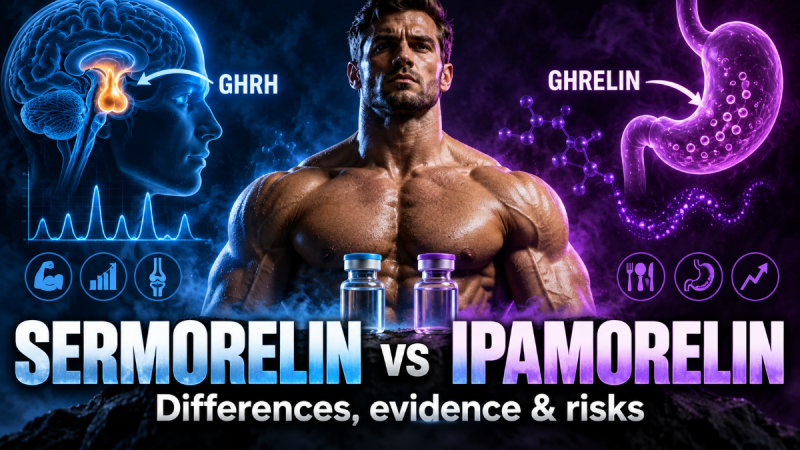
Taken separately, CJC-1295 and ipamorelin each have a week or a few weeks of human safety data showing mostly mild effects: flushing, headache, injection-site reactions, a dip in blood pressure. Taken together, as a DAC stack over months, they produce the kind of continuous growth hormone elevation that is known to cause fluid retention, nerve compression, higher blood sugar and, in theory, tissue growth, and nobody has measured how often. Add unverified products and the absence of any approval, and the honest summary is that the stack's side effects are probably mild for most people in the short term and unknown for everyone in the long term. For how these peptides compare with the one approved option in the class, see tesamorelin vs ipamorelin and tesamorelin vs CJC-1295 vs ipamorelin; for the "gentler" alternatives people consider, sermorelin vs ipamorelin.
FAQ
Commonly reported: water retention, headache, flushing, dizziness, numbness or tingling in the hands, joint aches, increased hunger and injection-site reactions. Documented in trials for each peptide alone: injection-site reactions, headache, flushing and a transient drop in blood pressure. The combination has never been tested in a trial.
Its safety has not been established. Each peptide was well tolerated in short studies, but there are no trials of the combination, no long-term data, and the products sold are unregulated. Sustained growth hormone elevation carries known risks to fluid balance, nerves and blood sugar.
Water retention is the most commonly reported effect, especially with CJC-1295 with DAC, which keeps growth hormone elevated for about a week per dose. Swelling of the hands, feet and face and a rapid weight gain of a few kilograms in the first weeks are typical descriptions.
It can. Growth hormone opposes insulin, and continuous GH elevation from the DAC form raises fasting glucose and insulin resistance in some users. People with prediabetes or diabetes are at particular risk.
Neither peptide is approved for any use. FDA lists both as compounding substances with significant safety concerns, selling them for human use is illegal in the U.S., and WADA bans both in sport at all times.
Sources
- 1Prolonged stimulation of growth hormone (GH) and insulin-like growth factor I secretion by CJC-1295, a long-acting analog of GH-releasing hormone, in healthy adults, J Clin Endocrinol Metab, 2006
- 2Pulsatile secretion of growth hormone (GH) persists during continuous stimulation by CJC-1295, J Clin Endocrinol Metab, 2006
- 3Prospective, randomized, controlled, proof-of-concept study of the ghrelin mimetic ipamorelin for the management of postoperative ileus, Int J Colorectal Dis, 2014
- 4Ipamorelin, the first selective growth hormone secretagogue, Eur J Endocrinol, 1998
- 5Systematic review: the effects of growth hormone on athletic performance, Ann Intern Med, 2008
- 6Certain Bulk Drug Substances for Use in Compounding that May Present Significant Safety Risks, U.S. FDA
- 72026 Prohibited List, World Anti-Doping Agency
- 8Acromegaly: An Endocrine Society Clinical Practice Guideline, J Clin Endocrinol Metab, 2014
This article is for information only. It is not medical advice and does not recommend using these peptides. Talk to a doctor before using any unapproved substance.

Dr. Andrii Kaleniuk
Author
Comments (0)
Be the first to comment on this article.
More articles