
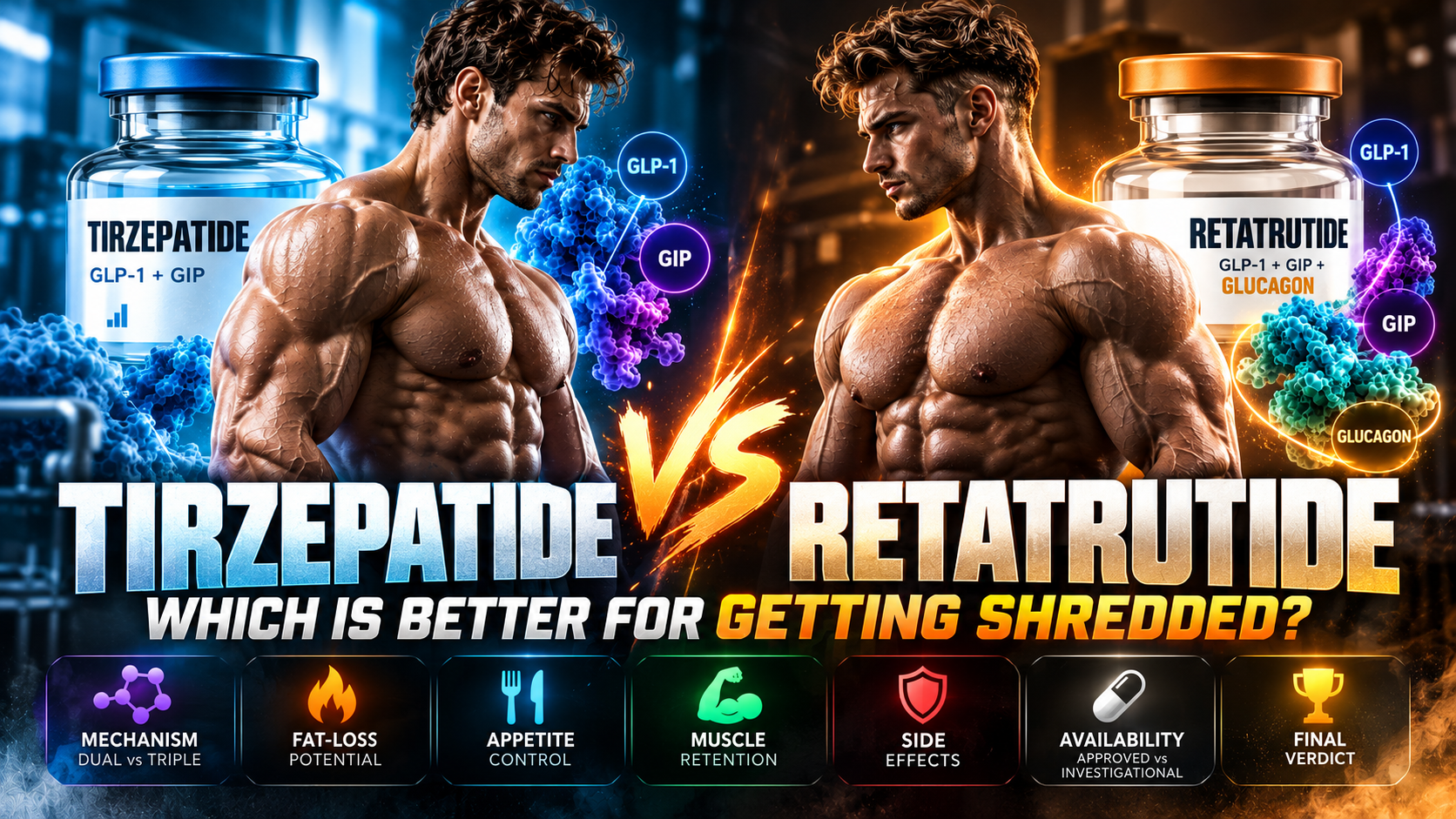
Tirzepatide vs Retatrutide: Which Is Better for Getting Shredded?
Tirzepatide and retatrutide are two of the hottest names in fat loss, but which one actually deserves the crown for bodybuilding? Tirzepatide delivered up to 20.9% average weight loss in a major clinical trial, while retatrutide pushed the headline number to 25.0% in a separate Phase 3 study. Sounds like an easy victory for Triple-G, right? Not so fast. Losing more weight doesn't necessarily mean losing more fat or keeping more muscle. We're putting both compounds head-to-head on fat-loss potential, appetite control, muscle retention, side effects, and availability to find out which one really has the edge when getting shredded is the goal.
Tirzepatide vs Retatrutide: Which Is Better for Getting Shredded?
Two of the most talked-about fat-loss compounds. Two impressive clinical trial records. One question bodybuilders actually care about: which one helps you get lean without destroying the muscle you worked years to build?
Tirzepatide has already changed the weight-loss industry. Retatrutide is threatening to raise the bar even higher. And the numbers explain why.
In the SURMOUNT-1 trial, tirzepatide delivered up to 20.9% average body-weight reduction over 72 weeks. Then came retatrutide. Its Phase 3 TRIUMPH-1 trial reported up to 25.0% average weight reduction over 80 weeks using the primary treatment-regimen analysis.
At first glance, the winner seems obvious. But here's the problem with declaring a champion based on those numbers: the studies weren't head-to-head, the participants weren't competitive bodybuilders, and the scale doesn't distinguish fat loss from muscle loss.
That's where the real battle begins. We'll compare these two drugs across seven categories: mechanism, weight-loss potential, appetite control, muscle retention, side effects, availability, and usefulness for getting shredded. And some of the winners might surprise you.
Round 1: How They Work — Dual Agonist vs. Triple Agonist
The biggest scientific difference between tirzepatide and retatrutide comes down to their hormone-receptor targets.
Tirzepatide: The Dual-Action Contender
Tirzepatide activates two receptors:
- 1GLP-1: Involved in appetite regulation, food intake, glucose control, and delayed gastric emptying.
- 2GIP: Influences insulin secretion and metabolic regulation.
Together, these pathways help regulate energy intake and blood glucose. For people who struggle to maintain a calorie deficit, the reduced appetite can be significant.
Tirzepatide is marketed as Mounjaro for type 2 diabetes and Zepbound for specific weight-management and obesity-related indications.
Retatrutide: The Triple-G Challenger
Retatrutide activates three receptors:
- 1GLP-1
- 2GIP
- 3Glucagon
That third receptor is the interesting part. Glucagon signaling participates in energy metabolism and may contribute to changes in energy expenditure. This gives retatrutide a potentially broader metabolic mechanism than tirzepatide.
But activating three receptors instead of two doesn't automatically guarantee better fat loss. What matters is how those mechanisms translate into real human outcomes. And so far, retatrutide has delivered impressive results.
Round 1 Winner: Retatrutide — for its additional receptor target and potential metabolic effects. That's a win for mechanistic innovation, not proof of superior bodybuilding results.
Round 2: Fat-Loss Potential — The Numbers Are Getting Serious
This is where retatrutide makes its strongest argument. Both compounds have produced substantial weight reductions in large clinical trials. But the headline figures are different.
Tirzepatide: Up to 20.9% Average Weight Loss
The 2022 SURMOUNT-1 trial enrolled 2,539 adults with obesity or overweight and at least one weight-related complication, excluding diabetes. After 72 weeks, average weight reductions were:
- 115.0% in the 5-mg group
- 219.5% in the 10-mg group
- 320.9% in the 15-mg group
- 43.1% in the placebo group
These are results from clinical trial treatment groups, not recommended cutting regimens. A reduction of more than 20% of starting body weight is substantial. Tirzepatide was already a serious contender long before retatrutide entered the conversation.
Retatrutide: Up to 25.0% Average Weight Loss
Retatrutide's Phase 3 TRIUMPH-1 trial raised expectations further. Published in September 2026, the study included 2,339 randomized participants with obesity without diabetes. After 80 weeks, the average reductions were:
- 117.6% in the 4-mg group
- 223.7% in the 9-mg group
- 325.0% in the 12-mg group
- 43.9% in the placebo group
Eli Lilly also reported a 28.3% reduction for the highest-dose group using a different efficacy estimand. That larger number isn't fictional. It comes from a different statistical approach. But for a clearer comparison of the published primary analyses, 25.0% is the more appropriate figure.
The Fat-Loss Scoreboard
- 1Study measure | Tirzepatide | Retatrutide
- 2Major trial | SURMOUNT-1 | TRIUMPH-1
- 3Participants | 2,539 | 2,339
- 4Duration | 72 weeks | 80 weeks
- 5Highest-dose average weight loss | 20.9% | 25.0%
- 6Placebo average weight loss | 3.1% | 3.9%
Retatrutide has the larger headline result. But be careful. These were separate trials involving different populations and durations. Even if both reported comparable treatment-regimen estimates, they were not a direct randomized comparison.
A registered head-to-head study, TRIUMPH-5, is designed to compare retatrutide directly against tirzepatide. As of October 8, 2026, results had not been publicly posted. So does retatrutide actually produce more weight loss than tirzepatide under identical conditions? We don't have the definitive answer yet.
Round 2 Winner: Retatrutide — for the larger weight-loss result reported in separate Phase 3 trials. Direct superiority remains unproven. And remember: total weight loss is not identical to fat loss.
Round 3: Appetite Control — Which One Makes Cutting Easier?
Anyone who has spent months cutting knows that hunger can become the enemy. The first few weeks might be manageable. Then food cravings intensify. Smaller meals stop feeling satisfying. Training performance can become harder to maintain. This is where appetite-suppressing medications attract attention.
Tirzepatide and Appetite Suppression
Tirzepatide can reduce appetite and food intake through its effects on hormone signaling. For people receiving treatment for approved medical conditions, that may make a reduced-calorie diet easier to maintain.
Some experience a substantial change in how often they think about food and how much they want to eat. But the response varies.
Does Retatrutide Suppress Appetite Even More?
Retatrutide also acts on GLP-1 and GIP pathways, while adding glucagon receptor activation. It clearly produces substantial weight reduction. However, greater weight loss doesn't automatically prove stronger appetite suppression. The additional metabolic pathway complicates the comparison.
We cannot accurately determine which drug creates a stronger appetite-reducing effect merely by looking at total weight lost. And there's another issue for bodybuilders: the strongest appetite suppression isn't always the most useful appetite suppression.
If someone loses interest in food to the point that protein and total energy intake become inadequate, muscle retention and recovery can suffer. A cutting phase needs nutritional control, not simply the elimination of hunger.
Round 3 Winner: Undecided. Both affect appetite, but reliable direct comparative evidence is insufficient to crown one the stronger appetite suppressant.
Round 4: Muscle Retention — The Category That Actually Matters
Here comes the most important round for bodybuilding. A drug could produce incredible weight loss and still be a disappointing tool for physique development. Because bodybuilders aren't competing to see who becomes the lightest. They're trying to create the best combination of muscularity, definition, and symmetry. And that requires preserving lean tissue.
What Tirzepatide Research Reveals
A 2025 body-composition analysis of SURMOUNT-1 examined DXA scans from 160 participants. After 72 weeks, the tirzepatide groups combined showed average reductions of:
- 1Measurement | Average reduction
- 2Body weight | 21.3%
- 3Fat mass | 33.9%
- 4Lean mass | 10.9%
Approximately 75% of the weight lost was fat mass, while around 25% was lean mass. That is a meaningful distinction. Tirzepatide reduced fat mass substantially. But lean mass declined too. And importantly, the proportion of fat versus lean mass lost was similar in the placebo group.
This doesn't establish that tirzepatide causes disproportionate muscle wasting. But it also doesn't prove that the drug protects muscle.
What About Retatrutide?
A 2025 body-composition substudy published in The Lancet Diabetes & Endocrinology examined retatrutide in adults with type 2 diabetes. In the pooled 8-mg retatrutide group, researchers observed an average 26.1% reduction in fat mass over 36 weeks. However, lean mass also declined.
The researchers reported that the proportion of lean-mass loss relative to total weight loss was similar to that seen with other obesity treatments. That's encouraging in one sense: the available evidence doesn't suggest retatrutide produces uniquely disproportionate lean-mass loss. But it doesn't show that retatrutide preserves muscle better than tirzepatide.
The Detail Many People Miss
Lean mass isn't the same thing as skeletal muscle. DXA-derived lean mass includes water, organs, muscle, and other non-fat tissues. Changes in glycogen-associated water and hydration can influence the measurements.
So saying that 25% of lost weight was lean mass does not mean exactly 25% was pure muscle. But it would be equally misleading to pretend the finding doesn't matter. Some genuine muscle loss can accompany substantial weight reduction. And the consequences may be especially relevant for athletes who are already lean.
What Actually Helps Preserve Muscle?
Regardless of whether weight loss is medication-assisted, muscle retention still depends on important fundamentals:
- 1Maintaining an appropriate resistance-training stimulus.
- 2Consuming adequate protein.
- 3Avoiding unnecessarily extreme calorie deficits.
- 4Monitoring strength, fatigue, and recovery.
- 5Ensuring that appetite suppression doesn't lead to nutritional deficiencies.
None of these principles becomes irrelevant simply because a medication makes eating less easier.
Round 4 Winner: Neither. Neither drug has demonstrated superior skeletal-muscle preservation in lean, trained bodybuilders. And without that evidence, calling either one the ultimate cutting compound is premature.
Round 5: Side Effects — The Price of Powerful Weight Loss
Now for the part that rarely gets as much attention as the transformation photos. Both drugs can cause adverse effects. And when you're training hard, even common gastrointestinal symptoms can become disruptive.
Tirzepatide: A More Established Safety Profile
Tirzepatide has been studied extensively, is approved for specified medical uses, and has accumulated postmarketing experience. Common side effects include:
- 1Nausea
- 2Diarrhea
- 3Vomiting
- 4Constipation
- 5Abdominal discomfort
More serious risks include pancreatitis, gallbladder problems, and dehydration-related kidney injury. Its US prescribing information also contains a boxed warning concerning thyroid C-cell tumors observed in rats. The relevance to humans is unknown, and specific contraindications apply.
For someone already struggling with reduced food intake, the combination of gastrointestinal symptoms and hard training deserves attention.
Retatrutide: The Newer Contender Has More Unknowns
Retatrutide also commonly causes gastrointestinal adverse effects. Clinical research has additionally reported:
- 1Dose-related increases in heart rate in Phase 2 research.
- 2Altered or heightened skin sensations.
- 3Treatment discontinuations due to adverse events.
In the Phase 2 obesity trial, heart-rate increases peaked around week 24 and subsequently declined. Some participants also experienced cutaneous hypersensitivity or related sensory symptoms.
The Phase 3 program has significantly expanded what researchers know about retatrutide. But its safety profile is still being evaluated, and it lacks the broader postmarketing experience available for tirzepatide.
Does That Mean Tirzepatide Is Safer?
Not necessarily in every respect. Different studies use different protocols and collect adverse-event data over different periods. Comparing side-effect percentages between unrelated trials cannot establish which drug is better tolerated under identical conditions.
However, tirzepatide has an important advantage: a more established clinical and regulatory safety record.
Round 5 Winner: Tirzepatide — for the more established safety evidence. That does not mean it is risk-free or appropriate for healthy bodybuilders seeking cosmetic fat loss.
Round 6: Availability — One Is Approved, the Other Isn't
This round has a much clearer answer.
Tirzepatide
As of October 2026, tirzepatide is an approved prescription medication in the United States. It is available under the brand names Mounjaro and Zepbound for specific approved medical indications.
That doesn't mean everyone can receive it. Eligibility depends on the indication, clinical assessment, contraindications, and relevant prescribing requirements. It is not approved simply to help already-lean bodybuilders achieve competition-level conditioning.
Retatrutide
Retatrutide is still investigational. As of October 8, 2026, it has not been approved by the FDA for routine clinical use. Eli Lilly has indicated plans to seek US regulatory approval in 2027. But filing an application and receiving approval are two different things.
There's also a serious problem with products being promoted online as retatrutide. Without a regulated pharmaceutical supply chain, buyers cannot reliably establish a product's identity, purity, concentration, or safety. Success in legitimate clinical trials does not validate unregulated products sold under the same name.
Round 6 Winner: Tirzepatide — for established prescription availability for qualifying patients.
Round 7: Which One Is Actually Better for Getting Shredded?
Here's where the entire debate changes. Suppose retatrutide ultimately proves more effective than tirzepatide for average weight reduction in a direct comparison. Would that automatically make it the better bodybuilding drug? No. Because fat loss and physique optimization aren't the same thing.
The Problem With Applying Obesity Trials to Bodybuilding
Most major trials of these medications enroll people with obesity or qualifying overweight. Competitive bodybuilders preparing for a show are fundamentally different. They may already have substantial muscle mass and relatively low body-fat levels. Their goals are different. Their nutritional demands are different. Their relationship between fat mass and lean tissue may also be different.
So we cannot simply transfer average results from obesity trials to a stage-lean athlete.
A Bigger Weight-Loss Number Can Hide a Worse Physique Outcome
Imagine two athletes finishing a cut. One loses more total weight but also experiences substantial declines in strength, muscle fullness, and recovery. The other loses less total weight while maintaining more of the physique built during the offseason. Which one had the better cutting phase?
The answer isn't necessarily the person with the lower scale weight. In bodybuilding, the final physique matters. And neither tirzepatide nor retatrutide has been demonstrated to produce superior competition-conditioning outcomes in lean, resistance-trained athletes.
The Real Muscle-Preservation Test
To establish that one compound is better for bodybuilding, researchers would need to examine outcomes such as:
- 1Actual changes in skeletal-muscle mass.
- 2Changes in fat mass at already-low body-fat levels.
- 3Resistance-training performance.
- 4Strength and recovery.
- 5Nutritional intake and adherence.
- 6Adverse effects in athletic populations.
Until then, discussions about the ultimate cutting drug remain speculative.
Round 7 Winner: Neither. For getting shredded while preserving muscle, the necessary comparative evidence does not exist.
Final Scoreboard: Tirzepatide vs Retatrutide
Let's put the entire battle into perspective.
- 1Category | Winner | Why
- 2Mechanism innovation | Retatrutide | Adds glucagon receptor activation
- 3Headline weight loss | Retatrutide* | Larger average in separate Phase 3 trials
- 4Appetite suppression | Undecided | No reliable direct superiority evidence
- 5Muscle preservation | Neither | No proven advantage in lean bodybuilders
- 6Established safety evidence | Tirzepatide | Longer clinical and postmarketing experience
- 7Approved availability | Tirzepatide | Approved for specified medical uses
- 8Getting shredded while retaining muscle | Neither | Bodybuilding-specific effectiveness unproven
*The weight-loss category reflects separate-trial results, not demonstrated head-to-head superiority.
The Verdict: Who Really Wins the Cutting Battle?
Let's settle what the evidence allows us to settle. Retatrutide wins the attention battle. Its triple-receptor mechanism and Phase 3 weight-loss numbers are genuinely impressive. The results suggest that it may become an important next-generation treatment for obesity. But the direct comparison with tirzepatide remains unfinished.
Tirzepatide wins the established-treatment battle. It has demonstrated substantial weight loss, holds regulatory approvals for specific conditions, and has a more developed safety record. For eligible patients seeking medically supervised obesity treatment today, that approval status is a meaningful distinction.
But here's the twist: neither has won the bodybuilding battle. Not because these drugs lack powerful effects on body weight. Because the central question remains unanswered.
Can either one help an already-lean, muscular athlete lose additional fat while preserving more muscle, strength, and performance? The research hasn't demonstrated that yet.
And there's a major difference between losing weight quickly and achieving a genuinely superior physique. For bodybuilders, the perfect cut isn't the one that produces the most dramatic number on the scale. It's the one that reveals the muscle underneath.
Retatrutide may be the bigger headline. Tirzepatide may be the more established medication. But neither has earned the crown for getting shredded without sacrificing muscle. That's the result of this battle—at least until better evidence arrives.
Frequently Asked Questions
Retatrutide has shown larger average weight-loss figures in separate major clinical trials. However, direct randomized evidence establishing superiority over tirzepatide is not yet available as of October 8, 2026.
Neither has been established as superior for cosmetic cutting in lean bodybuilders. Their major weight-loss trials primarily studied people with obesity or qualifying overweight conditions rather than competitive physique athletes.
Retatrutide has demonstrated substantial fat-mass reductions, but available studies do not establish that it removes more fat than tirzepatide under directly comparable conditions.
There is insufficient direct evidence to determine which drug better preserves skeletal muscle. Both have been associated with reductions in lean mass during significant weight loss.
That has not been conclusively demonstrated in direct comparative clinical research. Greater overall weight loss cannot be used alone to establish stronger appetite suppression.
Tirzepatide has a more established safety record and regulatory approval for specified indications. That does not prove it has fewer adverse effects in every circumstance. Retatrutide remains investigational.
Retatrutide has not been approved for human treatment as of October 2026, and its safety and effectiveness for bodybuilding have not been established. Products sold outside legitimate clinical trials may have uncertain identity and quality.
No. Neither tirzepatide nor retatrutide is an anabolic muscle-building medication, and neither has been demonstrated to build skeletal muscle in bodybuilders.
Research and Sources
- 1Jastreboff AM, et al. Tirzepatide Once Weekly for the Treatment of Obesity. New England Journal of Medicine, 2022. https://www.nejm.org/doi/full/10.1056/NEJMoa2206038
- 2Jastreboff AM, et al. Retatrutide, a Triple Hormone Receptor Agonist, for Treatment of Obesity. New England Journal of Medicine, September 29, 2026. https://www.nejm.org/doi/10.1056/NEJMoa2604169
- 3Look M, et al. Body Composition Changes During Weight Reduction With Tirzepatide in SURMOUNT-1. Diabetes, Obesity and Metabolism, 2025. https://pubmed.ncbi.nlm.nih.gov/39996356/
- 4Effects of Retatrutide on Body Composition in People With Type 2 Diabetes. The Lancet Diabetes & Endocrinology, 2025. https://pubmed.ncbi.nlm.nih.gov/40609566/
- 5Triple–Hormone-Receptor Agonist Retatrutide for Obesity — A Phase 2 Trial. New England Journal of Medicine, 2023. https://www.nejm.org/doi/full/10.1056/NEJMoa2301972
- 6TRIUMPH-5: Retatrutide Compared With Tirzepatide in Adults With Obesity. ClinicalTrials.gov. https://clinicaltrials.gov/study/NCT06662383
- 7Zepbound — Official US Prescribing Information. DailyMed, revised August 2026. https://dailymed.nlm.nih.gov/dailymed/drugInfo.cfm?setid=487cd7e7-434c-4925-99fa-aa80b1cc776b
- 8What to Know About Retatrutide. Eli Lilly, updated September 2026. https://www.lilly.com/news/stories/what-to-know-about-retatrutide
Research status: October 8, 2026. This article provides educational information, not medical advice or a recommendation to use prescription or investigational drugs for bodybuilding. Clinical trial results describe studied populations and should not be treated as individual predictions.
Dr. Andrii Kaleniuk
Comments (0)
Be the first to comment on this article.