
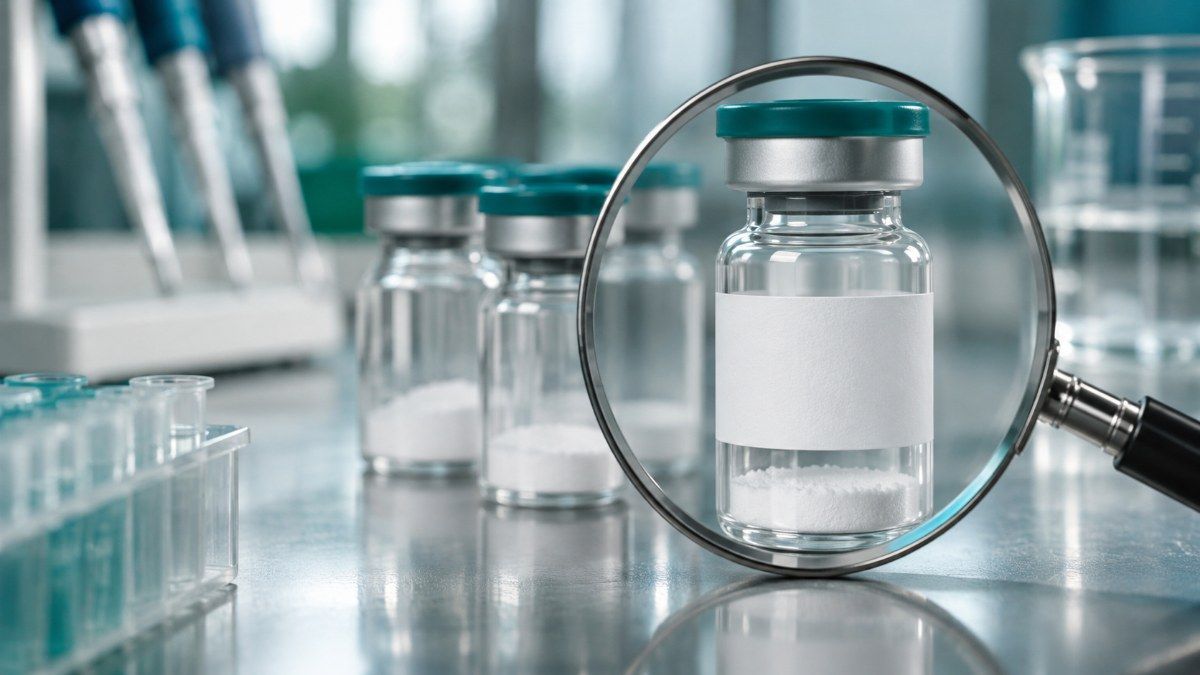
What 'Research Use Only' Really Means for Peptides
A research use only label does not make a peptide legal: FDA judges intended use. 2025-2026 warning letters, the PCAC vote, state actions and testing data.
Written by Dr. Andrii Kaleniuk. Updated November 12, 2026.
"Research use only" on a peptide vial is a seller's label, not a legal status, and it does not stop the US Food and Drug Administration (FDA) from treating the product as an unapproved drug. FDA decides what a product is by its intended use, which it judges from everything around the sale: website claims, dosing tips, calculators and whether the seller also supplies bacteriostatic water and syringes. In a run of warning letters from February 2025 to August 2026, FDA told peptide sellers that "research use only" and "not for human consumption" labels did not change its conclusion that their products were meant for people. The 2026 compounding changes did not legalize them either, and in one large testing dataset about 4 in 10 samples failed a basic quality benchmark. This legal explainer (general information, not legal advice) covers what the label means, enforcement, testing and warning signs.
Research Use Only Peptides: The Short Answer
- 1No loophole: FDA looks at intended use, and has said in warning letters that RUO disclaimers did not change its findings.
- 2Defined meaning is narrow: an RUO label has a formal regulatory role only for in vitro diagnostic products, such as lab test kits.
- 3Enforcement is rising: FDA issued RUO peptide warning letters in 2025 and 2026, including five on one day in August 2026.
- 4Not legalized: the July 2026 FDA advisory committee vote on BPC-157 and other peptides was non-binding and covers only licensed pharmacies.
- 5Quality is unreliable: a 2026 preprint found 41.6% of tested samples failed a compounding-style quality benchmark.
What Does "Research Use Only" Mean on a Peptide Vial?
In everyday terms, the seller is saying the product is meant for laboratory experiments, not for people. Many vials also say "not for human consumption." This wording has no special legal power for injectable peptides. The only place FDA has given "research use only" a defined regulatory meaning is for in vitro diagnostic products, meaning tests and reagents used on samples outside the body. FDA's 2013 final guidance on those products says an RUO label "must be consistent with the manufacturer's intended use." Nothing in that guidance creates a safe harbor for peptides that people inject.
So the label describes what the seller claims, not what the law says the product is. For background on one peptide often sold this way, see what is BPC-157.
How Does FDA Decide Whether a "Research" Peptide Is Really a Drug?
Through a rule called intended use. Under federal regulation 21 CFR 201.128, intended use means "the objective intent of the persons legally responsible for the labeling." FDA can show that intent through labeling claims, advertising, oral or written statements, the product's design or composition, and the circumstances of distribution. If a peptide is meant to treat a condition or change how the body works in people, it is a drug, and an unapproved drug cannot legally be sold for that use.
In practice, FDA looks at the overall net impression of a website, not one disclaimer. A page that says "research only" in small print but lists "Uses: Weight Loss," gives dosing guidance and offers a reconstitution calculator tells a different story. The 2026 regulatory picture is summarized in our guide to FDA peptide rules in 2026.
What Did FDA's 2025 and 2026 Warning Letters Say About RUO Labels?
A warning letter is a formal FDA notice that a company appears to be breaking the law and must fix the problems. Firm names below are given exactly as FDA lists them.
FDA warning letters to RUO peptide sellers, 2025 to 2026
Feb 26, 2025
USApeptide.com
Semaglutide, tirzepatide
Research use only; not for human consumption; lab purposes only
Sold with bacteriostatic water and insulin syringes
Mar 31, 2026
Gram Peptides
Retatrutide, tirzepatide
Research disclaimers
Website claims such as tirzepatide for weight management; bacteriostatic water
Mar 31, 2026
Prime Sciences
Peptides labeled for research
Research disclaimers
Part of a week of 7 letters covering more than 20 products
Mar 31, 2026
Lovega LLC dba Pink Pony Peptides
Peptides labeled for research
Research disclaimers
Part of the same week of letters
Jun 17, 2026
Wholesale Peptide
Prostamax, gonadorelin
RESEARCH USE ONLY
Claims such as "for Enlarged Prostate"
Aug 24, 2026
Peak Performance Peptides; Royal Peptides; NuScience Peptides; Peptide Partners; TXP Innovations (Tex Peptides)
Semaglutide, tirzepatide, retatrutide, tesamorelin, SS-31, PT-141, survodutide, mazdutide
Research use only
Reconstitution calculators, dosing guidance, bacteriostatic water
In February 2025, FDA said the disclaimers "did not change" its finding of intended human use. In March 2026 it told Gram Peptides the same, noting that injectables bypass some of the body's key natural defenses. A law firm analysis by Kelley Drye counted 7 letters that week covering more than 20 products, 5 of them to firms using research-only or not-for-human-consumption labels. In August 2026, FDA wrote in its letter to TXP Innovations (Tex Peptides) that the company's website "establishes that your products are intended to be drugs for human use." The total number of these letters is still growing; Public Citizen counted 14 firms as of June 2026, before the August letters.
Why Does Selling Bacteriostatic Water Matter?
Bacteriostatic water is sterile water with a preservative, used to dissolve a freeze-dried powder so it can be injected. Lab work on cells rarely needs a consumer kit of vials, water and insulin syringes, which is why FDA keeps citing it. In the Tex Peptides letter, FDA said bacteriostatic water provides "the means to prepare an injectable drug for human administration." When a seller bundles the tools for injection, a "not for human consumption" label becomes hard to take at face value.
Is It Legal to Get Research Peptides in the US?
This is where it helps to separate sellers from individual users. FDA's warning letters are aimed at the companies that market and ship these products, and the legal violations FDA cites, such as introducing unapproved drugs into interstate commerce, are about selling and distributing. We found no reported case of an individual being prosecuted simply for possessing research peptides for personal use. That does not make it legal or risk-free. State laws differ, peptides such as BPC-157 and TB-500 raise their own questions (see is BPC-157 legal and is TB-500 legal), and athletes in tested sports face anti-doping rules covered in peptides banned by WADA. For a specific legal question, speak to a lawyer licensed in your state.
Did the 2026 FDA Compounding Panel Make Peptides Like BPC-157 Legal?
No. Compounding, where a licensed pharmacy prepares a medicine for a patient with a prescription, is a separate legal track from research-use sales. Three 2026 events are often misread:
- 1Late February 2026: HHS Secretary Kennedy said FDA would act to make about 14 peptides more accessible through compounding.
- 2April 15, 2026: FDA said it would remove 12 peptides, including BPC-157 and TB-500, from its Category 2 list of substances with safety concerns. FDA stated that removal "does not render these bulk drug substances eligible for compounding."
- 3July 23 to 24, 2026: FDA's Pharmacy Compounding Advisory Committee (PCAC) recommended adding BPC-157, KPV, TB-500, MOTS-c, epitalon and Semax to the list of substances pharmacies may compound, and voted against emideltide. FDA's own reviewers had recommended against all seven.
The committee's vote is advice, not a decision. Based on the sources we reviewed through September 2026, FDA had not added any of the six to the list, and we could not confirm any change since. A second meeting on LL-37, GHK-Cu, dihexa, Melanotan II and PEG-MGF is expected before February 2027. Even if FDA does add some peptides, that would allow only licensed 503A pharmacies to fill prescriptions. It would give research-use sellers no new legal cover.
What Are States Doing About Research Peptides?
State attorneys general have stepped in alongside FDA. In February 2025, a bipartisan group of 38 attorneys general asked FDA to act against online sellers claiming GLP-1 drugs were "for research purposes only" or "not for human consumption." In August 2025, Connecticut reached a settlement under its unfair trade practices law with a distributor, Triggered Brand, over "research grade" semaglutide and tirzepatide; the distributor agreed to stop sales, with a $300,000 judgment suspended after a payment of $18,500. A law firm summary reports that in November 2025 the Alabama attorney general obtained a temporary restraining order against a clinic that gave patients materials labeled "not for human use"; we did not see the state's own announcement.
Private companies are also suing. On August 12, 2026, Eli Lilly filed 6 federal lawsuits over retatrutide, 4 of them against research-use sellers, mostly under state unfair competition laws.
What Did Independent Testing Find Inside Research Peptide Vials?
The largest dataset is a preprint by Mendias and Awan posted in April 2026. A preprint is a study that has not yet been peer reviewed by independent experts, so treat its numbers with care. It analyzed 6,441 samples from 203 companies in a database built by the testing company Finnrick. Samples were submitted by users and companies, so they may not represent the market. Still, 41.6% failed a benchmark modeled on compounded medicines (90% to 110% of the labeled amount and at least 98% purity), and 71.1% failed a stricter benchmark. Of 243 samples tested for endotoxin, a bacterial toxin that can cause fever and serious reactions when injected, 15% had measurable levels. TB-500 samples had a 10% identity failure rate, meaning the vial did not contain the expected peptide. Possible harms of specific peptides are discussed in BPC-157 side effects and TB-500 side effects.
Quality and safety findings for research peptides, 2026
Mendias and Awan preprint (not peer reviewed)
6,441 samples from 203 companies
41.6% failed a compounding-style benchmark; 71.1% failed a stricter one
Mendias and Awan preprint
243 samples tested for endotoxin
15% had measurable endotoxin
Public Citizen report
179 listed retatrutide vendors
71 (39.6%) rated poor, bad or fraud
Public Citizen report
14 firms with FDA warning letters
8 still selling retatrutide
FDA adverse event reports via Public Citizen
Retatrutide reports
10 in 2025 (4 hospitalized); 26 in Jan to May 2026 (11 hospitalized)
Why Is Retatrutide the Most Targeted RUO Peptide?
Retatrutide is an experimental weight-loss drug from Eli Lilly that has not been approved, and that combination of high demand and no legal supply has made it a focus. It appears in FDA's March and August 2026 warning letters and in Lilly's 2026 lawsuits. A June 2026 Public Citizen report found 179 vendors listed for it, and FDA adverse event reports rose from 10 in 2025 to 26 in the first five months of 2026 (see the table above). Such reports do not prove cause, but the rising count is a warning sign.
How Can You Tell a Legitimate Medicine From an RUO Product?
The safe route for any peptide medicine runs through a clinician, not a website. A legitimate medicine has these features:
- 1It is FDA-approved for the use, or prescribed by a licensed clinician who examined you.
- 2It is dispensed by a state-licensed pharmacy with a pharmacist you can contact.
- 3It comes with official labeling, including a patient information leaflet.
Red flags that a product is being sold outside the law include:
- 1"Research use only" or "not for human consumption" labels next to weight-loss, muscle or healing claims.
- 2Dosing charts, reconstitution calculators or injection guides on the same site.
- 3Bacteriostatic water and syringes sold alongside the peptide.
- 4No prescription required for a product that would need one as a medicine.
When to Talk to Your Doctor
- 1You have used, or are thinking about using, a peptide sold for research.
- 2You develop fever, redness, swelling or pain at an injection site after using any injectable product.
- 3You have symptoms after a peptide injection, such as vomiting, severe belly pain, fainting or a racing heart.
- 4You want help with weight, recovery or an injury and are looking for approved options.
- 5You compete in a tested sport and are unsure whether a substance is banned.
What to Do Next: Questions to Ask Your Doctor
- 1Is there an FDA-approved treatment for what I want to achieve?
- 2What does the evidence show for this peptide in people, not just in animals?
- 3If a compounded version is ever possible, how would that work through a licensed pharmacy?
- 4What tests or monitoring would you want if I have already used a research peptide?
The Bottom Line
"Research use only" is a label, not a legal shield. FDA judges intended use from the whole picture, and its 2025 and 2026 warning letters show it treats research disclaimers paired with dosing tips and bacteriostatic water as evidence that products are meant for people. The 2026 compounding changes did not legalize these products, and testing suggests many vials do not contain what the label says. The safest route for any peptide treatment is a clinician and a licensed pharmacy.
FAQ
FDA's enforcement targets sellers, and we found no reported prosecution of an individual for personal possession. But that does not make it legal or safe, and state laws vary. Ask a lawyer licensed in your state for advice on your situation.
It is a seller's disclaimer. FDA has said in warning letters that such labels did not change its finding that products were intended for human use, because it looks at the full context of the sale.
FDA warning letters are aimed at companies, not individuals. The bigger risks for most people are contaminated or mislabeled products and, for athletes, anti-doping violations.
No. An FDA advisory committee recommended adding BPC-157 to the pharmacy compounding list in July 2026, but the vote is non-binding, and we found no record of FDA adding it as of the sources we reviewed.
Sellers use the label to suggest their products are not drugs. FDA judges intended use from claims, dosing information and what is sold alongside the product, so the label alone does not decide the question.
Their safety is not established. A 2026 preprint found 41.6% of tested samples failed a basic quality benchmark and 15% of samples tested for endotoxin contained it.
Sources
- 121 CFR 201.128: Meaning of "intended uses", Legal Information Institute
- 2FDA. Distribution of in vitro diagnostic products labeled for research use only or investigational use only (notice of guidance availability), Federal Register, 2013
- 3Warning letter: USApeptide.com, FDA, 2025
- 4Warning letter: Gram Peptides, FDA, 2026
- 5Warning letter: Prime Sciences, FDA, 2026
- 6Warning letter: Lovega LLC dba Pink Pony Peptides, FDA, 2026
- 7Warning letter: Wholesale Peptide, FDA, 2026
- 8Warning letter: TXP Innovations LLC dba Tex Peptides, FDA, 2026
- 9Bulk drug substances nominated for use in compounding under section 503A of the Federal Food, Drug, and Cosmetic Act, FDA, 2026
- 10Attorney General Raoul co-leads bipartisan coalition calling for FDA action against makers of counterfeit weight loss drugs, Office of the Illinois Attorney General, 2025
- 11Bootleg GLP-1 weight loss drug distributor to cease unlawful sales in settlement with state, Office of the Connecticut Attorney General, 2025
- 12Mendias CL, Awan TM. Evaluation of research grade peptides marketed directly to consumers reveals extensive variability in purity and measured abundance (preprint), Preprints.org, 2026
- 13Whoriskey P. The "miracle drug" and the peptide craze: breaking the FDA, Public Citizen, 2026
- 14McDowell DL, Ferretti C. FDA turns up the heat on GLP-1 dupes sold "for research use only," finds intended use suggests otherwise, Kelley Drye, 2026
- 15Kundi A et al. RUO-ined: five peptide vendors learn that "research use only" is not a legal strategy, ArentFox Schiff, 2026
- 16Hawana JS. FDA's advisory committee votes on peptides: what it does and doesn't do, Mintz, 2026
- 17Asebey EJ. FDA to remove 12 popular peptides from the Category 2 "do not compound" list, Frier Levitt, 2026
- 18Asebey EJ. Lilly's retatrutide lawsuits: a new enforcement playbook, Frier Levitt, 2026
- 19GLP-1 weight loss drug enforcement in 2025: state attorneys general step into a growing regulatory gap, Stevens & Lee, 2025
This article is a legal and safety explainer for general information and is not legal or medical advice. Firm names appear only as listed in FDA warning letters or state announcements. The testing data cited come from a dataset built by a commercial testing company and have not been peer reviewed.

Dr. Andrii Kaleniuk
Author
Comments (0)
Be the first to comment on this article.
More articles